Saturday, January 5, 2019

Sepia Saturday: The Boy


Sepia Saturday challenges bloggers to share family history through old photographs.


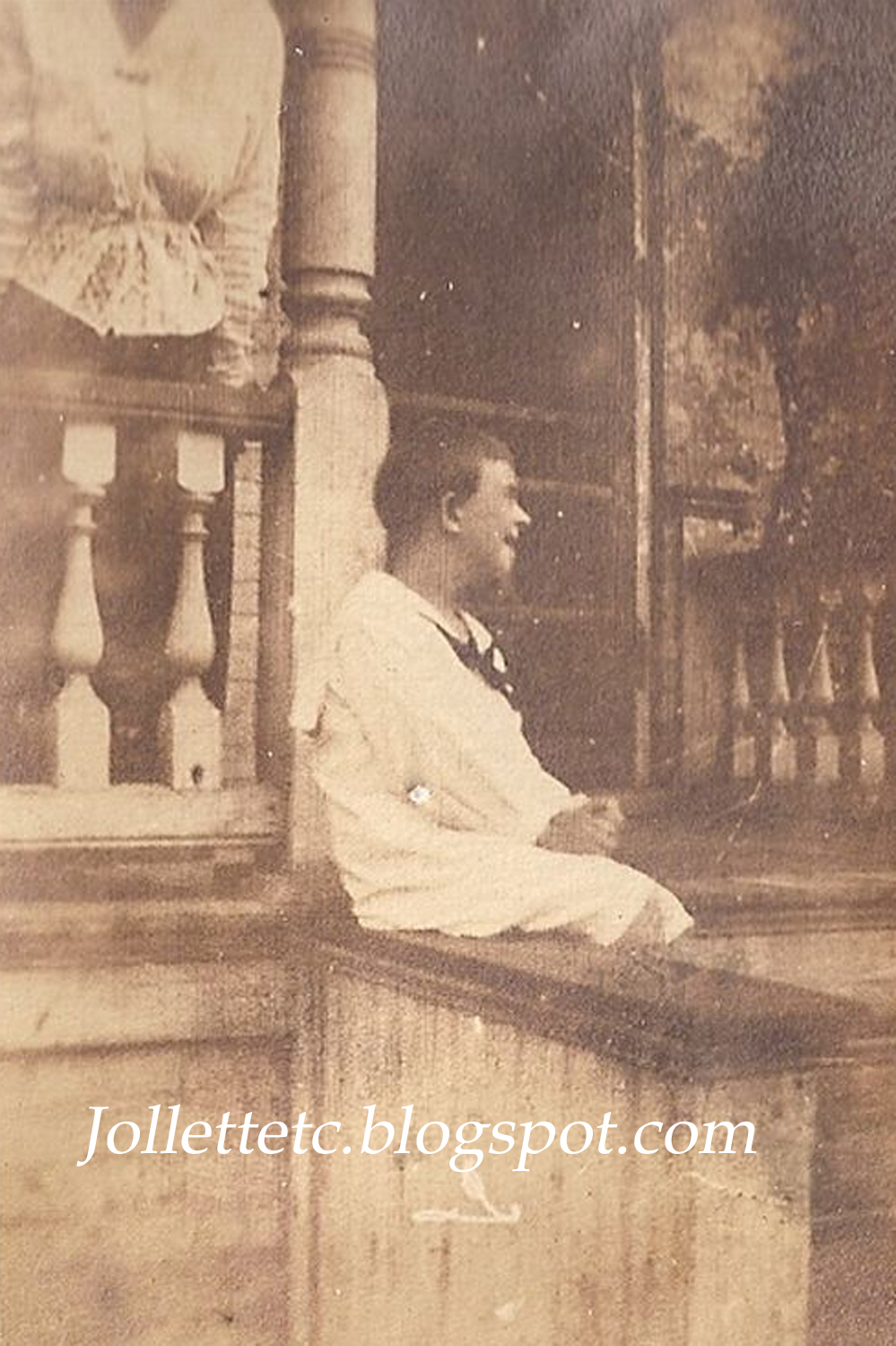
This week’s Sepia Saturday prompt featuring a model and two little boys made me recall a little boy whose story has been left unfinished too long. In 2012 and again in 2015, I posted pictures of this “mystery child” and put forth theories about who he might have been.

William A. Glynn 1919 https://jollettetc.blogspot.com


At first I thought maybe he was my great-grandmother Mary Theresa Sheehan Killeen Walsh’s child who might have died young. But I abandoned that thought since he was not in any census with our family.
William A. Glynn 1919 https://jollettetc.blogspot.com

Then I thought maybe he was a little boy named John Walsh who died in 1919, the same year these photos were taken. But when I saw the photo dated 1932, I had to reject this theory as well.

Lillie Killeen, William Glynn, Margaret Glynn 1932 https://jollettetc.blogspot.com
Dated 1932
Lillie Killeen, and very likely
William Glynn and Margaret Glynn
My third theory that he was one of the New York cousins was almost right. It seems he was indeed a cousin but not from New York. He lived just streets away from the Killeen-Walsh household in Portsmouth, Virginia.

In 2016 an email alerting me to a child I had missed in the Killeen family tree made me take another look at our Glynn “cousins.” Actually, the Glynns are not really my cousins; they are cousins of my great-grandmother’s children by her first marriage to John Joseph Killeen. His sister Bridget was married to John Joseph Glynn. (Those Irish Catholics did not exhibit much creativity in naming children.)

William A. Glynn's draft card WWII https://jollettetc.blogspot.com
Courtesy Fold3
A close inspection of census records soon offered a likely candidate for the mystery child. John and Bridget’s youngest son William at age 10 had not attended school and he could neither read nor write. At age 20, he still could not read or write. In the 1940 census, the column for highest grade completed contained only a dash. If it was not already obvious, his World War II draft card made it clear: “Blind in both eyes. Mentally deficient.”


William lived with his sister Margaret Glynn the rest of his life. He died at the age of 52 from cerebral thrombosis. Margaret never married but devoted herself to caring for her brother. 

Most likely the woman pictured with William and my grandaunt Lillie Killeen in 1932 was Margaret Glynn. I must say, Margaret and Lillie look every bit as stylish as the woman in the prompt! William was rather dapper too in those argyle socks.

Don’t stand there gawking, please visit Sepia Saturday for more stories.

Wendy
© 2019, Wendy Mathias. All rights reserved.

Thursday, January 3, 2019

52 Ancestors - FIRST: 90 Years in a Girdle Box


Amy Johnson Crow continues to challenge genealogy bloggers and non-bloggers alike to think about our ancestors and share a story or photo about them. The challenge is “52 Ancestors in 52 Weeks.”


This week’s challenge theme “FIRST” is the perfect time to tell about another donation to my alma mater, James Madison University. Back in October 2018, I delivered my grandaunt Velma Davis Woodring’s college scrapbook to the Special Collections division of the university library. During our meeting, Dr. Philip Herrington, professor of history, and Tiffany Cole, archivist, expressed interest in any other items I might have inherited that could benefit the students and other researchers. Unfortunately I have no other college memorabilia, just personal and family goodies like dishes and quilts.

Then Tiffany asked, “What about diplomas?”

Cha-ching! I do have diplomas but not Velma’s. They belonged to her older sister Violetta Davis Ryan, the FIRST in the Davis family to attend college. Their father Walter Davis stopped the boys’ education at the eighth grade and put them to work. The girls, however, were either allowed or required to go to college, not sure which way the story went.

Violetta Davis at the State Normal School Harrisonburg, VA https://jollettetc.blogspot.com
Violetta on the steps
of Spotswood Hall 1923
Violetta graduated twice from the same school. Her FIRST diploma was earned in 1923 when JMU was known as the State Normal School at Harrisonburg. Because she had graduated from high school, she qualified to earn the Professional Diploma. The two-year program allowed graduates to teach anywhere for seven years. Seven years later in 1930, she returned to her alma mater, by then renamed Harrisonburg Teachers College, to earn a Bachelor of Science Degree in Education. This four-year program entitled her to teach for life.

Formfit Girdle Box https://jollettetc.blogspot.com
Formfit Girdle box


In 2012, I blogged about Violetta’s college career HERE and HERE and even posted a photo of her diplomas. They had been rolled tight and stored in a girdle box, of all things, probably since 1923 or 1930. Those diplomas certainly held that rolled-up shape. It’s what 90 years in a girdle box will do, I guess. At every attempt to unroll the diplomas to take a picture, they snapped right back into a tight roll. If the Formfit girdle could hold a woman’s stomach flat, its box was equally effective in keeping the diplomas’ roll.
 
Violetta Davis Ryan's diplomas https://jollettetc.blogspot.com
Violetta's 2 diplomas
I had to weight them down with stone coasters to get a photo.
Apparently there has been quite a bit of interest in the early diplomas, so I am thrilled to add to the small but growing collection. I warned Kate Morris, the head of Special Collections, about the condition of the diplomas, but she was sure the Preservation Officer could flatten them.

And she did!
 
Violetta Davis Ryan's first diploma https://jollettetc.blogspot.com
Violetta's FIRST diploma 1923

Violetta Davis Ryan's second diploma https://jollettetc.blogspot.com
Violetta's SECOND diploma 1930

Wendy
© 2019, Wendy Mathias. All rights reserved.

Monday, December 31, 2018

Year In Review


Wow – I thought 2017 was a dry year at Jollett Etc but then 2018 is not any better. In fact, it is probably worse. Why? I don’t know, really. I could blame lack of inspiration. I could blame unsuccessful research that might have led to new stories to tell. I could blame being busy helping other women with their applications to DAR. Excuses. Excuses. No reasonable explanation comes to mind.

Enough of the “mea culpa” – let’s look back at 2018 with the attitude that quality is more important than quantity. Yeah, let’s hold on to that thought. Yeah.

Top 5 Blog Posts
I was pleased to see that two of the top 5 are from my brief participation in the 52 Ancestors in 52 Weeks challenge and two from Sepia Saturday. Numbers 5-8 in the tally were close in the number of page views. While #5 is just OK to me, the close competitors are actually more interesting.
  1. 52 Ancestors: In and Out of the Census
  2. Sepia Saturday: Mathias Homestead
  3. Sepia Saturday: Grave Expressions
  4. Another Scrapbook Moves On
  5. 52 Ancestors: Start with Frazier 
Top 5 Genealogy-Related Activities
  1. I did a lot of work for my DAR chapter this year including preparing and submitting applications for 6 new members, revamping the newsletter, and creating a new website.
  2. Before resigning from the GeneabloggersTribe admin board, I was in charge of the monthly calendar prompts. That required researching daily events and finding copyright-free images.
  3. I reviewed two genealogy mystery books for Nathan Dylan Goodwin and Steve Robinson.
  4. I completed another genealogy book for my family. This time the focus was on my parents BEFORE they became grandparents.
  5. I was proud to donate my grand aunt Velma Davis Woodring’s college scrapbook to James Madison University. I also gave Violetta Davis Ryan’s two diplomas to the Special Collections department of the library.
Top 5 Discoveries
  1. In researching my father’s paternal grandmother Mary Morrison Slade, I found her family was practically in my backyard FOR.EV.ER – not in Tennessee as I had always heard. My research might have uncovered a Revolutionary War patriot too.
  2. I found a marriage record for one of my elusive Irish ancestors, Gertrude Fraundorf. Yeah, she doesn’t sound too Irish, does she? But her mother was Catherine Hederman/Heatherman before marrying. Gertrude married an Italian. A regular international house of pancakes!
  3. In updating routine facts on the Frazier family, I stumbled upon a fascinating murder in the family.
  4. Find-a-grave may have helped identify Mr. and Mrs. Beavers whose photos are among those that Violetta Davis Ryan saved.
  5. I was thrilled to read the service record of my DAR patriot and 4X great-grandfather William Jordan. He served under such notable leaders as Daniel Morgan, Mad Anthony Wayne, Nathanael Greene, and the Marquis de Lafayette.
Top  5 Best Money Spent
  • Ancestry
  • Fold 3
  • Genealogy Bank
  • Newspaper Archive
  • Dues to the Greene County Historical Society and Virginia Historical Society 
I am determined to do better in 2019 because I have missed blogging and I have missed reading my favorite bloggers’ blogs. You need to stay on me. Don’t let me slide.

Wendy
© 2018-2019, Wendy Mathias. All rights reserved.

Monday, October 15, 2018

Another Scrapbook Moves On


In 1924 my grandaunt Velma Davis was just 16 and heading to the Harrisonburg Teachers College (now James Madison University - Go Dukes), about 20 miles from her home in Shenandoah, Virginia. Like many girls of the time, she delighted in taking pictures of her friends to glue into a black paper scrapbook. Close friendships, dorm life, silly antics, snow, and school activities are documented forever in those pages, pages now dusty and brittle, chipping away.

I am not sure why I was elected to be the caretaker of Velma’s scrapbook, but what a gift it has been. The tattered scrapbook has worked overtime providing me with lots of material to write about. Nearly every photo has been featured in my blog at least once, some multiple times. No wonder faithful readers have come to know Velma on a first name basis.

Wellington Hall 1924 Harrisonburg Teachers College James Madison University https://jollettetc.blogspot.com
But it was the photos of Velma’s dorm Wellington Hall that caught the eye of Dr. Philip Herrington, Assistant Professor of History at JMU. An ongoing project in his Historic Preservation course is documenting the area that was demolished and redeveloped as the Forbes Center across the street from the Quad.

A simple Google search brought him to my blog. According to Dr. Herrington, surprisingly very little information about the houses and buildings is available despite the fact that they were in use as late as 2006. He remarked that Velma’s scrapbook contains the largest collection of historically significant photos of the area. To me that is both sad and funny considering the poor quality and condition of some of the photos.

Velma Davis 1924 with Wellington Hall and other buildings across the street where Forbes Center is now https://jollettetc.blogspot.com
BEFORE: Velma 1925 with buildings demolished to make way
for the Forbes Center

Forbes Center James Madison University https://jollettetc.blogspot.com
AFTER: Forbes Center on Main Street, Harrisonburg, VA
Across the street from the Quad of JMU
NOTE: tunnel UNDER the street
One email led to another. When Dr. Herrington asked if I would allow the Special Collections department of the library to scan the photos, I realized it was easier for me to finish scanning what I wanted and just give them the scrapbook.

So on Friday, October 12, 2018, Velma’s scrapbook returned to its first home, the college campus. It will reside in an archival box in Special Collections on the second floor of the Carrier Library, a building that did not even exist when Velma was a student.

I must admit that I have an even greater appreciation for Velma’s photos after meeting with Dr. Herrington and Tiffany Cole, Special Collections Archivist. Both were eager to see the photos. It was fun to watch their faces as they looked for architectural clues, saw for the first time the outdoor pool which no longer exists, and spied the old hockey field now filled by a science building. While some photos are purely nostalgic, others will help Dr. Herrington’s students in their effort to develop an architectural history of the college. Without a doubt Velma and her sister Violetta would be thrilled to know the scrapbook is of interest nearly 100 years later. 

Three years ago, my sister and I proudly gave our father’s album recounting his time in the Coast Guard to the Custom House Maritime Museum in Newburyport, Massachusetts. Like Velma, Daddy was just a teenager killing time taking pictures with no thought of lasting influence. Inheriting such personal items as a scrapbook can be a burden when contemplating what will become of them when you’re gone. Donating them to a school, a museum, or a society that will preserve them feels good.

That good feeling never gets old.

Wendy
© 2018, Wendy Mathias. All rights reserved.

Sunday, August 26, 2018

Happy Blogiversary to Me!


When the early days of summer suddenly became the late days of summer, I began thinking about my upcoming 7th blogiversary. What profound insight could I offer about research? About blogging? Nothing. Nothing came to mind.

Many bloggers like to look back over the year or years and highlight the most popular posts. My “most popular” ones have such elevated page view numbers that I believe they are victims of spy bots thus making it impossible to determine their so-called popularity.

Instead I present to you the LEAST popular post for each year. The page views are so low that clearly even spy bots weren’t interested.


OK, those first 3 years, I get it. But Year 4? You can’t open Facebook without being bombarded by photos of everyone’s dog - cute dogs, funny dogs, injured dogs, abused dogs, rescue dogs, dogs wearing clothes. What happened with my cute little series? Trust me, there were several “Gone to the Dogs” entries in the running for “worst post of the year.” The photos were all from old albums and shoebox photos passed along to me. I thought it was a clever series, but people and spy bots must have disagreed.


This is the post I feel most sad about. It features a St. Patrick’s Day card sent to my great-grandmother Mary Theresa Sheehan Killeen Walsh by her niece identified only as Myra from Limerick. That little bit of information was key to pushing my Sheehan research back one more generation.


I guess the title made everyone imagine a snoozefest. The post is NOT about a pedigree chart; it is about an actual TREE where family members posed for pictures. Still a snoozefest? Eh, maybe.


I LOVE this post. It is about discovering the identity of “Captain Dick,” a name mentioned several times on photos and in letters that once belonged to my grand aunt Helen Killeen Parker. Too bad more people didn't share my view.

My blogging has slowed down considerably this year. I’m still here though. Let’s see what Year 8 brings.

Wendy
© 2018, Wendy Mathias. All rights reserved.

Saturday, August 11, 2018

Book Review: Letters from the Dead by Steve Robinson

Disclaimer: I received a pre-release copy of the book to review. I was under no obligation to like it. The opinions expressed here are my honest views. I will not receive any commission on the sale of books by this author.


Decaying mansion with rotting floors giving way. Mysterious watchers in the night. Greed. Forbidden love. Illegitimacy. Family feuds. Murders. What more could you want in a book?

How about letters written in 1823?

Or maybe a mysterious ruby known as The Blood of Rajputana, as big as a man’s fist?

All that and more can be enjoyed in Steve Robinson’s latest book Letters from the Dead due to be released on August 14, 2018.

The plot of Letters from the Dead alternates between the chilly and misty outskirts of modern day Perth, Scotland and colorful colonial India under British rule in the 1820s. The hero is professional genealogist Jefferson Tayte. The story begins when Tayte’s latest client asks him to answer a simple question: Who was my four-times great grandfather? Not such a daunting task. It sounds much like what most of us geneabloggers do routinely. But Tayte quickly finds this is no routine task. There are plenty more people wanting to find the answer to that question too, but not for personal curiosity or to flesh out a family tree. Their eyes are set on something bigger: the location of a valuable ruby known as the Blood of Rajputana.

With the aid of a single letter penned in 1823, Tayte almost effortlessly determines the identity of his client’s ancestor. However, as friends and family hoping to find the ruby begin dropping like flies, more old letters mysteriously appear like bread crumbs leading Tayte closer to the ruby and closer to personal danger.

As a genealogist, I enjoyed observing Tayte’s research process. (I have to admit I admire his ability to resist going down a rabbit hole.) I also like the structure of the story alternating past and present. When Tayte reads a news clipping or detects a possible clue in an old letter in the “present” chapter, we get to see those events played out in the “past” chapter. I am equally drawn to both of those worlds. I enjoyed the client’s decaying old mansion with its rotting floorboards, its library full of books about art and India, its cellar containing a sarcophagus, and its tunnels with hidden entries. I was also swept up in life at the grand British residence and garden, home of the Resident of Jaipur, the political agent for the East India Company.

Even better than the beautifully descriptive passages is the way Robinson builds the mystery and plants the clues. I am usually pretty good at predicting the outcome, but with this book I confess to being Wrong. Every. Time. Like our trusty genealogist, I was suspicious of everyone. It was impossible to tell who was a good guy and who was a bad guy. At one point I was ready to throw down the book thinking Robinson had made a very amateurish mistake making the location of the ruby too obvious. WRONG! Robinson surprised me at almost every turn. I like that!

What I find a little annoying though is that some of Tayte’s word choices do not fit his character. He is supposedly an American, but an American would not ask if someone were planning on “selling up.” I’ll blame the editor for this minor misstep.

Endings in which the murderer rattles off his list of reasons for killing this person or that always seems like the author couldn’t think of a better way to conclude an otherwise good story. While I LOVE the surprise of the ending, I was disappointed in how the ending was written. Eh – that’s just me being picky. I still like the book and look forward to reading more of the Jefferson Tayte mysteries.

Author Steve Robinson has been writing genealogy crime fiction for quite some time, but he is new to me. Letters from the Dead is book seven in the Jefferson Tayte Genealogical Mystery Series. The term “series” might cause a future reader to think he must start with book 1, but that is not the case. Each one easily stands alone. If the other six books are anything like Letters from the Dead, then Robinson has a new fan.

Wendy
© 2018, Wendy Mathias. All rights reserved.

Friday, July 6, 2018

Sepia Saturday: Mathias Homestead


Sepia Saturday challenges bloggers to share family history through old photographs.


This week’s Sepia Saturday photo has made me imagine what my early ancestors might have looked like sitting at some home-crafted table in their roughly-hewn log house in the wilderness of frontier America. My children and grand-baboos will not have to work as hard to imagine it as I do because they have an ancestral home to look to.
 
Mathias homestead Mathias, WV https://jollettetc.blogspot.com
Mathias Homestead Mathias, Hardy Co, West Virginia 1989

This is the John T. Mathias Homestead in where else but Mathias, West Virginia. This historic home was built by my husband Barry’s 4X great-grandfather in 1797 and remained in the Mathias family for over 165 years before the last owner deeded it to the Mathias Civic Center Association in 1974. Four years later it was listed on the National Register of Historic Places. The Mathias homestead even has its own Wikipedia page. Yeah, we’re pretty famous - in a small town.

John Tobias Mathias (who doesn’t love a rhyming name?) was among the earliest settlers in the area. Like many of our German ancestors, his family emigrated from Alsace-Lorraine to escape religious persecution. His family first settled around Philadelphia and then moved inland into Lancaster County. From there they moved to Frederick County, Maryland and then on to the Shenandoah Valley of Virginia. Their last stop was the Lost River Valley in Hardy County. At the time it was a frontier county of Virginia; since the Civil War, it is in West Virginia.

Mathias Homestead Mathias, WV https://jollettetc.blogspot.com
courtesy Justin A. Wilcox 2014
Wikimedia Commons CC by SA 4.0 
John T. acquired the land in 1791. The house he built had four rooms, an attic loft, sturdy interior stairs, a good number of windows, a double porch and fireplace on both floors. It was considered quite substantial for its time. However, the next generation found the house to be too small and so SOMEONE - probably his son John T. Jr. or grandson - built an addition in 1825.


Mathias Homestead Mathias, WV https://jollettetc.blogspot.com
Back view
courtesy Justin A. Wilcox 2014
Wikimedia Commons CC by SA 4.0 

Mathias Homestead Mathias, WV https://jollettetc.blogspot.com
End view
courtesy Justin A. Wilcox 2014
Wikimedia Commons CC by SA 4.0 

The Mathias house was considered rather grand for its time, especially for poor farmers living in the Lost River Valley. Its location on the main road made it a natural stop for travelers seeking a safe place to rest overnight. Not surprisingly the Mathias family found themselves hosting some famous people and events.

Lee Sulphur Springs Lost River State Park https://jollettetc.blogspot.com
Lee Sulphur Springs
Lost River State Park, Mathias, WV
One such guest was General Henry “Light Horse Harry” Lee of Revolutionary War fame. Supposedly he made the Mathias house his headquarters prior to purchasing his own tract of land just up the road in what is now Lost River State Park. In an earlier version of the park, it had been known as Howard’s Lick Resort, a popular vacation spot boasting the medicinal benefits of Lee Sulphur Springs. And just so you know, I’ve stood at those springs at many a Mathias reunion. Pee-yoo!

The Mathias homestead was also the site for some county court meetings. During the Civil War, Hardy County was divided over whether to support the Union or the Confederacy. From Barry’s ancestors’ Civil War records, it appears the folks in and around Mathias supported the South. Nearly a year after West Virginia was formed, a VIRGINIA County Court meeting was conducted at the Mathias house on May 2, 1864. Southern sentiment was still running deep, it seems.

The house likely passed from John T. in 1806 to his son John T. Jr who passed it to his son John B. in 1866. From John B. the house passed to John Thomas who in 1891 passed the house to Philip Seymour Mathias, a great-great grandson of John T. Mathias.

Philip’s family was the last to occupy the home. They are pictured here probably about 1905 judging by the assumed ages of the youngest children and the absence of two who were not yet born. The house had been modernized with clapboard siding and whitewashed.  


Photo courtesy RunionStrawderman on Ancestry
On the porch: Dock See, Virgil with father Philip Mathias, Roxie Mae Mathias,
and Philip's mother Mary A. Bowman Mathias
In front: Sadie Caldwell Mathias and Philip's sister Mary Etta Mathias Moyers
The last resident of the home place was Sadie Caldwell Mathias, Philip's widow. After her death in 1969, the house sat empty until sons Virgil and Wendell Mathias sold it to the Mathias Civic Center Association in 1974. The association also purchased additional property for the construction of its civic center.

For many years, the Mathias reunion was held at Lost River State Park on Father’s Day. One year failure to reserve a spot prompted the family to gather at the Mathias Community Center instead.  
 
Mathias Reunion 1989 https://jollettetc.blogspot.com
1989 - Daughter #2 outside the community center

Mathias Reunion 1989 https://jollettetc.blogspot.com
1989 - Descendants of John T. Mathias around the table
Mathias Reunion 1989 https://jollettetc.blogspot.com
1989 - Making room for all the food


Looking at the 1989 reunion pictures, I am amused by the two-tone wall - just the opposite of the walls in the prompt photo.

Everyone is invited to the table at Sepia Saturday.

Wendy
© 2018, Wendy Mathias. All rights reserved.