Tuesday, June 9, 2015

52 Ancestors: New Jollett on the Block

Amy Johnson Crow of No Story Too Small has issued a challenge:  write one blog post each week devoted to a specific ancestor.  It can be a story, a biography, a photograph, an outline of a research problem – anything that focuses on one ancestor.


This week’s Wedding theme falls perfectly in line with an announcement about a recent discovery. A few months ago, I made a trip to Rockingham County, Virginia in search of Davis records that would seal the deal in my application to the DAR. But you know how it goes:  you’re there anyway – you might as well look for so-n-so because you never know when you’ll get back.

So I looked for Armentrout and Lingle and, of course, Jollett. An index for marriages listed two: Fielding and Nancy. How thrilling to see that Fielding signed the bond guaranteeing he would marry Mary Ann Armentrout.  It was even more thrilling to see her father’s signature and to learn he used the German form of “John.”

Marriage Bond Fielding Jollett and Mary Ann Armentrout  http://jollettetc.blogspot.com


And there was Nancy Jollett. Not the Nancy born in 1850, daughter of Emanuel Jollett and Ann Elizabeth Breeden.  This marriage record was dated 1822. I had no idea who this Nancy could be. After all, in 20 plus years of family research, I had never even heard of her. But there she was. Right there in the Rockingham County Court House.

Not Nancy herself.  A marriage record.

Marriage Bond Nancy Jollett and Hiram Garnes  http://jollettetc.blogspot.com

Even though her name had never surfaced in other searches, George Sampson’s name on the bond added assurance that this Nancy was family.  George was married to Drada Jollett.  Therefore, it seems likely that Nancy was Drada’s sister and thus another daughter of James and Nancy Walker Jollett.  Of course, it is also entirely possible that she was someone else’s daughter too.  The location of the bond in Rockingham County seems to contradict logic since the legalities of getting married were usually conducted in the bride’s resident county; in this case, the bond more logically would have been posted in Greene County.

But maybe there is a logical explanation.  George and Drada had been married just a short time and were new parents.  Maybe Nancy was living with them, helping her sister with the babies.  Descendants of George and Drada believe their children were born in Rockingham although no census records have been found to substantiate it.  Maybe the Sampson family lived in Rockingham between the census years.  In this scenario, the Rockingham County connection makes sense.

I went to Ancestry.com to find out if anyone else knew this Nancy, but there was nothing under Nancy Jollett born probably about 1800. So I tried searching for Hiram Garnes. Several Garnes descendants have her listed, but as “Jatlet.” No wonder she remained hidden for so long.

As gratifying as this find is, more research is needed to confirm Nancy’s place in the Jollett constellation.


Two Generations of the Nancy Jollett and Hiram Garnes Family

Nancy JOLLETT ( 1790-1800  Orange Co, VA - ) & Hiram GARNES ( - Bef. 1850 Greene Co, VA)  08 May 1822 Rockingham Co, VA

1.  Robert GARNES ( 1823 - ) & Rebecca F. THOMASON ( May 1833 - )  30 Dec 1850 Greene Co, VA

  • Barbara GARNES ( 1849 Greene Co, VA - ) &  Unknown RAINES
  • H. L. GARNES ( 1851 Greene Co, VA - )
  • Nancy C. GARNES ( 1853 Greene Co, VA - ) & William S. Willis LAMB ( 05 Mar 1851 Rockingham Co, VA – 11 Jan 1915 Greene Co, VA )  17 Dec 1891 Greene Co, VA
  • V. T. GARNES ( 1856 Greene Co, VA - )
  • Virginia GARNES (1864 Greene Co, VA - Before 1898 Greene Co, VA ) & Matthew H. DEANE ( 1850 Greene Co, VA – after 1930 )  21 Sep 1886 Greene Co, VA
  • Fannie M. GARNES ( Aug 1866 Greene Co, VA – 1951 ) & Edward Henry HANEY 02 Mar 1860 Greene Co, VA – 1939 Greene Co, VA )  23 May 1893 Greene Co, VA
  • Mary F. GARNES ( 1867 Greene Co, VA - )
2. Margaret A. GARNES ( 1827 - )


© 2015, Wendy Mathias.  All rights reserved.

Friday, June 5, 2015

Sepia Saturday: The Summer Games

Sepia Saturday challenges bloggers to share family history through old photographs.


This week’s Sepia Saturday prompt of a man concentrating on a game of chess reminds me how games once helped bridge the conversation gap between our family and a summer visitor.

In the summer of 1993, our family joined 31 other families in Chesapeake and Portsmouth to host 32 foreign exchange students from Spain. Even though my daughters were much younger than the 15-17 year-olds who would be visiting Virginia, I thought this would be an educational addition to our summer plans. Besides, my girls were just starting to study Spanish in school, so the opportunity to practice the language would surely be a bonus.

Weeks before the students arrived, we exchanged letters. I was encouraged by our student’s beautiful handwriting and strong writing skills. Granted, hers wasn’t “perfect English,” but it was clear enough to boost my confidence that six weeks with a Spanish teen would go fairly easily. After all, she had been studying English for over three years. 

June 1993 Wendy and girls greeting foreign exchange students  http://jollettetc.blogspot.com
Zoe, Wendy, Jordan waiting for Iratxe
On the day of arrival, all the families waited in the parking lot for the bus that was transporting our guests from Dulles to Hampton Roads. It was a festive sight as everyone came with flowers and balloons of welcome. We all cheered as 32 backpack-laden teens bounded down the steps, thrilled by the reception. With clip-board and pen in hand, the coordinator quickly matched student to family.

As soon as we saw Iratxe, we were struck by her clothes and exotic look. She had maroon hair – fairly common today – but in 1993, that seemed so unusual and very European.

Iratxe Iturbe  http://jollettetc.blogspot.com
Iratxe from Guernica, Spain

Iratxe was struck by the heat.  It was a hot and humid day, very typical for Hampton Roads. A nice ride in an air conditioned car would solve that problem while giving us time to get acquainted. But that’s when all of us had a reality check. We could not understand a word Iratxe said. It was not a problem of accent. It was the pitch of her voice. It was her pronunciation. What was worse was that she did not understand us either.

Suddenly I could not get enough air as panic set in. How would we manage six long weeks of THIS?

from Flickr

Fortunately, kids are kids, and they discovered a way to BE together. Cards. The game of UNO was the perfect first step in breaking the language barrier. In fact, the game is even marketed as a game that works across cultures and languages. The rules of play were easy to say in just a word or two or by demonstration. It seemed that a day did not go by that Iratxe was not roped into a game of UNO.

As communication problems lessened, they graduated to other card games like Rummy. 

Girls playing cards http://jollettetc.blogspot.com
Zoe, Jordan, Iratxe playing Rummy

Of course, our summer with Iratxe was more than just card games. We showed her the local attractions, like Jamestown.  

Jordan challenged the blacksmith to a game
resembling horseshoes while Iratxe observed (far right)

We had already planned a trip to Canada as well, so we were glad to take her along. What an exceptional opportunity for Iratxe to see so much of America and Canada. We drove from Virginia to Pennsylvania, to New York, and on to Toronto. What did Iratxe see? The inside of her eyelids. The girl slept every time we got in the car.

When we stopped for meals or a break, we rejuvenated with a game of Frisbee.

Frisbee in Toronto  http://jollettetc.blogspot.com
Iratxe, Jordan, Zoe, Barry playing with a soft Frisbee
in a park in a Chinese neighborhood in Toronto

Shuffleboard table in our lake house
Our final stop in Ontario was Gananoque to tour the 1000 Islands. It was at our hotel there that we were introduced to the game of table shuffleboard. Off the restaurant was a pub with bar, pool tables, darts, and shuffleboard. There was never a question about what to do at night – we were at that shuffleboard table.

By the end of Iratxe’s visit, her English had improved dramatically. On her last day with us, she confessed that she was mortified at how bad her English was just a few weeks before. In Spain her grades in English were good, and she thought she was speaking well. She even revealed that she would sit in her bedroom, planning what she would say to us and then practicing before coming downstairs to be with us. How sad is that!

I can’t help thinking that the games we played in those early days made it easy for Iratxe to “fit in” when she felt so terribly alone and apart.

Memories of the fun we had as a family plus one prompted us to purchase a shuffleboard table for our vacation home.  When our girls come to spend time at Smith Mountain Lake, Iratxe will not be there to show off her skills at knocking her opponent’s puck into the sawdust, but I am sure we will recall how much fun we had with Iratxe in the summer of ’93.

If you’re game, please visit Sepia Saturday to see what my friends are playing today.
 

© 2015, Wendy Mathias.  All rights reserved.

Wednesday, June 3, 2015

Wordless Wednesday: Men of the Eastwind #22

Wordless Wednesday is a daily prompt at Geneabloggers that asks family historians to create a post in which the main focus is a photograph or image.

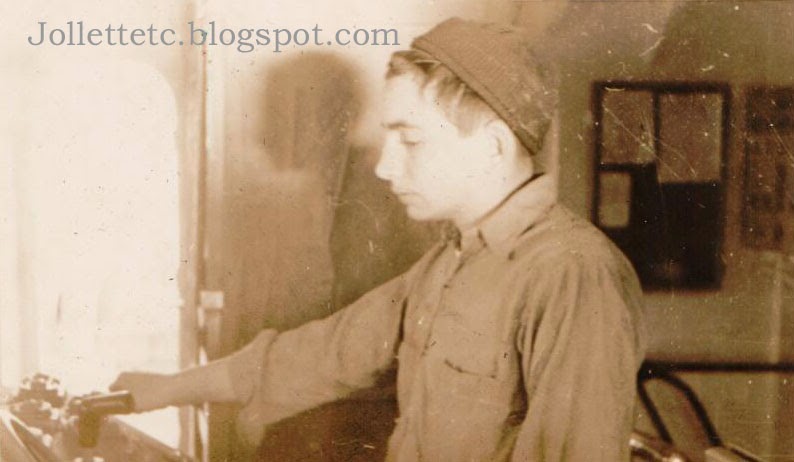
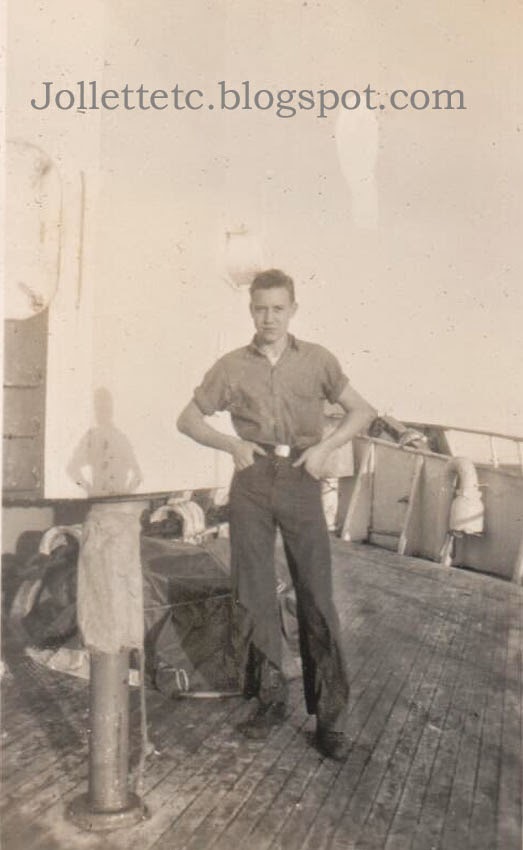
Unknown sailor on USCGC Eastwind 1946 or 47  http://jollettetc.blogspot.com

This is the last in the series.

When my dad was stationed aboard the Coast Guard Cutter Eastwind in 1946-47, he took pictures of his shipmates during tours to Thule, Greenland but didn’t provide names.  Maybe the family of these sailors will find my blog and share their story.


© 2015, Wendy Mathias.  All rights reserved.

Friday, May 29, 2015

Sepia Saturday: Rolling in the Dough

Sepia Saturday challenges bloggers to share family history through old photographs.


This week’s Sepia Saturday prompt has me thinking about pie. Cherry. Apple. Pumpkin. They’re my favorites, but I cannot choose a favorite favorite. While I’m no pastry chef, I do like to bake a pie from scratch. With so many packaged and frozen pie crusts on the market, rolling out the perfect crust is practically a lost art. But I prefer “the old ways” when it comes to pie – a pie deserves no less.

So why do so many cooks today opt for the ready-made crust?  Is it convenience? Fear? Maybe they don’t have the proper tools. I cannot remember the last time I saw “rolling pin” or “pastry cutter” on any bride’s gift registry. I own both and actually use them.  I also treasure the rolling pin and pastry cutter that belonged to my great-grandmother Mary Frances Jollett Davis.

Kitchen tools belonging to Mary Frances Jollett Davis  http://jollettetc.blogspot.com
Most of these tools belonged to Mary Frances Jollett Davis:
rolling pin, pastry cutter, potato masher, hand mixer,
spoon, lifter from a stove
Kitchen tools belonging to Mary Frances Jollett Davis  http://jollettetc.blogspot.com

Judging by her recipes penciled on scraps of paper and backs of envelopes, Mary Frances must have preferred creamy, pudding-like pies whereas I’m a fruit pie girl.

Recipes for Butterscotch, Caramel, Chocolate, and Mince-Meat pies

I can picture Mary Frances right now combining the flour and shortening with her pastry cutter, chilling the dough, patting it into a proper circle, and dusting it with flour before rolling out a perfect crust. I wonder which pie was her favorite – I hope it wasn’t mince-meat.

Mary Frances Jollett Davis http://jollettetc.blogspot.com
Mary Frances Jollett Davis
Is she holding a recipe card?

See what else is cooking at Sepia Saturday.


© 2015, Wendy Mathias.  All rights reserved.

Wednesday, May 27, 2015

Wordless Wednesday: Men of the Eastwind #21

Wordless Wednesday is a daily prompt at Geneabloggers that asks family historians to create a post in which the main focus is a photograph or image.

Unknown sailor on USCGC Eastwind 1946 or 47  http://jollettetc.blogspot.com


When my dad was stationed aboard the Coast Guard Cutter Eastwind in 1946-47, he took pictures of his shipmates during tours to Thule, Greenland but didn’t provide names.  Maybe the family of these sailors will find my blog and share their story.


© 2015, Wendy Mathias.  All rights reserved.

Wednesday, May 20, 2015

Wordless Wednesday: Men of the Eastwind #20

Wordless Wednesday is a daily prompt at Geneabloggers that asks family historians to create a post in which the main focus is a photograph or image.

Unknown sailor on USCGC Eastwind 1946 or 47  http://jollettetc.blogspot.com


When my dad was stationed aboard the Coast Guard Cutter Eastwind in 1946-47, he took pictures of his shipmates during tours to Thule, Greenland but didn’t provide names.  Maybe the family of these sailors will find my blog and share their story.


© 2015, Wendy Mathias.  All rights reserved.

Friday, May 15, 2015

Sepia Saturday: On Patrol

 Sepia Saturday challenges bloggers to share family history through old photographs.


This week’s Sepia Saturday prompt inspires thoughts about danger and safety. Every day parents entrust their children to bus drivers who might follow a car too closely or forget to check for sleeping students at the end of their run. At school, students pass through metal detectors and walk down halls monitored by uniformed guards. “Lock-down” is in everyone’s vocabulary. Since the massacres at Columbine High School and Virginia Tech, students’ safety in the classroom is no longer a given.

When I was a student in the 1950s-60s, chewing gum in class was a capital offense. The most dangerous thing we did was run in the halls. There was no uniformed guard to slow us down although maybe a teacher or the principal would call out a warning. Most often though our safety was in the hands of our own:  The Safety Patrol.

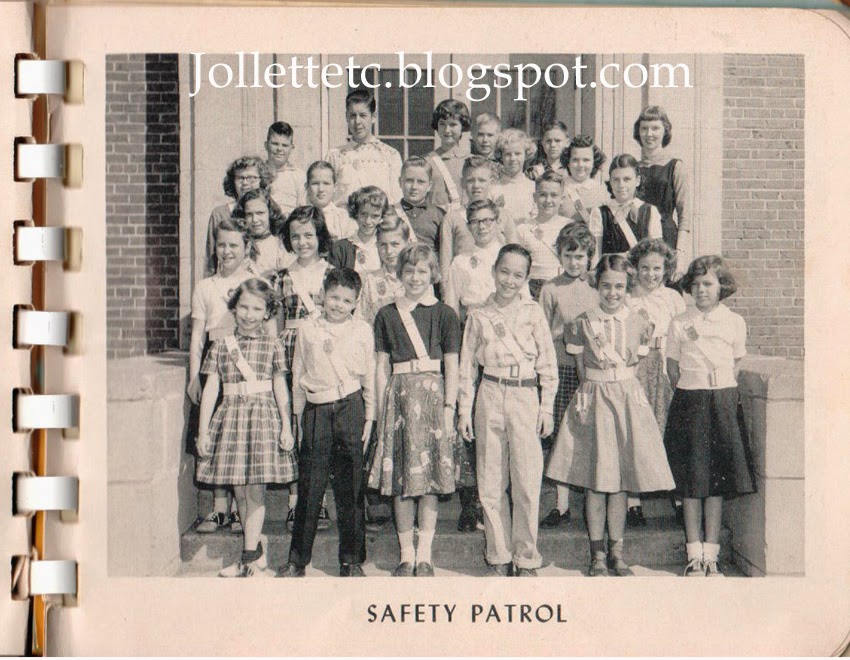
Safety Patrol Cradock Junior High 1956  http://jollettetc.blogspot.com
Cradock Junior High School 1955-56

I am not in this photo, but if the school photographer took pictures of the Safety Patrol six years later, then I was in that one. And I was likely smiling as proudly as the members of the 1956 squad.

The Safety Patrol at Cradock Junior High School was a volunteer position. We simply went to the office and signed up. If there was a slot open, we were in. I am not aware of any background check to ensure that we could actually model safe behavior.

Members of our Safety Patrol served several functions. One group stood inside and monitored the halls making sure no one ran. The other group was posted outside on the steps. That was my assignment. We made sure no one entered the building too early – we had to wait for the bell. In the afternoon, I’m not sure what we did. I suppose we held the door and made sure no one fell down the steps. Whether there was more prestige in being assigned inside or outside, I did not care. I actually liked standing on the top step where everyone could be in awe of my little white belt and shiny badge.

During my brief tenure with the Safety Patrol, I was more interested in wearing that belt than recognizing my role in a respected national program to promote safety. Until this week when the prompt sent me scrambling for a topic, I did not know that

  • The School Safety Patrol program was organized in 1920;
  • The American Automobile Association sponsors the Safety Patrol;
  • Former presidents Jimmy Carter and Bill Clinton were patrol members, as were a number of astronauts, a Nobel Prize winner, governor, baseball player, and chief justice;
  • The belt has a name:  Sam Browne.
Proceed safely to Sepia Saturday for more stories and old photos.


© 2015, Wendy Mathias.  All rights reserved.