Thursday, August 6, 2020

52 Ancestors - SMALL: Small Land Deals

Last week it was all about Amaziah Nathaniel Davis’s LARGE land deals. This week it’s about the SMALL land deals he made.

From his 123-acre purchase in 1892, Nathaniel carved out 30 acres for his younger brother Walter, my great-grandfather. I do not know if Nathaniel needed money or if Walter just wanted land. After all, he and Mary Frances Jollett had been married a few years and a baby was on the way.

Rockingham County, VA Deed Book 50, p 457

This Deed, made this 8 day of March one thousand eight hundred and ninety-four (1894) between A. N. Davis and Anna C. Davis his wife of the County of Rockingham and State of Virginia, party of the first part, and Walter B. Davis of the County of Page and State aforesaid party of the second part. Witnesseth that for and in consideration of one hundred and seventy-five dollars current money of the United States cash in hand paid to the party of the first party by the party of the second party, the receipt whereof is hereby acknowledged, have granted, bargained, sold and conveyed, and by these presents do grant, bargain ,sell and convey with General warranty unto the said Walter B. Davis his heirs and assigns a certain tract, piece, or parcel of land and the appurtenances thereunto belonging, situate, lying, and being, in the Eastern part of said County, near the base of the Blue Ridge, adjoining the lands of Jesse Wyant, George M. Shifflett and others, and is bounded as follows, Beginning at  a stone on the west edge of the west side of the Hawksbill, thence N 75° W 19 poles and 13 links to a stone on the east edge of the public Road, thence S 15° W 21 poles and 23 links to a stone, planted on the east side of said Simmons Gap Road, thence crossing said Road and running S 42° W 21 poles and 22 links to a pine on north side of a road, thence N 81° W ~ poles thence with said line in a S. E. direction ~ poles to a stake or white oak, thence East 28.32 poles to a white pine Stump, thence N 7° E 166 poles to a stump formerly a Sycamore on the east side of the Hawksbill, about 20 or 25 Steps above the ford of said Creek, thence with the Jesse Wyant line dower the said Creek to the Beginning, containing thirty acres more or less, to have and to hold the said tract, piece or parcel of land and the appurtenances thereunto belonging to him, the said Walter B. Davis, his heirs and assigns forever, But there is excepted twelve months longer time [ ? ] is mentioned in the article for the grantors to remove their timber as mentioned in the agreement.

And the grantee is allowed the right of ingress and egress to travel over the Wagon Road passing by said property, Witness the following signatures and seals the day and date first above written.

A.Nathaniel Davis

Annie C Davis

State of Virginia,

County of Rockingham to wit

I, J.W. T. Samuels a Notary Public for the County of Rockingham in the State of Virginia, do certify that A. Nathaniel Davis and Annie C. Davis his wife whose names are signed to the above Deed, bearing date on the 8th day of march 1894, have acknowledged the same before me, in my County  aforesaid.

Given under my hand this 8th day of March Anus Domini 1894

J. W. T. Samuels, N.P. 

In 1896, Nathaniel Davis made a teensy-weensy sale of land to his neighbor Scott Baugher: $10 for a 10’ strip.

Rockingham County  VA Deed Book 61 p. 416


This Deed made this 23rd day of November 1896, between A. N. Davis and Annie C. Davis, his wife of the county of Rockingham and State of Virginia parties of the first part, and G. Scott Baugher of the County and State aforesaid, party of the second part, Witnesseth That the said A. N. Davis and Annie C. Davis, his wife, for and in consideration of the sum of Ten Dollars current money of the United States cash to them in hand paid by the said party of the second part, the Receipt whereof is hereby acknowledged, have granted, bargained, sold, and conveyed, and by these presents do grant, bargain, sell and convey with General Warranty unto the said G. Scott Baugher a certain piece or lot of land situate, lying and being in the eastern part of the said County on the east side of the Simmon’s Gap Road and described as follows. Beginning at the Simmon’s Gap Road thence east running with a road leading to the lands of G. A. Wyant’s and on the South side of said road to G. S. Baugher’s corner, thence south with his line ten feet, thence west to a point on the Simmon’s Gap Road ten feet south of the beginning, containing 1 ½ rods more or less.

The above described strip, piece or lot of land is to be used as an outlet or Roadway from the lands of the said G. Scott Baugher to the Simmon’s Gap Road, the nearest public Road, the said road to be made on this strip piece or lot of land is to be used and be in his, the said G. Scott Baugher’s jurisdiction, and his heirs and assigns forever at all times freely to pass and repass on foot, or with animals, vehicles or otherwise, to and fro, between the lands of the said G. Scott Baugher, and the Simmon’s Gap Road, the Roadway to be ten feet. The said parties of the first part covenant to and with the said party of the second part that they have the right to convey the said strip or lot of land to the said Grantee and that the said grantee shall have quiet and peaceable possession of the same, free from all in-

Rockingham County VA Deed Book 61 p 417

cumbrances, and that they, the said grantors will execute such further assurances as may be necessary to perfect the title hereby conveyed to the said grantee.

It is further agreed as a further consideration for the above conveyance, that the said G. Scott Baugher is to build and keep in repair a bridge at the eastern end of the above described lot, piece or strip of land over the Hawksbill Creek.

Witness the following signatures and seals, the day and date first above written.

A.N.Davis

Annie C. Davis

Scott Baugher then had to build a bridge for his little $10 purchase. So who got the better deal?

Amy Johnson Crow continues to challenge genealogy bloggers and non-bloggers alike to think about our ancestors and share a story or photo about them. The challenge is “52 Ancestors in 52 Weeks.”

 Wendy

© 2020, Wendy Mathias. All rights reserved.

Saturday, August 1, 2020

Sepia Saturday: The Merchant


Sepia Saturday challenges bloggers to share family history through old photographs.


Pictures like this week’s Sepia Saturday prompt can be a real time-suck for me because I find myself Googling to identify the model of the cars, to determine whether products like Meadow Gold milk and butter are still available, and to find old photos of buildings identified by their signage. It’s a handsome photo, one with which I cannot compete. I have grocery stores and grocers in the family, but most have already been introduced on my blog. The good news is I still have one more. The bad news – and it’s really not that bad – is that he isn’t family.

When Barry and I were planning our wedding in 1973, the FOLK WEDDING was the rage. I guess it grew out of the “Make love, not war” / “Do your own thing” attitudes of the 1960s-early 70s. Less formal than traditional wedding ceremonies, the folk wedding often included folk tunes accompanied by guitar. So I needed a singer. And a guitar. My aunt, my dad’s sister, suggested Joanie Glynn. What? Who? “You know – the Glynns. They’re cousins,” she said and Daddy confirmed.

I’ve gone years just accepting that the Glynns are our cousins. I figured they must be those distant cousins, those 2nd or 3rd cousins that no one really gets to know. When I actually did the research, I saw almost immediately that they are not MY cousins at all. They are not my aunt’s or dad’s cousins either. They are not even my grandmother’s cousins. The Glynns are cousins of my grandmother’s HALF-siblings. My great-grandmother married twice; my family descends from the second husband. The Glynns are related to the first husband, the OTHER side of the family.

So here is John Joseph Glynn. 
John Joseph Glynn (1862-1942)
probably Matthew C. Glynn  (1891-1969)
John Joseph Glynn was born to Michael and Mary Irwin Glynn in Ireland in 1862, immigrated to the United States in 1884, and in 1890 married Bridget Mary Killeen, sister of John Joseph Killeen, my great-grandmother’s first husband. John Joseph Glynn and John Joseph Killeen – try keeping that straight. I guess the Irish did not have much imagination when it came to naming babies.

Bridget Mary Killeen Glynn (1863-1948)
either John Joseph Jr or Ellen Frances


John and Bridget were in Virginia by 1890 as all 6 children were born there between 1891 and 1910. John operated a grocery store at the corner of Henry and Second Streets. In the 1900 and 1910 census, they lived on Second. In later censuses, they lived on Henry. In every census except 1940, John was enumerated as a grocer or merchant. City directories through 1935 also show him as a grocer. By 1936, he was retired.
 
Portsmouth City Directory 1935
Photo albums that I have inherited from my Killeen aunts Helen and Lillie reflect the closeness of the Killeen and Glynn families.
 
September 1931
Bridget, John Joseph,
daughter Ellen, aka "Nell"
Captioned "Brothers"
possibly John Joseph Jr and Matthew
but assumed age difference is too much

Lillie Killeen with cousins
William and Margaret Glynn
"Cousin Nell"
That's cousin Nell on the right - not sure of the other 2
I have the Glynns to thank for my very existence. My great-grandmother Mary Theresa Sheehan Killeen had planned to be a New Yorker until John Joseph Killeen died in 1905 leaving her a widow with 5 children to raise. Her sister-in-law Bridget Killeen Glynn persuaded her to come to Portsmouth to be with family. According to family lore, it was Bridget who introduced Mary Theresa to her future second husband John Fleming Walsh. And as they say, the rest is history.

I’ll say this though about the Sheehan-Killeen-Walsh group, they did not and do not discriminate based on a last name. Family is family. A cousin is a cousin regardless of DNA.


There is more in store at Sepia Saturday.

Wendy
© 2020, Wendy Mathias. All rights reserved.

Thursday, July 30, 2020

52 Ancestors - LARGE: Living Large in Beldor


My great-grandfather Walter Davis
You’ve probably heard the saying “A son is a son till he takes a wife; a daughter is a daughter the rest of her life.” That is probably why I have more photos of Mary Frances Jollett Davis’s side of the family than I do of Walter Davis’s family. I have spent so much time on the Jolletts that I feel as if I actually knew her sisters and brothers.

I cannot say the same for Walter and his 14 brothers and sisters. They are just faceless names.

But that is beginning to change. The Virginia Legislature recently approved unlocking records on FamilySearch to remote users enabling me to find new information about my Davis line in Rockingham County. One name that makes a frequent appearance in land records is that of Walter’s older brother Amaziah Nathaniel (20 Feb 1858 – 22 Feb 1934).
 
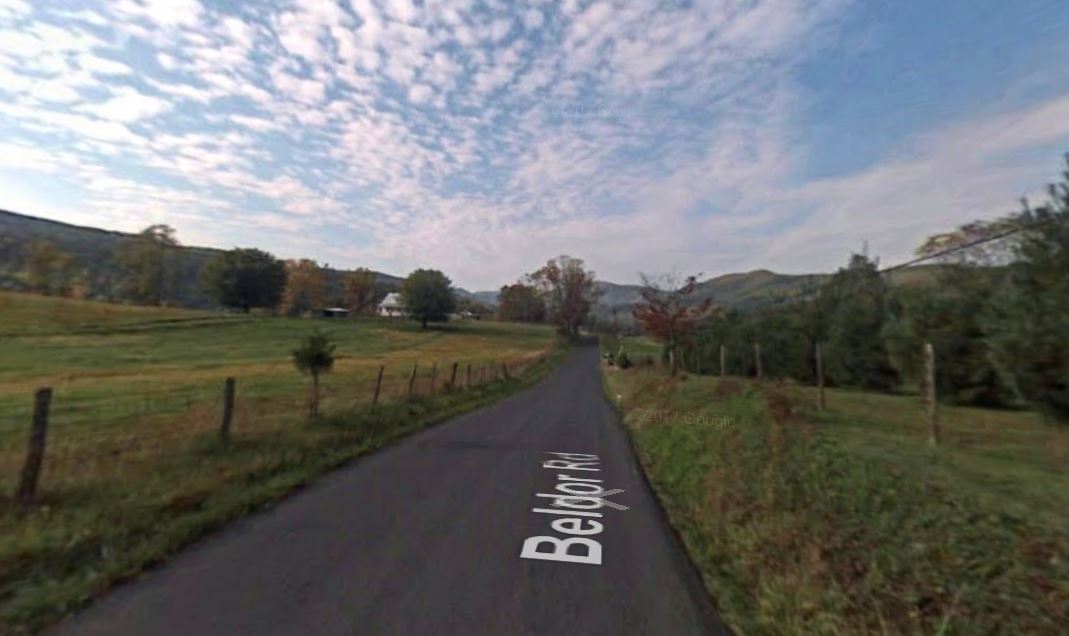
Road into Beldor not far off the Skyline Drive
Stomping grounds of my Davis family
The sheer number of deeds makes Nathaniel appear to be a real mover and shaker, a wheeler and dealer, a man living large in the Beldor community in the eastern portion of Rockingham County, Virginia. One of the earliest deeds was dated December 1892. Nathaniel and Annie Long had been married about 13 years when the land that originally belonged to his grandmother’s brother Frederick Wyant was offered for sale by the heirs of a subsequent owner, Mary Gilmer.

The Frederick Wyant tract contained 123 acres. That was a good size plot of land for a farm at that time. Nathaniel paid $1000. I have read many a deed in my years of research and rarely have I come across that high a purchase price.

Rockingham County
Deed book 45 p 203
This Deed made this 15th day of December, one thousand eight hundred and ninety-two (1892) between William H. Hickle and Ella F his wife, Thomas A. Sellers, Oscar D. Sellers & Virginia Sellers his wife, parties of the first part and Amaziah Nathaniel Davis party of the second part, all of the County of Rockingham and State of Virginia,
Witnesseth, that the said parties of the first part for and in consideration of the sum of one thousand Dollars current money of the United States cash to them in hand paid by the party of the second part, the receipt whereof is hereby acknowledged, have granted, bargained, sold and conveyed, and by these presents do grant, bargain, sell and convey with general warranty of title unto the said Amaziah Nathaniel Davis, his heirs and assigns a certain tract, piece or parcel of land, and the appurtenances thereto belonging and is known as being a part of the “Old Frederick Wyant Tract of land” situate lying and being in the eastern part of said County, in the Blue Ridge, on the Simmons Gap Road, and is bounded as follows, Beginning at a Marked Chesnut by the side of the Simmons Gap road, thence S 70° E 164 2/10 poles to a Hickory in the line of the lands claimed by Franklin Davis, thence with his line S 26° W 32 poles to three Chesnuts one cut down, John Wyant’s corner and with the bearing of his land (under date of ~ ) as called for by his papers N 75° W 130 poles to a Locust stake on bank of Creek, corner to Dower lot of widow of Peter Wyant dec’d [Frances Wyant Davis, grandmother of Nathaniel Davis], and thence up the several courses of the South West branch of the Hawkesbill (said creek) to a stump, formerly a Sycamore thence S 7° W (by said John Wyant’s Survey) 166 poles to a White Pine in Lawson’s line, thence West 28.32 poles to a stake, thence N 17 1/2° E 257.12 poles to a Boxed Pine, thence N 8° E 56 poles to a marked pine, thence N 70° E 45 poles to the Beginning, embracing all the lands included in said boundary, supposed to contain 123 acres, be the same more or less. It is further covenanted and provided that the widow Elizabeth Wyant (Frederick Wyant’s widow) is entitled to the same privileges in this conveyance as are in the deed made by her and others to Mary M. Gilmger on the 10th day of November 1877. To have and to hold the said tract, piece or parcel of land and the appurtenances as aforesaid, to him the said Amaziah Nathaniel Davis his heirs and assigns forever,
Witness the following signatures

It’s a good thing Nathaniel bought that land. It saved him a couple times as we will see in the coming weeks of "52 Ancestors in 52 Weeks."

 
Amy Johnson Crow continues to challenge genealogy bloggers and non-bloggers alike to think about our ancestors and share a story or photo about them. The challenge is “52 Ancestors in 52 Weeks.”

Wendy
© 2020, Wendy Mathias. All rights reserved.

Saturday, July 25, 2020

Sepia Saturday: What the Heck

Sepia Saturday challenges bloggers to share family history through old photographs.


Let me say right here and now: I will be surprised AND disappointed if I am the only HomoSepian with NO photos of ancestors riding in a sidecar. Our noble leader is determined to test my creativity in meeting this week’s Sepia Saturday challenge.

While various relatives ran general stores, none of them delivered in a sidecar, so I had to think of another angle. The best I can offer is people beSIDE a CAR. 

So how about a child sitting on the fender of a car?
John Holland 1920 https://jollettetc.blogspot.com
My father's cousin
John Holland 1920
son of Mae Killeen and Clifton Holland
Or a child propped up against the wheel? (Really – what were they thinking? Was a car the best prop they could come up with?)
Unknown baby 1920 https://jollettetc.blogspot.com
Unknown baby
in album of Lillie Killeen
Or children sitting on the running board?
Gang 1920 - album of Helen Killeen Parker https://jollettetc.blogspot.com
Helen Killeen captioned this picture "The Gang 1920"
The ages possibly fit the 3 youngest in the family -
my grandmother Julia, Catherine, Tate
but who would be the 4th???
The woman probably standing outside the car
could be Mrs. Ollice, a friend of the family.

I hear sidecars have made a comeback in parts of the world. The only sidecar I am interested in is this kind:

Hang on for a wild ride over at Sepia Saturday. (I know everyone will put me to shame!)
  
Wendy
© 2020, Wendy Mathias. All rights reserved.

Wednesday, July 22, 2020

52 Ancestors - OLD COUNTRY: From Palatinate to Virginia


I sometimes look at today’s farms in Rockingham County, Virginia and wonder why early immigrants would come here. It’s mountainous. It’s rocky. The soil has a lot of clay. It looks like too much work to overcome for farming. Yet come they did when agents and advertising in colonial Pennsylvania lured German immigrants to Virginia where similar land was much cheaper.
View of Shenandoah Valley from Skyline Drive

In 1751 a representative of the Armentrout family made a trip to the valley of Virginia to check out the claims. He was so impressed with the limestone outcroppings that he entered into a provisional contract to purchase. He then returned to Pennsylvania with glowing reports that Virginia looked just like the home they left in Germany.

That story came back to me a couple years ago during our river cruise along the Danube River from Budapest through the Wachau Valley to Vilshofen, Germany. As I admired the scenery, I couldn’t help thinking, “Yep, these mountains really do look just like the ones in Virginia.” They are low mountains, lush with green trees. They are in sharp contrast to the tall stony, snow-capped Rocky Mountains of America and the Alps of Europe.
 
View during excursion on Danube River Cruise 2017
MEANWHILE BACK IN GERMANY
Virginia is indeed beautiful, so I understand why the German immigrants wanted to settle here. But why did they leave Germany in the first place?

Germans had been immigrating to American colonies since the earliest days. War and plundering of the lower and middle classes alike went on for years and years. Add religious persecution, and it is easy to see why my ancestors would have traded one set of hardships for the unknown. Could it be any worse? While their arrival was decades after William Penn had drawn Germans to his colony with the promise of religious freedom, it seems likely that was still a strong motivation.

Present-day map of Nassau - red marker shows
location of Irmtraut
The Armentrouts were Protestants of the Reformed Faith and were called Palatines, as they were residents of the Palatinate, a small state in the Holy Roman Empire along the Rhine. Today that area is the State of Nassau, Germany. There is even a small farming village by the name of Irmtraut straddling National Route 54. Most certainly my ancestors must have lived at least close by. The first mention of Irmtraut was in 879 when the Germunden Monastery was established.

The name “Irmtraut” means “Friend of the Valkyries” suggesting that members of the family served their liege lords in military service. It is likely, but not proven, that the Armentrouts who arrived in America descended from this old German family.

THE VOYAGE
Once the Armentrouts made their decision to pick up sticks and relocate to America, they would have gathered only the possessions they could carry and traveled down the Rhine to Rotterdam to board the Samuel. The ship made one stop in Deal, England to load supplies and water. On 26 August 1739, 340 passengers arrived at the port of Philadelphia. Disembarking the next day were my ancestors: a widow Anna Elizabeth Ermantraudt (age 40) and her 7 children – Johannes, Anna Elizabeth, Johan Phillip, Johan Friederich, Christopher (or Christople), Johan Heinrich, and Johan George. All males 16 and older were required to sign an Oath of Allegiance to England
 
Signatures of the oldest sons and possibly uncle
Johannes Ermantraudt
Johan Phillip Ermantraudt
Johan Friederich Ermantraudt
Peter Hain 
NOTE: Ermantraudt is the spelling used most often for members born before 1800. The Anglicized spelling is used for those born after. Even then, there are variations.

So where was Anna Elizabeth’s husband? It is not clear whether he died during the voyage or in Europe. A passenger named Peter Hain accompanied the Armentrouts on the trip. It is believed he was Anna Elizabeth’s brother who perhaps had returned to the Palatinate to escort his sister and family. If they wanted or needed an escort, it is very likely that Anna Elizabeth’s husband had died before the trip even began.

LIFE IN PENNSYLVANIA
For a time the Armentrouts lived with George and Veronica Hain until they could get settled and purchase their own land. George was Peter’s older brother. George had immigrated years earlier as part of the English project for settling German Protestants from the refugee camps around London to the Scoharie area of the New York Colony. There the Germans were put to work for the English Navy. Dissatisfied with conditions, many of the Germans left and moved into what is now Berks County, Pennsylvania.

Present-day Wernersville, PA
The oval shows approximately where the Armentrouts lived.
The Hains Church was located on land donated by George Hain.
Probably the Armentrouts were of some means. In less than 10 years, they managed to acquire over 500 acres of some of the best land in present-day Berks County. Yet, they gave it up to move once again to the valley of Virginia.

Source:
Armentrout, Russell S. Armentrout Family History 1739-1978


Amy Johnson Crow continues to challenge genealogy bloggers and non-bloggers alike to think about our ancestors and share a story or photo about them. The challenge is “52 Ancestors in 52 Weeks.”

Wendy
© 2020, Wendy Mathias. All rights reserved.

Saturday, July 18, 2020

Sepia Saturday: Monument Avenue


Sepia Saturday challenges bloggers to share family history through old photographs.


Last week’s Sepia Saturday prompt featured a postcard of Broad Street in Richmond, the capital of my state, Virginia. It was from the early 20th century, probably about the same time that my great-grandparents and their friends made a trip to Richmond.

A couple very old photos in the album belonging to my grandaunt Helen Killeen Parker fascinated me. I can date the photos to before 1918 because that is the year my great-grandfather John Fleming Walsh died.  
 
Possibly John Fleming Walsh
and Mary Theresa Walsh

My first thought was that they must have toured the beautiful Monument Avenue which has long offered a scenic drive through the city. Dotted every few blocks are monuments, most dedicated to the leaders of the Civil War. The one exception is a statue erected to honor Arthur Ashe, Richmond native tennis star.


George Washington Statue
Richmond, VA
When I saw this photo, I first thought it was of General Robert E. Lee, but the position of the horse did not match. It is actually the George Washington statue which is not even on Monument Avenue. Instead it stands outside the state capitol and marks the terminus of Grace Street.

Only 3 monuments were in place on Monument Avenue when the Walshes and friends made the trip. The neighborhood had only recently begun to come alive with grand residential architecture and gardens. No wonder they took so few photos. They probably were not very impressed.

Foreground - J.E.B. Stuart Monument (green-looking)
Robert E. Lee Monument (black-looking)
Way in the distance a column - Jefferson Davis Memorial
Today, few will be impressed with Monument Avenue. Few will remember the annual Monument Avenue 10K race or the spring time event, “Easter on Parade” when locals strolled the avenue in beautiful hats and other finery. In response to changing attitudes and standards, the statues were removed in early July 2020.

Stroll along the avenue to Sepia Saturday.

Wendy
© 2020, Wendy Mathias. All rights reserved.

Sepia Saturday: PiggyBack


Sepia Saturday challenges bloggers to share family history through old photographs.


Two weeks ago I was too busy with a family wedding and out-of-town guests to participate in Sepia Saturday. However, the prompt is too amusing to ignore. Here is a photo that is not exactly a match but close enough.
 
Mac and Skeeter at Lucas's house 1925 https://jollettetc.blogspot.com
Mac and Skeeter 1925
from scrapbook of Velma Davis Woodring
They are identified in my grandaunt Velma Davis Woodring’s college scrapbook as Mac and Skeeter. Those names mean nothing to me. The house belonged to the Lucas family. The year was 1925.

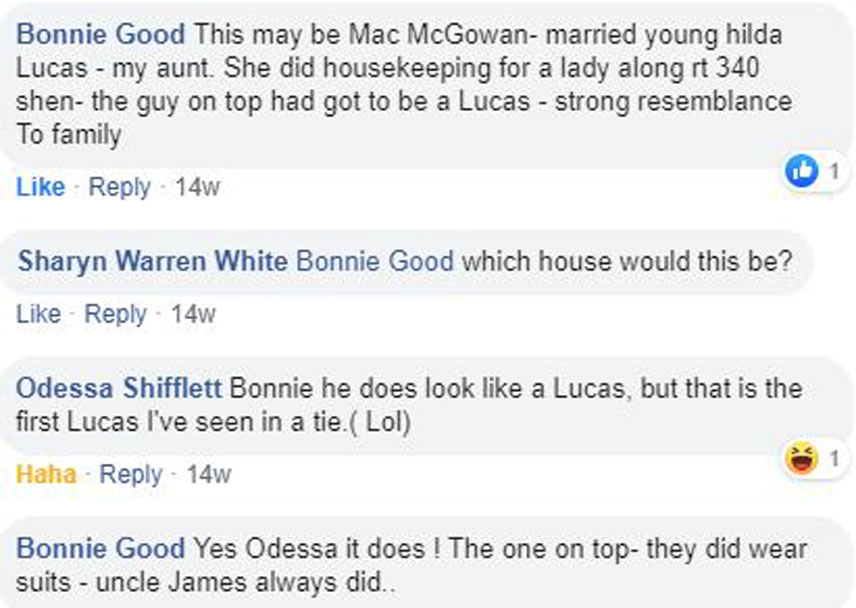
I posted the photo in a Facebook group inhabited by folks who live or lived in Shenandoah, Virginia, Velma’s home before college graduation. The conversation that followed was quite funny, if not informative.


Better late than never. I guess.

Wendy
© 2020, Wendy Mathias. All rights reserved.