Wednesday, October 15, 2014

Wordless Wednesday: Gone to the Dogs #14

Wordless Wednesday is a daily prompt at Geneabloggers that asks family historians to create a post in which the main focus is a photograph or image.

My granddaddy Fred Slade had a kennel of hunting dogs that he kept at his sister's property in nearby Nansemond County.  But these are not hunting dogs.  I wonder who adopted whom.

Slade dogs on Tanner Place, Portsmouth, VA 1940s  http://jollettetc.blogspot.com
Family dogs at my grandparents' home 1940s
Fred and Julia Slade
Tanner Place, Portsmouth, Virginia

Counting down the number of photos of dogs in my collection


© 2014, Wendy Mathias.  All rights reserved.


Sunday, October 12, 2014

52 Ancestors: #41 - Anthony Jacob HENCKEL / HINKLE

Amy Johnson Crow of No Story Too Small has issued a challenge:  write one blog post each week devoted to a specific ancestor.  It can be a story, a biography, a photograph, an outline of a research problem – anything that focuses on one ancestor.


When my 4X great-grandparents Mary Elizabeth HINKLE and her husband Jacob Foland migrated from the Shenandoah Valley of Virginia to eastern Tennessee in the early to mid-1800s, they were imbued with the same spirit of optimism that drove generations before them to leave the old country and board ships sailing for a new life in the colonies across the Atlantic Ocean. 

Did Mary Elizabeth’s father George HINKLE tell her the story of his great-grandfather’s journey to America?  Did he inspire her to feel pride in her Hinkle roots?

The progenitor of the Hinkles and Henkels in America today is my 8X great-grandfather Anthony Jacob HENCKEL (1668-1728), son of Georg Henckel (1635-1678) and Anna Eulalia Dentzer (1640-1700).  He was born in Mehrenberg, Germany in 1668.  Anthony Jacob studied at University of Giessen, a Lutheran college and one of the oldest schools of higher education in Europe.  It was the same school where his father Georg had studied to become a schoolmaster. 

Anthony Jacob was ordained a Lutheran minister on February 28, 1692.  He served in various parishes around Heidelberg, Germany for twenty-five years.   So what made Henckel decide to accept William Penn’s invitation to help settle his new colony in America? 

One theory is that Reverend Henckel had found himself in some legal trouble that he was not likely to win.  A Catholic priest had requested permission for his congregation to share Henckel’s church, which he refused to do.  The priest broke into the church with an axe and the two fought.  Henckel complained to the patron of the church who did not give him much support. 

In a second case, Henckel complained that the patron of the church was using lands belonging to the church and keeping the tithes.  Not surprisingly the patron not only denied the charges but also slandered Henckel’s good character.  Who needs such grief?  

So at almost 50 years old, Anthony Jacob, his wife Maria Elizabeth and their 7 adult children arrived in Philadelphia in September 1717.  In fact, he and his son-in-law Valentine Geiger were leaders of a large group of Lutherans who arrived on three ships. 

The next year, Henckel purchased 250 acres in New Hanover and remained there the rest of his life.  He continued his calling as a minister throughout the area and even started several Lutheran churches.  In 1721 he founded St. Michael’s Lutheran Church in Germantown which continues today.  

St. Michael's Lutheran Church in Germantown, Pennsylvania  http://jollettetc.blogspot.com
St. Michael's Lutheran Church
Germantown, Philadelphia, Pennsylvania

The Reverend Anthony Jacob Henckel died in August 1728 from injuries sustained in a fall from his horse.  He was returning to his home in New Hanover following a visit with an ill parishioner in Germantown.  Evidently he knew the end was near and so delivered his will orally before witnesses.  First, to his wife he left his estate, both real and personal, provided she did not marry again.  If she were to marry, she would retain her third according to law.  Second, he willed his 250-acre plantation in New Hanover to his two youngest sons who would take ownership upon the death or remarriage of their mother.  They were instructed to pay each of the other five children 100 pounds in Pennsylvania currency.  Finally, he gave an extra five shillings to his eldest son beyond the 100 pounds his brothers would pay him.

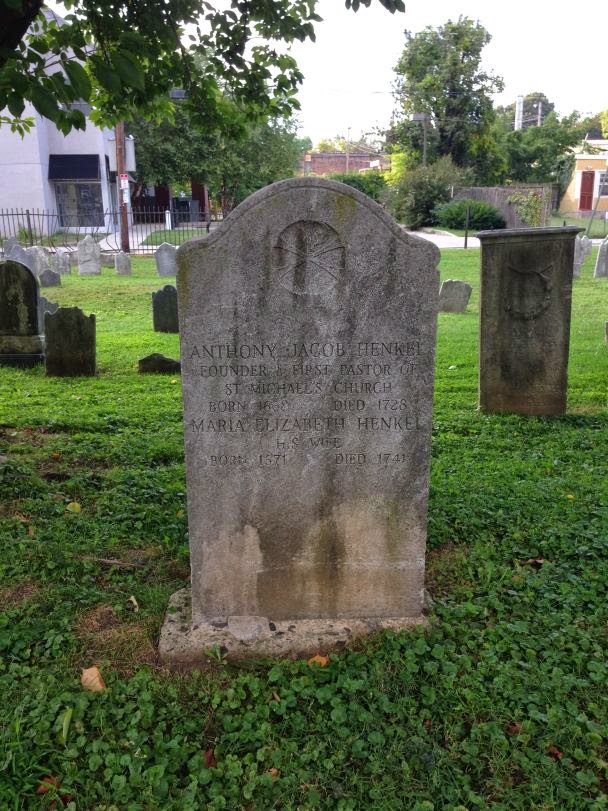
Tombstone of Anthony Jacob and Maria Elizabeth Henckel http://jollettetc.blogspot.com
Tombstone of Reverend Henckel and his wife
photo courtesy Dean Roth Findagrave.com

Anthony Jacob Henckel and his wife Maria Elizabeth are buried in the St. Michael’s Lutheran Church Cemetery.

Anthony Jacob Henkel
Founder & First Pastor
St. Michael's Church
Born 1668   Died 1728

Maria Elizabeth Henkel
His wife
Born 1671   Died 1741


SOURCES:
Ancestry.com.  The Henckel Genealogy, 1500-1960: Ancestry and Descendants of Reverend Anthony Jacob Henckel, 1668-1728, Pioneer Evangelical Lutheran Minister, Emigrant from the German Palatinate to America in 1717 [database on-line].  Provo, UT:  The Generations Network, Inc. 2005. Original data:  Junkin, William Sumner.  The Henckel Genealogy, 1500-1960: Ancestry and Descendants of Reverend Anthony Jacob Henckel, 1668-1728, Pioneer Evangelical Lutheran Minister, Emigrant from the German Palatinate to America in 1717. Spokane, WA: Henckel Family Association, 1964.

“Henckel-Elsworth Families.” My West Virginia Pioneer Families. N.p., n.d. Web. 07 Oct. 2014. <http://freepages.genealogy.rootsweb.ancestry.com/~wvpioneers/hinkle.html>.

“History: Generations of Henckels.”  The Henckel Family National Association. The Henckel Family National Association. N.p., n.d. Web. 07 Oct. 2014. <http://www.henckelfamilyassociation.com/>.

“Our History.”  St. Michael’s Lutheran Church.  Web.  07 Oct. 2014.  <http://stmichaelsgermantown.org>.

Weis, Frederick Lewis. The Colonial Clergy of the Middle Colonies: New York, New Jersey, and Pennsylvania, 1628-1776. Baltimore: Genealogical Pub., 1978. Web. 7 Oct. 2014. <http://books.google.com/books?id=ASo0bJXoXbMC&printsec=frontcover#v=onepage&q&f=false>.


© 2014, Wendy Mathias.  All rights reserved.

Friday, October 10, 2014

Sepia Saturday: On the Road to Bayse

Sepia Saturday challenges bloggers to share family history through old photographs.


This week’s Sepia Saturday prompt features two men engaged in conversation along a stage coach route.  Maybe one needed directions.  Maybe they were stretching their legs.  Regardless of the reason behind this animated conversation, stopping on the side of the road is a common occurrence even among my ancestors. 


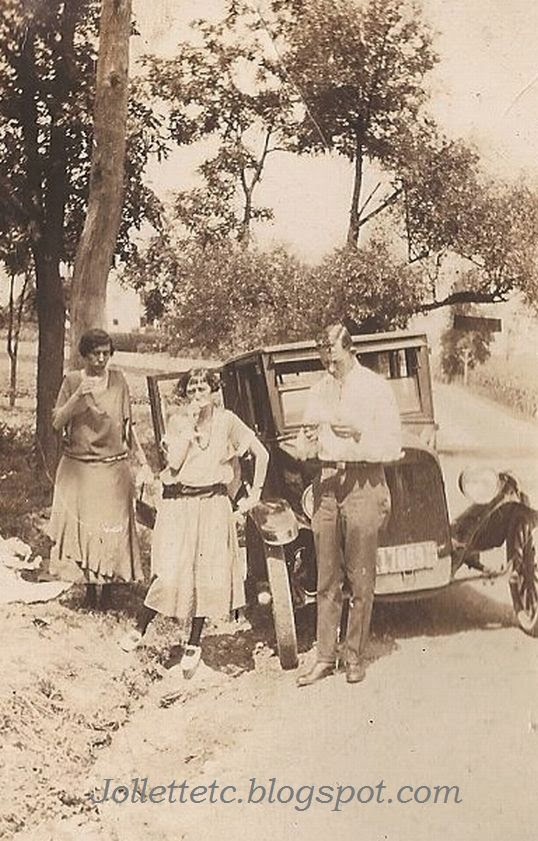
Sullivans and Breedens on the road to Bayse, VA  1923-24  http://jollettetc.blogspot.com
Left: maybe Minnie Breeden
Leota Sullivan and  Wesley Breeden


And there they are:   two of the Sullivan sisters (first cousins twice removed) and their brother-in-law Wesley Breeden.  Their reason for pulling over on the side of the road was to enjoy a quick lunch.  Leota (in glasses) was tearing into that sandwich.  Wesley appears to be checking his email, but that was impossible; maybe he was studying a sandwich or seeing if his hands were sticky – it’s not clear what he was doing.  I’m not sure who the other Sullivan sister was.  It should be Minnie, Wesley’s wife, but it’s also possible Minnie was taking the picture.

Eating on the side of the road suggests they anticipated a long ride, probably on an out-of-the-way route with limited dining options.  Fortunately, the photo was dated and captioned:  "On the road to Basie 1924."  And just to confuse matters, it is also dated 1923 – on the same photo!


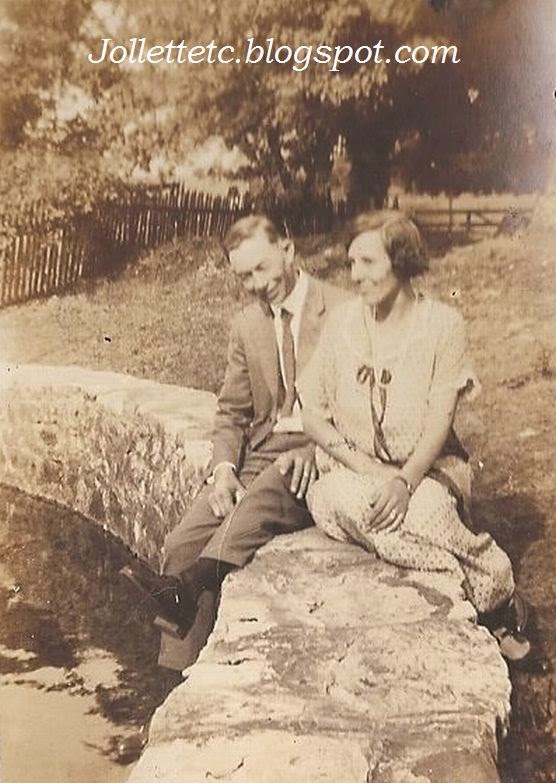
Wesley and Minnie Sullivan Breeden 1923  http://jollettetc.blogspot.com
Wesley and Minnie Breeden
Assuming they were traveling to Bayse (the correct spelling) from their home in Shenandoah, they had to cross a mountain.  Today that ride would take roughly an hour.  But in 1923 or 1924, it was probably longer than that, surely long enough to require a stop on the side of the road to stretch one’s legs and grab a snack. 

What was the draw to Bayse?  Likely it was Orkney Springs, a resort boasting numerous underground mineral springs with healthful qualities.


Orkney Springs  http://jollettetc.blogspot.com
Orkney Springs
photo courtesy of wikimedia commons


Virginia House Orkney Springs Hotel, Virginia http://jollettetc.blogspot.com
Virginia House Orkney Springs Hotel
photo courtesy wikimedia commons


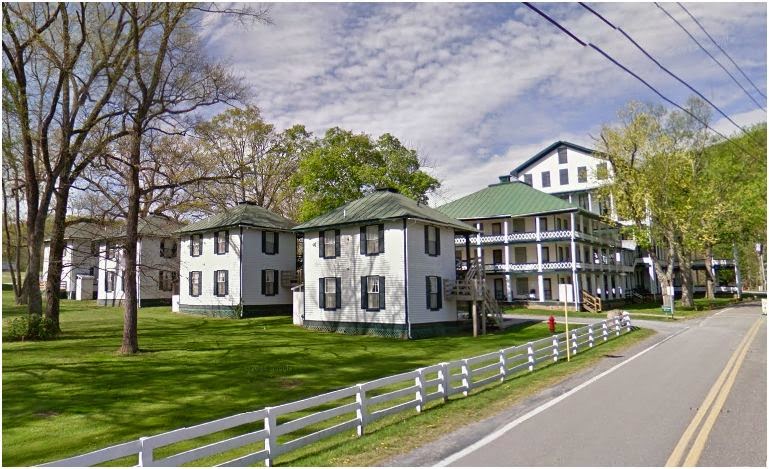
Most of the original buildings which were constructed in the mid-late 1800s still stand.  In fact, the Orkney Springs Hotel is listed on the National Register of Historic Places.  The crowning jewel is the Virginia House, a 4-story hotel with wrap-around porches.  Supposedly it is the largest wooden structure in Virginia dating to the 1870s.


Elsewhere on the property are neatly painted cottages and small hotel-like buildings with names like Maryland House, Pennsylvania House, Williamsburg House, Norfolk House, Arlington House, and Fairfax House.  During the Civil War, Maryland House served as a hospital for Confederate soldiers.

Orkney Springs Hotel near Bayse, Virginia  http://jollettetc.blogspot.com
Cottages, Pennsylvania House (3-story)
Virginia House (4-story)
snipped from Google Maps Street View

From its beginnings, the resort advertised heavily in newspapers drawing tourists from throughout the state and beyond, even from New York.  Society columns are filled with the names of respected families who were spending their entire summer at Orkney Springs.

Richmond Times Dispatch April 1923
GenealogyBank.com

Today the hotel is owned by the Episcopal Diocese of Virginia which hosts conferences and retreats and summer camps.  It is also known for the annual Shenandoah Valley Music Festival held on weekends from July to Labor Day. 

Orkney Springs is just as beautiful and well-kept today as when the Sullivans and Breedens saw it in 1923 or 1924. 


Take a ride by stage coach or touring car to Sepia Saturday for lots of animated conversations on this week’s theme.


 © 2014, Wendy Mathias.  All rights reserved.

Wednesday, October 8, 2014

Wordless Wednesday: Gone to the Dogs #13

Wordless Wednesday is a daily prompt at Geneabloggers that asks family historians to create a post in which the main focus is a photograph or image.


Fred Slade and beagles  http://jollettetc.blogspot.com
My granddaddy Fred Slade and his babies


Fred Slade and beagles  http://jollettetc.blogspot.com
My granddaddy feeding those pups in the beagle kennel
Fred Slade and beagles  http://jollettetc.blogspot.com
My granddaddy was proud
of his beagles


Counting down the number of photos of dogs in my collection


© 2014, Wendy Mathias.  All rights reserved.

Sunday, October 5, 2014

52 Ancestors: #40 - Jacob FOLAND

Amy Johnson Crow of No Story Too Small has issued a challenge:  write one blog post each week devoted to a specific ancestor.  It can be a story, a biography, a photograph, an outline of a research problem – anything that focuses on one ancestor.


My 4X great-grandfather Jacob FOLAND was the third generation of Folands born in America and the second to be born in Virginia.  Jacob’s great-grandfather Johan Phillip Foland arrived in New York in 1715, at the age of 12.  Nine years later he married Eva Switselaar, also a German immigrant.  While they remained in New York for the rest of their lives, their son Jacob joined the migration of Germans moving south along the east coast.

Before 1755, Jacob and his bride Anna Zufelt settled in Rockingham County, Virginia where they raised their family.  Their son Jacob Valentine Foland was born there in 1756.  Church records for the Rader Lutheran Church suggest the family lived in or near what is now Timberville, Virginia. 

Valentine lived his entire life in Rockingham County, but perhaps it was during the Revolutionary War that he wound up in Frederick, Maryland where he met and married a nice German girl, Anna Christina Schuckmaeninn.  They married in 1775 and raised about 15 children, among them my 4X great-grandfather Jacob. 

Fort McHenry Flag War of 1812
Flag from Fort McHenry War of 1812
from wikimedia commons
Jacob was born in February 1786.  At age 19 he married Mary Elizabeth Hinkle, and the two raised thirteen children.  In 1814, Jacob was drafted into the Virginia Militia engaged in “Mr. Madison’s War,” the unpopular War of 1812.  He served as a private under Captain Reuben Moore for 60 days between September 1 and December 1.  How quickly new recruits were sent into battle is not known, but the timing was right for Jacob to have been a part of the defense of Fort McHenry, preventing the British from entering the Baltimore Harbor.  This was the battle that inspired “The Star Spangled Banner” which became our national anthem.


Jacob mustered out at Camp Crossroads near Baltimore, Maryland, and headed back to Rockingham County.

Jacob Foland's discharge from the Virginia Militia

 He qualified for bounty land, but I’m not positive he applied for it.  In fact, the Folands remained in Virginia until sometime after 1835 when the whole clan –except one – took off for Jefferson County, Tennessee.  The lone exception was Helena, my 3X great-grandmother who married William EPPARD in 1835.

The rest of the Folands settled in Tennessee, Indiana, or Missouri.  Jacob died in Tennessee on September 8, 1846.  Fortunately his wife Elizabeth lived long enough to see the Act of February 1871 which granted pensions to widows of servicemen from the War of 1812 based on service alone, provided they had served sixty days and were honorably discharged.  Before then, only those whose husbands had died in service received any pension. 

Elizabeth Foland was 82 when she began jumping through the government’s hoops.  The pension file contains over twenty pages, but the best tidbit is the description of her address: 

Her P.O. is Erie, Roane Co, Tenn, her domicile or place of abode
is on wagon road leading from Kingston to Athens, & 16 miles from Kingston.


Kingston is just west of Knoxville, Tennessee.  If the Folands were alive today, no doubt they would vacation in Gatlinburg and visit the stomping grounds of Dolly Parton in Pigeon Forge. 


THREE GENERATIONS:

Jacob FOLAND ( 14 Feb 1786 Virginia – 08 Sep 1846 Jefferson City, Jefferson, TN ) & Mary Elizabeth HINKLE  (15 May 1789 Virginia – 12 Dec 1876 Jefferson, TN)   Feb 1807 Shenandoah Co, VA

1.  Maria FOLAND ( 1807 Rockingham Co, VA – 1812 Rockingham Co, VA )
2.  Valentine FOLAND ( 20 May 1810 Rockingham Co, VA – 31 Oct 1893 Indianapolis, IN ) & Jane Ann SMITH 07 Mar 1855 Jefferson Co, TN
3.  Nimrod FOLAND ( 13 Dec 1812 Rockingham Co, VA - Before 1850 Jefferson Co, TN ) & m1) Lucretia BAUGHER ( 1814 Rockingham Co, VA – 1840 Jefferson Co, TN)  11 Dec 1834 Rockingham Co, VA ; & m2) Emeline HINKLE 23 Jun 1842 Jefferson Co, TN
4.  Solomon FOLAND ( 1814 Rockingham Co, VA – Before 1900 Indiana ) & Sarah Belle FRANCISCO (1824 – 1905 )  19 Aug 1844 Montgomery Co, OH
5.  Helena FOLAND ( 02 Apr 1818 Rockingham Co, VA – 1880 Page Co, VA ) & William EPPARD ( 1803 Rockingham Co, Va – 24 Feb 1872 Page Co, VA )  24 Dec 1835 Rockingham Co, VA

  • Thomas Alfred EPPARD ( 30 Jan 1837 Page Co, VA – 19 Jun 1908 Page Co, VA ) & m1) Mary Jane “Polly” MONGER  (15 Apr 1846 Rockingham Co, VA – 20 Mar 1884 Page Co, VA ) 10 Sep 1865 Rockingham Co, VA ; & m2) Elizbeth HAM (08 May 1846 Page Co, VA – 02 Jan 1903 Page Co, VA ) 08 Apr 1886 Page Co, VA ; & m3) Annie MERICA 14 Nov 1907 Page Co, VA
  • George Harvey EPPARD ( Sep 1839 Rockingham Co, VA – 13 Jan 1917 Rockingham Co, VA ) & Segourney F. SHIFLETT (1851 Virginia – 09 Feb 1926 Washington D.C.)  28 May 1870 Rockingham Co, VA
  • Sarah Elizabeth “Betty” EPPARD ( 1843 Rockingham Co, VA – 18 Mar 1924 ) & William Lewis BAKER ( 1837 – 13 Apr 1905 ) 24 Sep 1869 Rockingham Co, VA
  • William Henry EPPARD ( Jan 1850 Page Co, VA – 14 Aug 1916 Muncie, IN ) & Pamela Ann ROGERS (03 Aug 1848 Rockingham Co, VA – 22 Apr 1939 Page Co, VA )  16 Sep 1867 Page Co, VA
6.  Esau FOLAND ( 1820 Rockingham Co, VA – 1897 Indiana) & Jeanette A. MCDEVITT  01 Jan 1873 Wayne Co, IN
7.  Sarah FOLAND ( 1823 Rockingham Co, VA – 1892 Missouri ) & William J. PUTNAM 18 Sep 1847 Jefferson Co, TN
8.  Henrietta FOLAND ( After 1825 Rockingham Co, Virginia – )
9.  Matilda FOLAND ( 19 Jan 1825 Rockingham Co, VA – 28 Dec 1903 Roane, TN ) & William B. SELLERS  Jan 1852 Jefferson Co, TN
10.  Erasmus FOLAND ( 17 May 1826 Rockingham Co, VA – 29 Dec 1891 Vernon Co, MO ) & m1) Mary Ann TUCKER  (10 Feb 1837 Kentucky – 1878 Vernon Co, MO )  15 Jun 1858 Vernon Co, MO ; & m2) Ida Wentworth ANDERSON ( 29 May 1858 Kentucky – 02 Feb 1927 Vernon Co, MO )
11.  Harriet FOLAND ( 18 Oct 1827 Rockingham Co, VA – 26 Jan 1880 Jefferson Co, TN ) & John SELLERS  Dec 1850 Jefferson Co, TN
12.  William FOLAND ( 1832 Rockingham Co, VA – 1885 Jefferson Co, TN ) & Mary SMITH  17 Jun 1848  Jefferson Co, TN
13.  Jacob FOLAND ( 1833 Rockingham Co, VA – 1925 Vernon Co, MO ) & Sarah Elizabeth JONES  05 Feb 1857 Jefferson Co, TN


© 2014, Wendy Mathias.  All rights reserved.

Friday, October 3, 2014

Sepia Saturday: The Boss

Sepia Saturday challenges bloggers to share family history through old photographs.


This week’s Sepia Saturday prompt features the cover of a Saturday Evening Post with suggested themes including magazine covers, packages, and the little guy. 

John C. Holland at Ocean View about 1919  http://jollettetc.blogspot.com
John C. Holland, about 1919
from album of Helen Killeen Parker
captioned "The Boss"
Clifton and Mae Holland with John  http://jollettetc.blogspot.com
Clifton and Mae Holland with baby John
probably 1918
Helen captioned this one "They're happy"


No little guy was more welcome to the family than John Clifton Holland.  Born in 1917, he was the first child of my grandaunt Mae Killeen Holland and her husband Clifton; he was also the first grandchild of my great-grandmother Mary Theresa Sheehan Killeen Walsh.

Not only was John the first of the new generation, but also he was no doubt the pet of the entire household of dear sweet Irish aunties.  The little guy was probably fought over and passed around like a special prize, making sure everyone had a turn holding him and posing for pictures.

Helen Killeen with John C. Holland about 1918  http://jollettetc.blogspot.com
Helen with John

Helen Killeen and Lillie Killeen with John C. Holland about 1920  http://jollettetc.blogspot.com
John's aunts Helen Killeen and Lillie Killeen 


In adulthood, John Holland was anything but “a little guy.”  He was a big man with a huge personality, a character who was larger than life.   And he was a self-made millionaire. 

What was John’s secret of success?  Garbage. 

No, seriously. 

John bought land and created a landfill.  He developed a business to collect, destroy, and process trash.  I guess it’s true:  one man’s trash is another man’s treasure. 

John shared that treasure with lots of charities.  In particular, Toys for Tots was a favorite charity that his children have carried on now that they run the family business.

The Hollands still look out for the little guys.


Please visit the little guys and gals at Sepia Saturday to see what they made of this week’s prompt.


 © 2014, Wendy Mathias.  All rights reserved.


Wednesday, October 1, 2014

Wordless Wednesday: Gone to the Dogs #12

Wordless Wednesday is a daily prompt at Geneabloggers that asks family historians to create a post in which the main focus is a photograph or image.


Fred Slade and Pups Portsmouth, Virginia http://jollettetc.blogspot.com
My paternal grandfather Fred Slade
and his precious hunting dogs
probably early to mid 1950s

Fred Slade's kennel of hunting dogs  http://jollettetc.blogspot.com
Looks like a new momma beagle
at Granddaddy's kennel on Jolliff Road
(now Chesapeake, Virginia)

Counting down the number of photos of dogs in my collection


© 2014, Wendy Mathias.  All rights reserved.