Saturday, April 6, 2013

A to Z April Challenge: F is for Floral

This is Day 6 of the A to Z April Challenge.  My theme is women with unusual names although I must cheat now and then or I’ll have a name but no story.


is for Floral.

Floral May Sullivan Merica was my maternal grandfather’s cousin, therefore my first cousin twice removed. 

She was the third of five daughters born to William and Laura Jollett Sullivan. 


Pearl, Minnie, and Floral Sullivan about 1896
Seated: Minnie Sullivan
Standing in the back:  Pearl Sullivan
Standing in front:  Floral Sullivan


Growing up, I always thought it ironic that Laura had a lovely and refined name but she had selected the most old-fashioned old-lady names for her own girls:  Minnie, Pearl, Floral, Leota, and Elta.  On reflection, those were probably cutting edge names in their day while “Laura” had assumed the title of “old fashioned.”

They must have been a fun bunch, judging by the number of photos my grandfather and his sisters had from their younger days spent with their cousins.

Sullivan house 1924
Unknown gentlemen
outside the Sullivan gate
1924

While there seemed to be lots of men calling at the Sullivan house, Floral did not marry until late in life.  She completed four years of high school and achieved success as an assistant cashier and later THE cashier for the local bank in Shenandoah, Virginia.


Sometime between 1940 and 1954, Floral married Cletus Homer Merica (now THAT’s a name!).  Those dates are based on the 1940 census when she was single and living at home and a 1954 city directory for Alexandria, Virginia, in which she appears as “Floral S. Merica” alongside Cletus H.


Sullivan sisters and Grandma Davis
Left to right:  Floral Sullivan Merica, Lucille Rucker Davis (Grandma),
Pearl Sullivan Strole, Leota Sullivan Racey, Elta Sullivan Farrar

There were no children, and Floral outlived her husband.  She died in a nursing home in Chesapeake.  My guess is that this was most convenient for her only living sister and survivor, Elta Sullivan Farrar.

Tombstone of Cletus and Floral S. Merica
Tombstone at EUB Church Cemetery
Shenandoah, Virginia


For more F Fun, Find your way over to the A to Z April Challenge.  


© 2014, Wendy Mathias.  All rights reserved.

Friday, April 5, 2013

A to Z April Challenge: E is for Elmira


This is Day 5 of the A to Z April Challenge.  My theme is women with unusual names although I must cheat now and then or I’ll have a name and no story.


is for Elmira.  I first became aware of Elmira last year when I was looking – REALLY looking – at a photo album that had belonged to my great aunt Helen Killeen Parker.


Julia Walsh Slade and Elmira Christian about 1919
Julia Walsh Slade
Elmira Christian
about 1919


The picture was captioned “Julia and Elmira.”  At the time I focused on “Julia” because that’s my Granny Slade.  I had no idea about Elmira.

But that pretty face of Elmira kept flashing into my mind’s eye.  She was begging to be discovered. 

I pulled out some old notes that I had taken when I was quizzing my aunt about my dad’s side of the family.  There was a list of my great-grandmother’s sisters:  Josephine Sheehan Burns, Sarah Sheehan Burns, Delia Sheehan Christian. 

But where did they live?  The best guess was New York because some of the pictures in Helen’s album reflected trips to New York.  Also that is where Mary Theresa Sheehan Killeen Walsh had lived when she and her sisters emigrated from Ireland. 

I put both FamilySearch and Ancestry to work and got a hit with Delia Christian.  There she was - Elmira (Elmyra). 

Elmira was the daughter of William and Delia Sheehan Christian.  In 1910, they were living at East 90th Street in Manhattan, New York.  William was a shipping clerk and Delia was caring for their 2-year old daughter Elmira. 

In 1920, the family moved back to William’s home state of New Jersey where he took to farming.  Elmira, age 12, was the oldest of 4 children:  Grace 8, Raymond 5, and William Jr. 1. 

Adventures in farming didn’t last long.  In 1925 they were back in New York, renting an apartment in Brooklyn where William worked as an importer-exporter and Delia was helping to support the family as a stenographer.  The children were all in school.

By 1930, William operated a dry cleaners.  And like George Jefferson, they had moved on up, now the proud home owners of 493 Stratford Road in Brooklyn.  Elmira followed in her mother’s footsteps working as a stenographer for a publishing house. 

House on the left is 493 Stratford Rd.
from Google Maps

At age 32 in 1940, the still unmarried Elmira was living at home with her parents, as was William Jr.  The 1940 census was interested in how the Depression had impacted people’s lives, where they lived, how they worked, and so forth.  Therefore, I can tell that Elmira’s father had maintained his dry cleaning business full time while Elmira herself had been unemployed throughout 1939.  However, she had recently found work as a clerk-typist for a tea company. 

That’s the sum total of what I know of Elmira – just what the census records reveal.  I found a small family tree for her sister Grace, but most of it is Private, and the submitter has not been active on Ancestry in over a year.  Nevertheless, an email is in order to learn more of Elmira’s story. 

Elmira and my granny seem to have been as close as cousins can be.


Maybe Grace Christian, Julia Walsh Slade, Elmira Christian
Left to right: Unknown (maybe Grace Christian),
Julia Walsh Slade, and Elmira Christian

This picture might have been taken in New York.
Elmira and Julia
Maybe this is William Jr.


If you want to Explore more E subjects, Exit this blog and Enter A to Z April Challenge.


© 2014, Wendy Mathias.  All rights reserved.

Sepia Saturday: You must remember this

Sepia Saturday challenges bloggers to share family history through old photographs.


This week’s Sepia Saturday photo is all about castles and monuments.  While castles in the United States are limited to mansions that call themselves “castles” and to fantasy castles in parks like Disney World, a monument in Gettysburg made me take another look.  Looks like a castle to me!

Monument to 12th and 44th Infantry Regiments of New York at Gettysburg
Edith Davis at the New York Monument
at Little Round Top, Gettysburg


One of several New York monuments, this one in particular is at Little Round Top and is dedicated to the 12th and 44th Infantry Regiments.  Interestingly, the monument measures 44 feet high and 12 feet wide, dimensions representing the two regiments. 

Followers of Sepia Saturday might recall that just a couple weeks ago I shared photos from trips my great aunts and uncles had taken to Gettysburg.  Are you in luck --  I have more!

Millard Davis at Gettysburg
Millard Davis and the Warren statue
Also at Little Round Top is the statue of Gouverneur K. Warren, a Union general most remembered as “The Hero of Little Round Top.”  The statue is often photographed from behind, giving the photographer a glimpse of what Warren saw standing on this boulder.  Gazing across the valley below, Warren detected the movement of Confederate troops.  Warren was given credit for quickly organizing the defense of Little Round Top.  

Millard Davis at Pennsylvania Monument, Gettysburg
Millard Davis
Pennsylvania Monument


The Pennsylvania Monument is the largest of the state monuments at the Gettysburg battlefield.  It is 110 feet from the ground to the tip of the sword held by Winged Victory.  The bronze plaques contain the names of not only all the regiments and batteries but also over 34,000 Pennsylvanians who served in the Civil War.  


Virginia Monument
from Velma Davis Woodring's
summer trip with Olive Williams and family


The Virginia Monument was the first Confederate monument and also the largest.  And why not?  After all, we contributed the largest number of soldiers and the leader, General Robert E. Lee depicted here on his trusty horse, Traveler.  (Interesting bit of trivia:  Traveler’s skeleton is preserved at Washington & Lee University in Lexington, Virginia.)  The seven soldiers at the base of the statue represent the types of men who left their jobs to defend the South:  farmer, artist, business man, boy, professional man, mechanic, and youth.   


And one more monument but NOT from a battlefield (try to hide your despair). 

Woody Woodring at Gov. Spotswood monument October 1926
Woody Woodring
October 1926
monument to Governor Spotswood

This pyramid is dedicated to Governor Spotswood and the Knights of the Golden Horseshoe.  Back in 1710, Alexander Spotswood was the royal governor getting a lot of pressure from “back home” in jolly ol’ England to expand westward.  So he gathered some prominent citizens and embarked on a journey across the interior of Virginia and on across the Blue Ridge Mountains.  They celebrated their amazing expedition, and stories of their discovery of such a beautiful valley with fertile soil spread quickly.  Of course, the whole idea had been for people in the east to move west, but the mountains proved to be difficult to cross.  Instead, people trickled in from the northern colonies, particularly Scots and Germans from Pennsylvania. 

This little pyramid is near and dear to my heart because the Shenandoah Valley is the center of my genealogical world.  My roots. The marker is at Swift Run Gap, right at the entrance to the Skyline Drive.  As a kid, I always looked for that marker, although I didn’t know its significance.  To me it merely signaled that we had finished climbing UP the mountain, and we’d be going DOWN the other side.  (I bet Governor Spotswood thought the same thing!)  It would be just a short ride to visit my cousins in Shenandoah

Please visit Sepia Saturday for some monumental stories and photos.


© 2014, Wendy Mathias.  All rights reserved.

Thursday, April 4, 2013

A to Z April Challenge: D is for Drada

This is Day 4 of the A to Z April Challenge.  My theme is women with unusual names.

is for Drada.  It’s such an unusual name that there is no explanation for its meaning in any of the online baby name sites.

Sister to my 3G grandfather Fielding Jollett, Drada (also known as Drady) was born about 1798 in Orange County, Virginia, the seventh of ten children born to James and Nancy Walker Jollett.  In 1819 she married George Sampson.

I know little of Drada until 1850 when women were finally listed by name in the census records.  That year she was the wife of a teacher and mother to the two youngest girls still living at home. 

1850 Monroe County, Virginia (now West Virginia)

But marriage and death records of other children tell the story of a much larger family: 5 girls and 2 boys.  Shortly after Drada and George married, they moved to Rockingham County, Virginia, just across the mountain from her homeplace.  All of the children were born there.
  • Lucretia 15 May 1820- 16 Jun 1820
  • Julia Ann 20 Feb 1822 – 23 Dec 1867
  • Nancy Ann 11 Jul 1824 – after 1880
  • James William 7 Oct 1826 – 17 Feb 1900
  • Benjamin Franklin 10 Apr 1830 – 4 May 1871
  • Elizabeth Jane 13 Oct 1832 –
  • Frances Virginia 19 Feb 1842 – 8 Nov 1930

I cannot pinpoint Drada and family in the 1860 census, but it might be because of the Civil War.  I suspect they were in Greenbrier County by then, in the southwestern tip of Virginia.  That county became part of West Virginia after the war.  A death date generally accepted for her is 1867, which makes sense considering George was living with his daughter Jane in 1870 and son James in 1880.

Do take a minute to Discover other Delights at the A to Z April Challenge.


© 2014, Wendy Mathias.  All rights reserved.

Wednesday, April 3, 2013

A to Z April Challenge: C is for Confusion!


 This is Day 3 of the A to Z April Challenge.


 is for Columbia and Cabel, two mysteries in my database.  

According to the 1870 Federal Census for Greene County, Virginia, Columbia A. was the fourth child of James Franklin and Lucy Ann Shiflett Jollett, making her my great grandaunt. 

1870 Greene County, Virginia

The chronological list indicates she was three years old, falling between sisters Laura and Mary.

Easy enough.  But look what happened just ten years later in 1880. 

1880 Greene County, Virginia


There is no Columbia.  While it would be easy to assume Columbia had died, there is a new name:  Leanna.  There was no Leanna in the 1870 census.  However, there she is in 1880 listed between Laura and Mary, just as Columbia had been, and she’s the same age that Columbia would have been had she been listed.

I have two theories to explain this mystery:
  1. Census taker error:  Possibly Columbia and Leanna were twins, but with so many names to list, the census taker simply forgot to list both. 
  2. Morphing of names:  A common nickname for Columbia was “Lum.”  MAYBE her middle name was Anna.  MAYBE people called her “Lumanna.”  MAYBE after awhile it simply morphed into “Leanna” and that name stuck.

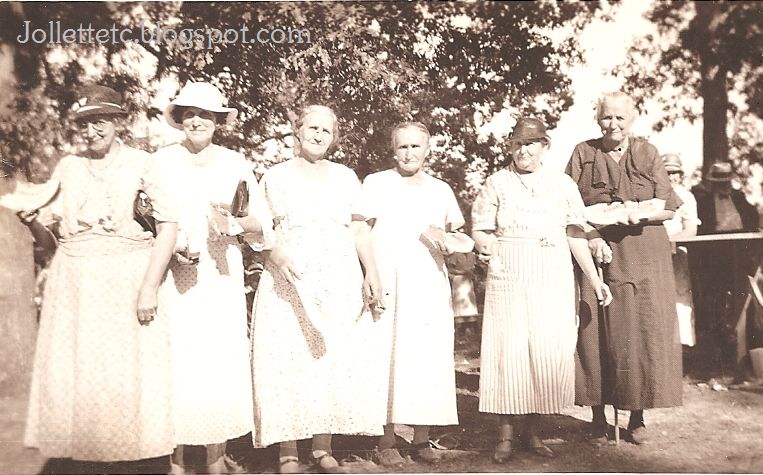
Leanna Jollett Knight is the fourth sister from the left.
Victoria Jollett Breeden, Sallie Jollett Clift, Mary Frances Jollett Davis,
Leanna Jollett Knight, Laura Jollett Sullivan, Emma Jollett Coleman


This next mystery concerns Cabel or Cabell Slade who is either my second great grandaunt or second great granduncle. 

Yeah.

In the 1850 and 1870 census in Florida, Cabel is listed as a male.  

1850 Madison County, Florida
1870 Lafayette County, Florida


However, in 1874, there is a marriage record in Lafayette County, Florida, for Cabel Slade and Charles A. Ross.  

from FamilySearch.org

Did Stephen and his wife SAY Cabel was a male or did the census taker just assume so? 

And what about 1860?  No Cabel in 1860.  

1860 Lafayette County, Florida

However, there is a Louiza who is the same age as Cabel should be, but no Louiza in 1850 or 1870.  I wonder if Cabel was really Cabel Louiza Slade or Louiza Cabel Slade.   

It’s possible.

To “C” what others have Created, Carry yourself over to the A to Z Challenge.


© 2014, Wendy Mathias.  All rights reserved.

Tuesday, April 2, 2013

A to Z April Challenge: B is for Bessie

This is Day 2 of the A to Z April Challenge.


is for Bessie.  Ok, it’s not really an unusual name like I promised yesterday, but her story is unusual and therefore worth the telling.

Bessie E. Merica, my second cousin twice removed on my mother’s side, was the youngest of 8 children born in 1895 to John and Victoria Frazier Merica.  The farming family lived surrounded by other Merica families in the Shenandoah district of Page County in Virginia.  


1900 Page County, Virginia census


By the time Bessie was thirteen, her mother had died and had been replaced by an 18-year old bride and stepmother, Ila Anne Meadows.  It was rather common (at least in my research on my family lines) for a much older widower with a passel of kids to take on a young bride, someone with energy to keep up with the demands of laundry and cooking for a crowd, someone who hadn’t already been dumped on thoughtlessly.   Ila might have seemed more like a big sister than mother. 

1910 Page County, Virginia Federal Census


In 1915, Bessie, age 21, married William Henry Cardin, 22.  One month shy of their first anniversary, young Bessie died despite receiving treatment in the hospital for three weeks.

Meanwhile, back at the Merica ranch, Bessie’s father John and his replacement wife, the young Ila, probably provided quite a bit of comfort to their widowed son-in-law.  So when John died in 1920, it probably surprised no one that the widowed stepmother-in-law and widowed stepson-in-law found comfort in each other.   And if truth be told, age-wise they made more sense together than Ila and John ever did.

So on August 7, 1921, Ila Meadows Merica and William Henry Cardin were united in marriage, a marriage that was a “till death us do part” kind.  William Henry died in 1948. 


William H. Cardin
Jan 6, 1893 - Mar 13, 1948
Photo courtesy Jan Robinson
Ila Merica Cardin
Feb 8, 1890 - Dec 7, 1974
Photo courtesy Jan Robinson


Breeze on by or Barge in at the A to Z April Challenge for a Bounty of Blogs.  Be Brave.


© 2014, Wendy Mathias.  All rights reserved.

Monday, April 1, 2013

A to Z April Challenge: A is for Arlee and Alda


is for Arlee as in “Arlee Bird,” founder of the A to Z April Challenge.  Arlee is my creative hero, the godfather of my blog.  Before I stumbled into last year’s A to Z April Challenge, I had no real vision about what to do with my research on the Jollett family.  A to Z rescued me from the dry and dusty deeds and wills, pointing me in the direction of story-telling.  Thank-you, Lee.  I appreciate all the encouragement you have given me.

My A to Z challenge this time will focus on the women in my database, particularly those with unusual names, some more unusual than others.  First up is Alda Beatrice Clift, my first cousin twice removed.

When Alda was just 8 years old, she testified in her parents’ divorce trial.  And what a story she had to tell:


Deposition on file with Page County Chancery Causes
online at Library of Virginia


Lawyer: Just tell me what happened when your father came to the house.
Alda:  When he come in, Mama said she was not expecting him home, and he said I come home when you are not expecting me.  Mama asked him if he wanted his supper and he said yesem, and he said what do you have for meals, and Mama said 25 cents, and he gave her 25 cents and she laid it up on the shelf.  Mama cooked his supper and he set down and he eat and he pulled out a pass out of his pocket and said Sallie I got a pass for Luray.  I am going to Luray and get me a divorce, and Mama went into the kitchen to wash the dishes and he got up and came out there, and Mama came back in the dining room and Papa pulled out his gun and held it up that away, and said I am going to kill you, and then me and Mama commenced to scream and I said Papa put your gun back in your pocket and then me and Mama went out doors, and he followed us out and when we got out to the gate he got his gun out again and then he said I dare you to come back in here, I will shoot your G__ D__ brains out; you or any other man.  Me and Mama went on down street and then we went hunting for Mr. Whiteside, and Eddie Bricker come to me and Mama first, and we found Mr. Whiteside and he went on up home.
Alda Beatrice Clift 1905 - 1982
It looks like she has only one arm,
but it's behind her back.
Lawyer:  Where did you and your Mama stay that night?
Alda: Down to Aunt Vick’s (meaning Mrs. Decatur Breeden)
Lawyer:  Do you want to stay with your mother or would you rather go live with your father?
Alda:  I want to stay with my Mama.
Lawyer:  Why would you not want to live with your father?
Alda:  Because he is too mean to me.


No Appointment necessary to Alight Among the Artists and Authors at A to Z.


© 2014, Wendy Mathias.  All rights reserved.