Monday, June 7, 2021

On This Day - Helen Killeen Parker


a large metal photo button

My grandaunt Helen Martha Killeen Parker was born on this day 7 June, 1903. She was the last child born to John Joseph Killeen and my great-grandmother Mary Theresa Sheehan Killeen Walsh.

Wendy

© 2021, Wendy Mathias. All rights reserved.

Saturday, June 5, 2021

Sepia Saturday: Pvt Rucker, Artificer

Sepia Saturday challenges bloggers to share family history through old photographs.


This week’s Sepia Saturday photo features a soldier looking carefree. My great-grandfather’s brother John Wesley Rucker sporting his uniform and rifle in this photo looks more proud and ready than carefree. Despite the prevailing sentiment of Virginians opposed to war with Spain, he was one of thousands of soldiers who reported to Jacksonville, Florida in 1898, to aid Cuba in its fight for independence.

John Wesley Rucker at Camp Cuba Libre
photo courtesy Linda Pruett

from Fold3
In 1898, John Wesley and Matilda Stockdell had been married 18 years and were parents to teenagers Elizabeth Rucker and her brother Percy Cleveland Rucker. When war became a reality, John Wesley enlisted in Company C of the 2nd Virginia Regiment Infantry and was assigned as an artificer. He was the man charged with maintenance of a military unit’s equipment. In other words, he was basically a mechanic and repairman.  

The 2nd Virginia was sent to Florida in June 1898 and became part of the Seventh Corps under the leadership of Major General Fitzhugh Lee, nephew of Robert E. Lee. Camp Cuba Libre had been established in May 1898 near Jacksonville to serve as an assembly area in preparation for the liberation efforts in Cuba. 


Fitzhugh Lee
He looks like his uncle Robert E,
don't you think?


In the early days of Camp Cuba Libre, the soldiers had to fend for themselves as supplies were sent elsewhere. Some supplies were sent to other corps already scheduled to deploy; other supplies were deliberately withheld as a way to toughen up new soldiers. The men received only partial uniforms, and they ate with their hands off shingles since there were no forks or plates. 

That was the early days before Fitzhugh Lee arrived on the scene. He saw the horrible conditions and implemented changes that turned Camp Cuba Libre into a model camp. 

Like his comrades, John Wesley Rucker spent his days in drill and target practice. However, the Seventh Corps never saw action. The Peace Protocol was signed in August 1898 resulting in the War Department ordering the release of many regiments, among them the 2nd Virginia. It was another month before any of them left camp to return to their home station. The Regiment was officially mustered out in mid-December 1898.


Souvenir booklet

Souvenir Booklet - 2nd Virginia Regiment Company C
from Historical Society of West Virginia
https://hswv.pastperfectonline.com/archive/60E14615-F0B0-4E26-98D9-347608891170

I don’t know what John Wesley did in the months following, but he left his home in Shenandoah, Virginia on May 1, 1899 to work in the shipyard in Newport News. Within just a week he was too sick to work and returned home where he died on May 29 at the age of 44. 

The obituary does not say but it is possible that he suffered from typhoid fever. The outbreak in the Florida camps had drawn so much national attention that even Clara Barton and Walter Reed visited Camp Cuba Libra to gather information. In fact, more soldiers died of disease in Jacksonville than did soldiers who died in battle.

Matilda wrote her husband’s obituary. One can’t help sensing that the family was devout in their Christian belief.

IN MEMORIAN [sic]

In loving memory of John W. Rucker, who died May 29, 1899. The subject of this notice was a son of Frank and Sarah Rucker, born July 20, 1854, and at the time of his death was forty-four years, ten months, and nine days old.

He left his home and family on May 1st for Newport News, Va, where he obtained work in the Navy yard. He worked only a week when he was taken down on a sick bed from which he never rose, although brought home and everything that loving hands and kind friends could do was done to relieve his sufferings. He died in three days after he arrived home. Death had marked its victim and nature had to yield to a Power stronger than man’s. While we are almost crushed with grief at the loss of our dear one, we know of this beautiful possibility of his soul’s salvation. Just a few hours previous to his death he said, “The Lord is gathering in his sheaves” and that he did not fear the dreadful hour of death.

His funeral was preached by Rev. Black, taking for his text Amos, fourth chapter and a part of the twelfth verse, “Prepare to meet thy God.”

We laid him to rest in the new cemetery at Elkton, close to father and mother, to await the resurrection day when we hope to meet and clasp the hand of our dear one in the New Jerusalem.

Dear husband, you have left us

Here our loss we deeply feel.

'Tis God who has bereft us,

He can all our sorrows heal.

By his wife

John Wesley's tombstone
in Elk Run Cemetery
Elkton, VA
Ironically, Matilda is buried
in Fields UMC Cemetery
Shenandoah, VA

For more stories of soldiers and carefree photos, please visit Sepia Saturday.

Wendy

© 2021, Wendy Mathias. All rights reserved.

Friday, June 4, 2021

Photo Friday - Tourists


This photo is not in good shape, but I am always drawn to it. Who are these women? Where were they? What is this tourist hot spot?

Wendy

© 2021, Wendy Mathias. All rights reserved.

Tuesday, June 1, 2021

52 Ancestors - MILITARY: Stephen Slade in the Florida Wars

On Memorial Day when we honor those who served our country during the Civil War, Spanish-American War, World Wars, Korean Conflict, Vietnam, and Iraq, we view them as heroes who gave their all. There were some lesser-known wars too, like the Mexican War in 1846 and the Florida Wars, also known as the Seminole Wars.  If anyone even thinks about – or even knows about – the soldiers who fought in the Florida Wars, today’s attitudes and standards would likely prevent them from thinking of those soldiers as heroes.

from Wikimedia Commons
produced by US Marines - in public domain

My 3X great-grandfather Stephen Slade was such a soldier when Florida was just a territory. While Florida’s muster rolls and enlistment records are not complete, it appears that at least by the age of 20 Stephen Slade did what the territory required: enroll in the local militia. The militia were the forerunner of today’s National Guard, civilians who volunteer for military service in the event of war, civil unrest, or natural disaster.

All able-bodied WHITE men between the ages of 18 and 45 were expected to join and attend required drill sessions. Postmasters, clergy, teachers, and judges were exempt. Officers wore uniforms like those of the US Army, but non-officers wore whatever they had and provided their own weapons.

The 1816 Springfield Musket was the most popular weapon
of the soldiers at that time. It had a range of 100 yards
and was not very accurate. 

The number of militia units grew as tensions escalated between white settlers and Native Americans in the 1820s and 1830s. A series of military conflicts came to be known as the Seminole Wars. Stephen Slade was just a toddler during the First Seminole War, 1816-1819. That is the period when Spain agreed to give up Florida to the US after it could not defend the territory against rebellions. A treaty required the Seminoles to leave northern Florida and confine themselves to a reservation in central Florida.

It was during the Second Seminole War (1835-1842) that Stephen Slade was of age to be called into action. This war was the result of the Indian Removal Act of 1830 which was the government’s attempt to force the Seminoles to leave Florida altogether and move west of the Mississippi. 


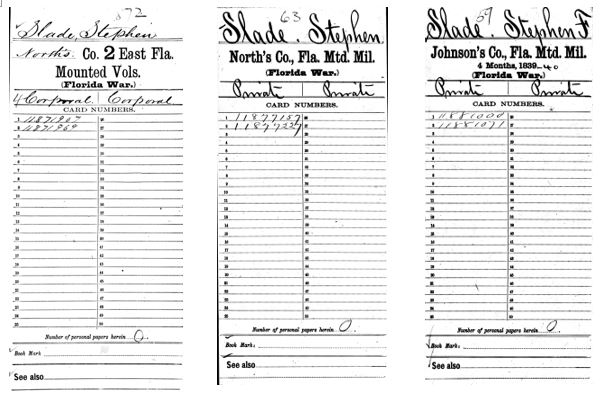
On 2 January 1835, Stephen Slade enlisted in McLemore’s Mounted Company. In May the following year he enlisted in Colonel John Warren’s Regiment, another mounted company. In January 1837 he was a private in North’s Co 1 of Warren’s mounted regiment but in June he was a Corporal in Co 2 of the East Florida Mounted Volunteers. 

This company was formed under the Act of Congress 23 May 1837 which allowed the President to accept the services of volunteers and to raise regiments of Dragoons, or Mounted Riflemen. At the time, the Company consisted of fifty-one privates, three officers, and eight non-commissioned officers which included the rank of Corporal.

After that Stephen Slade returned to serving as a private, still in a mounted company, under officers Lewis Norton and later Captain Hall.


Early on despite being outnumbered, the Seminoles managed to hold on by using guerilla warfare. The Army and militia responded by destroying Seminole farms and villages. By the 1840s, most of the Seminole population had either been killed in battle, died from starvation and disease, or relocated to Indian Territory. Only a few hundred were allowed to remain in an unofficial reservation.

An uneasy peace between White settlers and the Seminole lasted 13 years. When the Third – and last – Seminole War began in 1855, there is no sign that Stephen Slade took part.

I do not know what battles Stephen Slade saw during his time in the militia, but the Second war cost the lives of 1,500 soldiers, mostly from disease. More than 40,000 regular military, militia, and volunteers served in that war which cost as much as $40,000,000. There is no record of the number of Seminole killed in action or how many died from starvation and disease.

If you want to learn more about the Seminole Wars but don’t want to read VOLUMES, here are some good sources:

Florida Seminole Wars Heritage Trail    

Seminole Wars 


Amy Johnson Crow continues to challenge genealogy bloggers and non-bloggers alike to think about our ancestors and share a story or photo about them. The challenge is “52 Ancestors in 52 Weeks.

Wendy

© 2021, Wendy Mathias. All rights reserved.

Sunday, May 30, 2021

Sentimental Sunday


This week marks several important events:

30 May 1865 – My great-grandmother’s sister Laura Jollett Sullivan was born in Greene County, Virginia.

31 May 1978 – My grandmother’s sister Margaret Killeen Sprott died in Norfolk, Virginia.


31 May 1888 – Minnie Coleman was born, daughter of my great-grandmother’s sister Emma Jollett Coleman.


 1 June 1845 – My 3X great-grandfather Leonard Davis Jr. died in Rockingham County, Virginia.

3 June 1930 – My 2X great-grandfather James Franklin Jollett died in Augusta County, Virginia.


5 June 1905 – Alda Clift was born, daughter of my great-grandmother’s sister Sallie Jollett Clift.


Wendy

© 2021, Wendy Mathias. All rights reserved.

Saturday, May 29, 2021

Sepia Saturday: Death by Fire

Sepia Saturday challenges bloggers to share family history through old photographs.


This week’s Sepia Saturday photo shows a family rescuing what remained of their household belongings following a fire. Interviews with survivors of housefires always say the same thing: “We lost everything, but at least we’re alive. We can rebuild.” I hope that if such tragedy comes my way, I can be that positive. Several distant relatives experienced the horror of devastating fires.

For several years I have searched without success for the story of a fire that took the lives of two little children, Vernon and Daisey Clift.

George and Sallie Jollett Clift
Vernon and Daisey

Vernon and Daisey were the first children born to George and Sallie Jollett Clift, my great-grandmother’s sister. Whether the house caught on fire or the children were playing near an open fire is not known. However, their little tombstones tell a bit of the story.


Vernon
Son of
Geo. T. and Sallie
Clift
Died Mar. 30, 1897
Aged 5 yrs 0 mos and 15 days
The LORD gave and the LORD has taken away.
Blessed be the name of the Lord. 


Daisey
Dau of
Geo. T. and Sallie
Clift
Died Apr. 8, 1897
Aged 3 yrs 6 mos and 8 days
Suffer the little children to come unto me and forbid them not
for to such is the kingdom of heaven.

Some years later, a similar tragedy struck the Jollett family again. Macile Sullivan, granddaughter of my great-grandmother’s brother Burton Lewis Jollett, was just a little over a year old when she got too close to an open flame. Her clothes caught fire and she suffered extensive burns. Was it from a fireplace in the house? Was there a burn pile outside where her parents John and Fleta Sullivan burned trash and brush? Apparently, her death did not make the newspaper either.


On the back of the death certificate.
I don't understand the request for eye drops.

In 1959 a son-in-law of my great-grandmother’s sister Leanna Jollett Knight died from pneumonia brought on due to 2nd and 3rd degree burns. Ben Shifflett had tried to put out a brush fire when his clothes caught fire.

Ben and Bertha Knight 
Shifflett

This was a real downer, wasn’t it! Let’s hope my friends at Sepia Saturday will have amusing stories of moving households and people with mattresses on their head.

Wendy

© 2021, Wendy Mathias. All rights reserved.

Friday, May 28, 2021

Photo Friday - One Who Served

With Memorial Day coming up, I thought shining the light on a relative who served our country would be appropriate.

Andrew and Minerva
World War I
photo courtesy John Thompson

This is a distant cousin, Andrew Frazier and his wife Minerva. Andrew was the son of Caroline Frazier and John W. L. Shiflett.

Wendy

© 2021, Wendy Mathias. All rights reserved.