On Memorial Day when we honor those who served our
country during the Civil War, Spanish-American War, World Wars, Korean
Conflict, Vietnam, and Iraq, we view them as heroes who gave their all. There
were some lesser-known wars too, like the Mexican War in 1846 and the Florida
Wars, also known as the Seminole Wars. If
anyone even thinks about – or even knows about – the soldiers who fought in the
Florida Wars, today’s attitudes and standards would likely prevent them from
thinking of those soldiers as heroes.
 |
from Wikimedia Commons
produced by US Marines - in public domain |
My 3X great-grandfather Stephen Slade was such a soldier
when Florida was just a territory. While Florida’s muster rolls and enlistment
records are not complete, it appears that at least by the age of 20 Stephen
Slade did what the territory required: enroll in the local militia. The militia
were the forerunner of today’s National Guard, civilians who volunteer for
military service in the event of war, civil unrest, or natural disaster.
All able-bodied WHITE men between the ages of 18 and 45
were expected to join and attend required drill sessions. Postmasters, clergy,
teachers, and judges were exempt. Officers wore uniforms like those of the US
Army, but non-officers wore whatever they had and provided their own weapons.
 |
The 1816 Springfield Musket was the most popular weapon
of the soldiers at that time. It had a range of 100 yards
and was not very accurate. |
The number of militia units grew as tensions escalated between
white settlers and Native Americans in the 1820s and 1830s. A series of military
conflicts came to be known as the Seminole Wars. Stephen Slade was just a
toddler during the First Seminole War, 1816-1819. That is the period when Spain
agreed to give up Florida to the US after it could not defend the territory against
rebellions. A treaty required the Seminoles to leave northern Florida and
confine themselves to a reservation in central Florida.
It was during the Second Seminole War (1835-1842) that
Stephen Slade was of age to be called into action. This war was the result of
the Indian Removal Act of 1830 which was the government’s attempt to force the
Seminoles to leave Florida altogether and move west of the Mississippi.
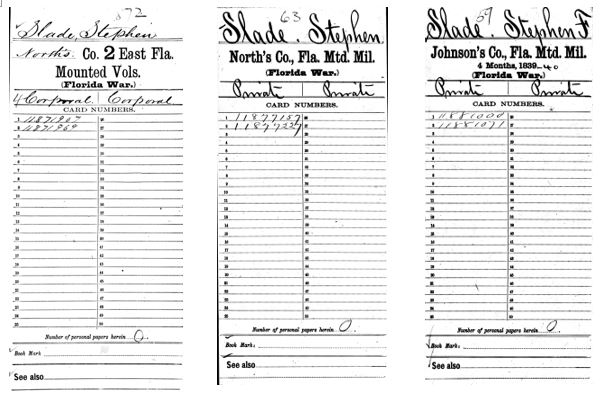
On 2 January 1835, Stephen Slade enlisted in McLemore’s
Mounted Company. In May the following year he enlisted in Colonel John Warren’s
Regiment, another mounted company. In January 1837 he was a private in North’s
Co 1 of Warren’s mounted regiment but in June he was a Corporal in Co 2 of the
East Florida Mounted Volunteers.
This company was formed under the Act of
Congress 23 May 1837 which allowed the President to accept the services of
volunteers and to raise regiments of Dragoons, or Mounted Riflemen. At the
time, the Company consisted of fifty-one privates, three officers, and eight
non-commissioned officers which included the rank of Corporal.
After that Stephen Slade returned to serving as a
private, still in a mounted company, under officers Lewis Norton and later
Captain Hall.
Early
on despite being outnumbered, the Seminoles managed to hold on by using
guerilla warfare. The Army and militia responded by destroying Seminole farms
and villages. By the 1840s, most of the Seminole population had either been
killed in battle, died from starvation and disease, or relocated to Indian
Territory. Only a few hundred were allowed to remain in an unofficial
reservation.
An uneasy peace between White settlers and the Seminole
lasted 13 years. When the Third – and last – Seminole War began in 1855, there
is no sign that Stephen Slade took part.
I do not know what battles Stephen Slade saw during his
time in the militia, but the Second war cost the lives of 1,500 soldiers, mostly
from disease. More than 40,000 regular military, militia, and volunteers served
in that war which cost as much as $40,000,000. There is no record of the number
of Seminole killed in action or how many died from starvation and disease.
If you want to learn more about the Seminole Wars but don’t
want to read VOLUMES, here are some good sources:
Florida Seminole Wars Heritage Trail
Seminole Wars
Amy Johnson Crow continues to challenge genealogy
bloggers and non-bloggers alike to think about our ancestors and share a story
or photo about them. The challenge is “52 Ancestors in 52 Weeks.”
Wendy
© 2021, Wendy Mathias. All rights reserved.