Saturday, July 18, 2020

Sepia Saturday: What Are You Advertising?


Sepia Saturday challenges bloggers to share family history through old photographs.

This week’s Sepia Saturday prompt is a charming ad that juxtaposes a diving woman and apples. If we did not notice that the box label is promoting the Diving Girl Brand of California Apples, we might be here all day scratching our head.

I have to wonder what the “Mad Men” who created advertising for the General Baking Company were thinking about when they created this ink-blotter advertisement:
 
Ink-blotter ad for Bond Bread https://jollettetc.blogspot.com
Ad found in boxes of stuff in my grandparents' attic
A loaf of bread and a Navy fighter? What – “Our fighters are wholesome”? “Our bread is the bomb”?

Oh, I see - the FINEST plane and the FINEST bread. OK, well, that's cute. 

EBay has another ink-blotter ad for Bond Bread that features a different kind of plane. It draws a comparison based on LEADING:
 
Image from eBay

The Bond bread ink-blotter ad is one of three ink-blotter ads found in the STUFF retrieved after being hidden away for 70 years in my grandparents’ attic. The other 2 are for local businesses in the town of Shenandoah, Virginia where my mother grew up.
 
Owen Strickler insurance ad https://jollettetc.blogspot.com
Owen Strickler was a friend of the family.
Oh look - there's an ink smudge at the top!
Ink blotter ad for Higgs Garage https://jollettetc.blogspot.com
Higgs needed a grammarian
who knew how to use an apostrophe!
I was not familiar with ink-blotter ads until I did a little research for this post. Ballpoint pens did not hit the market until after World War II. Before then the fountain pen was the most popular writing tool, but it dripped ink and the ink smeared. Ink blotters were the solution. It was a small card of soft, absorbent paper. In 1885 Charles Murch patented a way to adhere printable paper to blotting paper which led to this widely-used advertising novelty.

By the way, a Bond Bread-Grumman Fighter ink-blotter is selling on eBay for $15 and is not in nearly the pristine condition as mine.

Dive in to more fun stories and old photos at Sepia Saturday.

Wendy
© 2020, Wendy Mathias. All rights reserved.

Wednesday, July 15, 2020

52 Ancestors - NEWSWORTHY: One-Sixteenth


When historians look back on 2020, no doubt attention will be given to the global pandemic of Covid-19. Of equal if not more interest will be the racial tensions that escalated following the death of George Floyd at the hands AND KNEE of Minneapolis police. In my lifetime racial tension has been a fact of life. I was a teenager when public schools were mandated to integrate. That was about 50 years after a dirty little secret about race and public education revealed itself.

 
From Harrisonburg Daily News Record
25 Jan 1915

In 1910 the State of Virginia passed an act prohibiting children with one-sixteenth negro blood to enroll in public school. Five years later, Miss Price, the teacher at the Rocky Bar mission school in Rockingham County, put that law to the test. With only the word of neighborhood gossips as proof, Miss Price reported to the Rev. J. R. Ellis, who was in charge of the mission schools in the eastern part of the county, that several children of William Shifflett needed to be expelled because of their questionable heritage. The word back in the holler was that William was the great-grandson of Nancy Shifflett and a man named Bradley, ostensibly a “negro.”

Kicking those little children out of school caused quite a stir. The case was finally brought to the School Board when the Shifflett family petitioned the Board to have the children readmitted. The family argued that they married as white, attended white churches, went to white schools, and that, in fact, Bradley was actually Mexican. In their corner was lawyer Charles Hammer who could explain the mathematics of genealogy. As he pointed out, even if Bradley were half-black, the blood of William Shifflett’s children would have been only one-thirty-second black therefore making the children eligible to attend white schools.

From Harrisonburg Daily News Record
25 Jan 1915


No one seemed to want to take the blame for what turned out to be an unpopular decision about the Shifflett children. Miss Price said it was Rev. Ellis’s authority to expel the children. He said Miss Price did it. School Board members claimed ignorance of the situation until the petition was presented to them. To everyone’s credit, it did not take the School Board long to reverse the teacher’s order and welcome the children back to school.


Amy Johnson Crow continues to challenge genealogy bloggers and non-bloggers alike to think about our ancestors and share a story or photo about them. The challenge is “52 Ancestors in 52 Weeks.”

Wendy
© 2020, Wendy Mathias. All rights reserved.

Wednesday, July 8, 2020

52 Ancestors - MULTIPLE: Written in Stone

Adam Kohne family https://jollettetc.blogspot.com
Adam Kohne family
Back row: Joseph, Sarah, William
Front: Charles, Floyd, Adam and Caroline, Hattie, Birdie
(judging by the assumed ages of Hattie and Birdie,
the picture was taken likely 1901 before the last child was born)
I recently hosted a bridal tea for my nephew’s fiancĂ©. Among the many conversations at the party was the subject of BABIES. It was NOT a baby shower, but babies were on everyone’s mind, partly due to my OTHER nephew’s wife who has recently announced they are expecting. The lively chatter revealed that the bride’s mother is a twin. One of the bridesmaids is a twin. While not news to me, others were surprised to learn my husband is a twin.

The big question of the day was, “Is it true twins skip a generation?” Oh, if only that were true, my grandchildren would be twins. But alas NO. We didn’t have twins. My girls did not have twins. My husband’s twin sister did not have twins, nor did her children. If twins skip a generation, the rule was broken in our immediate family.

I recall my mother-in-law saying that twins and even triplets run in the family. THE family. Did she mean the Mathias family or her side of the family, the Kohnes? I went looking, starting with the Kohnes. Sure enough, in no time I found a set of triplets.

Leonard, Billie, and Jack were born 19 Feb 1923 to Floyd Kohne and wife Mary Emswiler.  Floyd was an older brother to Hattie Kohne, my mother-in-law’s mother, thus making Floyd my mother-in-law’s uncle and the triplets her cousins.

These little boys never made it into a census. However, they have a marker and memorial on Find a Grave. The stone appears to memorialize a set of twins and older brother, yet death certificates show otherwise. 

Kohne Triplets tombstone memorial https://jollettetc.blogspot.com
Kohne Triplets
Woodmere Memorial Park, Huntington, WV

Leonard died the day he was born, 19 Feb 1923. The other two died weeks later in March. The cause of death was simply recorded as “premature.” 
Leonard Kohne 19 Feb 1923- 19 Feb 1923
Jack Kohne 19 Feb 1923- 21 Mar 1923
Billie Kohne 19 Feb 1923 - 21 Mar 1923
I was all set to conclude that the stone and inscription must have been provided many years later by a big-hearted and well-meaning descendant of the family who did not have access to accurate records until I had the bright idea that a birth of triplets surely would have been newsworthy. I was right.

from Harrisonburg Daily News Record 5 Jan 1923
Lo and behold, now even the accuracy of the death certificates is in question. If the boys were born on February 19, how did a news article about their birth appear in January? The article which was posted on Friday the 5th of January claims the triplets were born “last Wednesday.” Wednesday that week was January 3. Could “LAST Wednesday” refer to 27 December 1922? If so, then the tombstone would be correct since Leonard died the day he was born, ostensibly in 1922, and Jack and Billy lived longer, dying probably March 21, 1923 as recorded on the death certificates.

This seems like a logical explanation. What does not make sense, though, is how Floyd did not remember the date of birth for the triplets. And what was the delay in recording Leonard’s death?

Even when something is "written in stone," it isn’t necessarily “written in stone.”


Amy Johnson Crow continues to challenge genealogy bloggers and non-bloggers alike to think about our ancestors and share a story or photo about them. The challenge is “52 Ancestors in 52 Weeks.”

Wendy
© 2020, Wendy Mathias. All rights reserved.

Wednesday, July 1, 2020

52 Ancestors - SOLO: Piano Recitals


One of the fond memories my children and nephews likely will have of their grandmother is hearing her play carols on the piano on Christmas Eve. She did not use a book of popular songs or sheet music. She played by ear. If she knew a tune, she could play it.
Mary Eleanor Davis Slade Christmas 1993  https://jollettetc.blogspot.com
Christmas Eve 1993
Mary Eleanor Davis Slade with Clay, Justin, Joel
Wendy and Zoe on the sofa
What a gift.

Yet what an irritation to me whenever I needed help reading the music I was supposed to practice for my upcoming piano lesson. Momma always claimed she did not read music well or that she had forgotten most of what she learned as a piano student.

If she didn’t really READ music, why were there a gazillion pieces of sheet music in a box retrieved from my grandparents’ attic after 70 years? Honestly, the stack of sheet music stood at least a foot deep. That is a lot of music.

Many of the pieces were popular tunes of the day by artists like Frank Sinatra, Bing Crosby, and Dean Martin - teenage heart-throb music of the 40s.

However, two of the pieces of music might have been songs my mother played as a beginning student under the tutelage of Priscilla Harman at the Harman School of Music in Shenandoah, Virginia. Maybe Mary Eleanor was given “Mickey Mouse’s Birthday Party” copyright 1936 and “Whistle While You Work” 1937 in the year they were written or shortly after. At age 7 or 8, what little girl would not have wanted to play a song from Disney’s new movie Snow White and the Seven Dwarfs?

I had hoped to find that one or both had been a recital piece, but no such luck. In 1938, when she was just 9 years old, she and 3 other little girls performed a “piano quartal.” The piece was called “In the Procession” which was written for “one piano – eight hands.” That must have been interesting to watch, to say the least. (A reviewer on Amazon described the piece as a “show stopper” when she, her mother, and her sisters performed it as the finale of a recital in 1962.)
from Harrisonburg Daily News Record
30 Apr 1938

Finally, in 1939, at just 10 years old, little Mary Eleanor performed a solo called “Mirth and Gayety” by Carl Wilhelm Kern. The piece appears simple because it is primarily single notes played one at a time rather than big chords, but the 16th notes in 2:4-time, key changes, and fingering techniques like staccato make this piece quite a challenge.
Mary Eleanor Davis
age 10


Harrisonburg Daily News Record
15 Jun 1939
I do not think I ever played a piece quite like that one when I was a piano student under Mrs. Anne Shuler. My love-hate relationship with the piano has been shared before HERE. After that post appeared, Mrs. Shuler’s daughter Jan sent me pictures of the programs from our 1966 and 1967 recitals. Oh boy - “Lament” and Chopin's Prelude Opus 28 No. 4 – yes, I was wallowing in that teen phase of loving dreary and moody pieces.
1967 Recital
1966 Recital


Here is a little YouTube video of SOMEBODY playing my recital piece. I’m sure that’s exactly how it sounded when performed by me as a moody teenager.


Amy Johnson Crow continues to challenge genealogy bloggers and non-bloggers alike to think about our ancestors and share a story or photo about them. The challenge is “52 Ancestors in 52 Weeks.”

Wendy
© 2020, Wendy Mathias. All rights reserved.

Saturday, June 27, 2020

Sepia Saturday: Check Us Out


Sepia Saturday challenges bloggers to share family history through old photographs.

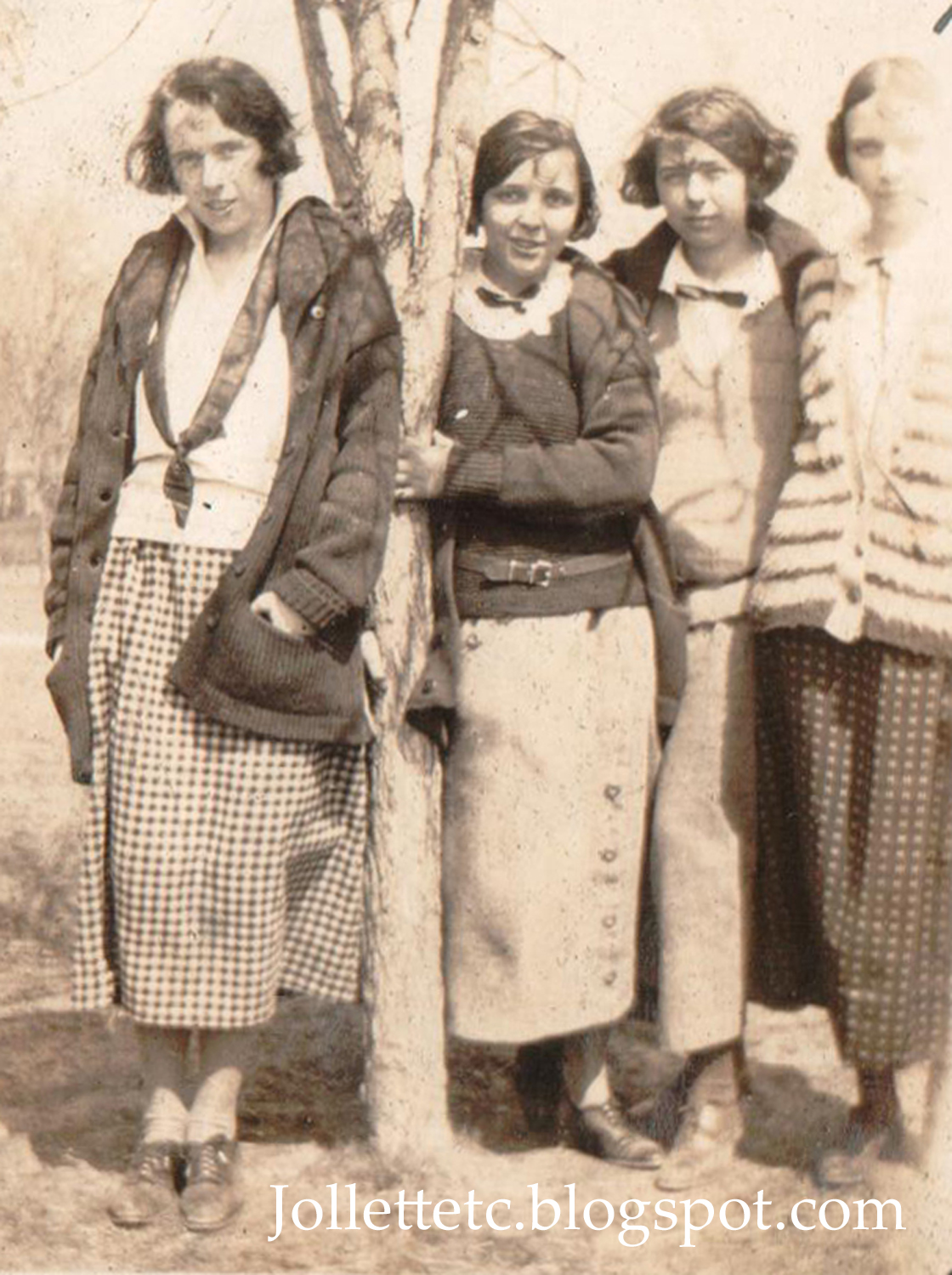
This week’s Sepia Saturday prompt reminded me of so many of the 1920s era photos in my collection. Skirts in check fabric. Big sweaters. Bows and ties. One of my favorites is this one.
Pals at Harrisonburg Teachers College 1924 https://jollettetc.blogspot.com
"Pals"
Harrisonburg Teachers College 1924
(now James Madison University)
The photo from my grandaunt Velma Davis’s college scrapbook was captioned “Pals.” Since these girls do not appear often in the scrapbook, I believe they were each other’s pals more than Velma’s. Most likely they all lived in the same dorm, Wellington Hall.

I knew nothing about the Pals, so I decided to study Velma’s yearbook to see what I could learn. By carefully inspecting facial features, how they parted their hair, whether they had straight or curly hair, I THINK I have them identified.
Yearbook photos 1926
What do you think?

JEAN WALTON BROADDUS
Jean (actually “Eugenia” – she must have hated that name) was from Bowling Green, Virginia. She was quite active in school serving as both secretary and president of the Page Literary Society and vice-president of the Racquet Tennis Club. She was a member of the Cotillion Club, Choral Club, Grammar Grade Club, Athletic Association, and YWCA. The quote assigned to her was “Could I love less I would be happier.” The Class Prophecy predicted Jean would “enter a domestic life with a lawyer-husband who’s proud of his wife.” And that is exactly what happened. She married Bernard Mahon, a lawyer. In the 1940 census, they had 2 children and a live-in maid. At her death in 1992, she was the owner of an inn in Bowling Green.


FRANCES ADELINE BROYLES
Frances was from Luray, Virginia. Unlike Jean, Frances was a member of only the YWCA. Her quote was “He that hath patience may compass anything.” (What? Is that supposed to be “accomplish”? I guess someone had no patience for proofreading.) Frances married William Shenk who managed a kennel, according to the 1930 census. When Frances died in 1985 in Lynchburg, Virginia, she was a retired school teacher.


GWENDOLYN MARY MARTIN
Gwen was the most difficult to identify, but when I noticed she was from Bowling Green, I was encouraged. Sure enough, she and Jean grew up together as neighbors. While in college, Gwen was as busy as her pal Jean. Gwen was in the Page Literary Society, High School Club, French Circle, Grammar Grade Club, Choral Club, Athletic Association, and YWCA. Her quote was “She hath a pleasant word and a smile for everyone.” Gwen married Clem Jordan, a machinist. She died in 1995 in New Port Richey, Florida.


JESSIE MELVILLA MATTHEWS
Jessie was from Bentonville in Warren County, Virginia. She enjoyed some of the same activities as her pals: Choral Club, Alpha Literary Society, Grammar Grade Club, Athletic Association, and YWCA. Her quote was “Ready in heart and ready in hand.” Those must have been the qualities that attracted her husband William Cullers, a Baptist preacher. Jessie worked as a teacher but not during the 1930 or 1940 census. She died in Richmond, Virginia, in 1971.


Check out my pals at Sepia Saturday.

Wendy
© 2020, Wendy Mathias. All rights reserved.

Wednesday, June 24, 2020

52 Ancestors - MIDDLE: House Divided


My poor 3X great-grandmother Helena Eppard – she was truly caught in the middle. It was 1860 and war was declared between the North and South. As residents of Rockingham County, Virginia, the Eppards sided with the Confederacy declaring the right to secede from the Union.

Helena’s two sons, Thomas and George, both served in Company L, 97 Virginia Militia under Col. Mann Spitler. Thomas rose to the rank of Sergeant while George remained a private, probably because he was unable to fight after breaking his leg in 1863.


While no doubt Helena worried about her sons, she probably was equally concerned about “the enemy,” some of them anyway. Across the line in Tennessee, Helena’s brothers and nephews donned the blue uniforms of the Union. 

Being caught in the middle was not unique to the Eppards. In neighboring Greene County, Thomas Frazier, nephew of my 3X great-grandmother Nancy Frazier Shiflett, was himself torn about the issues that had divided the nation. He wrote a short book called The Olive Branch in which he explained how he had wished to side with the Union because he opposed slavery but did not want to fight and kill his friends and neighbors. As a result, he ran. After he was caught and imprisoned as a deserter, he managed to escape. A rather long excerpt is available on the Shiflet Family Website. It is quite a lively story.

When I studied the Civil War in American History in high school, I thought the Mason-Dixon Line marked a true division in politics. I thought the entire North was anti-slavery and the entire South was pro-slavery. But no. Within Virginia and within families, sentiments were frequently in conflict.

House divided.


Amy Johnson Crow continues to challenge genealogy bloggers and non-bloggers alike to think about our ancestors and share a story or photo about them. The challenge is “52 Ancestors in 52 Weeks.”

Wendy
© 2020, Wendy Mathias. All rights reserved.

Saturday, June 20, 2020

Sepia Saturday: Not a Shaggy Dog Story


Sepia Saturday challenges bloggers to share family history through old photographs.

I was surprised to find a perfect match for this week’s Sepia Saturday prompt featuring a man wearing his dog.
Burlington Cab Company 1956
Julia Slade and friends
The photo was taken at my grandparents’ home and taxi cab yard in 1956. That is my granny leaning on one of the cabs. I suspect the man holding the dog was a driver, but I do not know for sure. Maybe they were just friends of the family. 

I like dogs. I don’t want a dog. I don’t want to walk them. I don’t want to vacuum up their hair. I don’t want to follow along behind them with a plastic bag and a scoop. I don’t want to have to bother with boarding them so that I can leave town. But I do like dogs. Other people’s dogs.
Wendy about 1952 https://jollettetc.blogspot.com
Me and a dog probably 1952
This is one of my favorite pictures. That’s me with a dog. I don’t know whose dog it was or where this picture was taken. I like this picture so much that it is one of the few of me in a frame. I’m not even sure why I like it. Maybe it’s that vintage bottle or the way I was strapped into the seat with a towel or blanket or possibly a cloth diaper. Maybe it’s those little fists. Oh, maybe it’s the dog!

Apparently, dogs like me.
Fred Slade and the Moores' dog https://jollettetc.blogspot.com
Granddaddy Slade
and George Moore's dog
Here is my paternal grandfather with his brother-in-law’s dog. When our family visited my dad’s Aunt Margaret and Uncle George Moore, the dog watched over me while I napped. No one could get near me until I woke up. Good dog!

My grandparents used to laugh telling a story about me and their neighborhood dogs. We lived in Burlington, North Carolina a short while when Daddy was helping out with his parents’ taxi business. I would gather all the dogs on the steps to our house to play school. Even after we moved back to Virginia, the dogs showed up faithfully, at least for a while until they got the hint. (Hmm, I wonder if the dog on that man's shoulders was one of my students.)

See – I really do LIKE dogs, but this is the only dog I need.

Planter - need a plant AND a new spot in the yard


For some good ol’ shaggy dog stories, visit Sepia Saturday.
Wendy
© 2020, Wendy Mathias. All rights reserved.