Saturday, April 7, 2018

A to Z April Challenge: G is for Glasses


When my sister and I cleaned out our parents’ home, we had to make many decisions about what to do with all the stuff. Which things are truly “valuable” and which have only sentiment in their favor? Should we sell it, keep it, or throw it away? To help ensure a future for our family’s heirlooms, I plan to leave a booklet for my daughters telling the stories of what they will inherit one day. (Not TOO soon, I hope!) With this challenge I begin my book of Heirlooms.


is for glasses, eyeglasses, that is.

As a child I was told these glasses were my maternal grandfather’s. That is what I always believed. However, now I have my doubts.

Glasses belonging to Orvin Davis https://jollettetc.blogspot.com
The glasses sit on a shelf in a guest bedroom.
The size of the glasses make me think they would have been worn by a child, but in none of my granddaddy’s childhood pictures was he wearing glasses.

Not here.

Orvin Davis https://jollettetc.blogspot.com 


Not here.

Davis and Sullivan cousins https://jollettetc.blogspot.com
My granddaddy - the only boy!
With his sisters, Sullivan cousins, mother, and aunt

Not here either. 

Orvin Davis https://jollettetc.blogspot.com


I suppose it is possible he was self-conscious and removed the glasses for photos.

But perhaps they were not glasses worn by a child. Granddaddy’s daddy wore glasses that look just like them.

Walter Davis https://jollettetc.blogspot.com
Walter Davis
The glasses are very bendable, almost stretchy. Perhaps they would have fit an adult.

Maybe - Maybe not.

Wendy
© 2018, Wendy Mathias. All rights reserved.

Friday, April 6, 2018

A to Z April Challenge: F is for Flue Cover


When my sister and I cleaned out our parents’ home, we had to make many decisions about what to do with all the stuff. Which things are truly “valuable” and which have only sentiment in their favor? Should we sell it, keep it, or throw it away? To help ensure a future for our family’s heirlooms, I plan to leave a booklet for my daughters telling the stories of what they will inherit one day. (Not TOO soon, I hope!) With this challenge I begin my book of Heirlooms.


is for flue cover plate.

A what? Flue covers were used to hide an unsightly and drafty hole in the wall once a stovepipe was removed either permanently or seasonally. Sometimes in spring and summer homeowners took down the stovepipe that had provided heat to the home during the winter.

Flue cover from Davis store https://jollettetc.blogspot.com 


This tin flue cover is all that remains of
the Davis Store, once a vibrant little enterprise built by my great-grandfather Walter Davis and operated by his sons Millard and Orvin, my maternal grandfather. For over 20 years, the store served the community of Shenandoah, Virginia.

Davis Store Shenandoah, VA 1920s https://jollettetc.blogspot.com 


Even after the store closed in the 1940s, the apartment continued to house renters until recent years. Eventually asbestos made the building unsafe; termite damage made it not even worth flipping. Besides, the corner lot was too valuable for other uses. 


My grandmother behind the counter - she ran the store.
There is the stovepipe where the flue cover would have gone.

On April 16, 2015, the building was bulldozed.
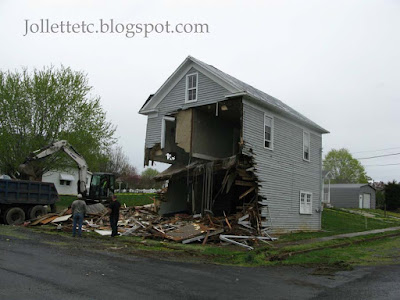
 
Davis Store demolition April 2016 https://jollettetc.blogspot.com
Photo courtesy of Jan Hensley

That I have any souvenir at all is by sheer luck. I was chatting with my cousin who casually informed me that the old store building was being torn down that day. She said it with all the enthusiasm accompanying a report of the day’s trip to the grocery store. For me, it was big news that demanded she get over there right away and take a picture at least. However, my cousin had no love for the store building; she actually lived in the apartment as a child, and the memories of a cold building with poor heat and no hot water have not left her.

I seldom post on Facebook, but I did that day – a mini tribute to the old store on its passing. Jan Hensley, a dedicated researcher of families in the Shenandoah Valley and one with whom I have collaborated, saw my post and scurried over to the corner of Sixth Street and Pennsylvania Avenue to snap a picture. She even spoke to one of the workers and asked if there were anything worth snatching from the rubble. He thought a minute and soon brought out the flue cover.

This winter scene is a common one. One exactly like it sold on eBay for $13. Similar ones range from $10-$35. The fancier ones made of glass go for $40-$80. This illustrates the paradox of many heirlooms: they are worthless and priceless at the same time.

Wendy
© 2018, Wendy Mathias. All rights reserved.

Sepia Saturday: Two Paintings


Sepia Saturday challenges bloggers to share family history through old photographs.


This week’s Sepia Saturday prompt features a man at the piano. On the wall is a painting that bears a slight similarity to one that once hung above the fireplace at my grandparents’ home.
 
Reverse Glass Painting belonging to Mary Sudie Rucker https://jollettetc.blogspot.com
Me and baby sister 1959
Too bad the picture isn’t in color. Then one could appreciate the varied shades of the teal of the water next to the olive green of the grass. The mother of pearl accents in the houses look like the lights are on. And no wonder - after all, it appears either a storm or night is approaching. All in all, it is a very moody painting - moody in a good way.

This is one of two paintings my grandmother inherited from her mother Mary Sudie Rucker. The other is this smaller square one. 

Reverse Glass Painting belonging to Mary Sudie Rucker https://jollettetc.blogspot.com
Square reverse glass painting
The color is still good and hints at the milky tones of its rectangular sister.

In my young mind, the two pictures were part of a single thought, with the mill and church being at the other end of the stream separating the houses in the other picture. I could sit in Grandma’s living room and stare at these paintings for the longest time creating little stories. Often I imagined arriving by rowboat to visit someone in one of the houses. Sometimes I imagined climbing out of the second story window of the mill and balancing myself on that wooden structure leading to the church. (What is THAT? Is it a chase? A fence?)

Eventually the pictures went to my mother and finally to me. I wanted to display the longer one, but I noticed the painting was damaged. The paint was flaking off.

This painting dates to the early 1900s when the ancient technique of reverse glass painting was still quite popular; adding touches of mother of pearl was too. Artists painted with acrylics and oils on the back of the glass and then turned it over. We view the image through the glass. Pastoral scenes like the ones here were probably easier to create than portraits since the artist was essentially painting backwards.

I looked for an artist who could repair the painting or at least prevent further damage, but no one would take the job on. So the long painting has been donated to a charity thrift store; maybe the frame will be useful to someone. I still have the smaller one, but it too is showing signs of paint ready to flake away.

Reverse Glass Painting belonging to Mary Sudie Rucker https://jollettetc.blogspot.com
Paint is pulling away from the glass.
I wonder how much longer this one will last.

Please visit Sepia Saturday for more stories of pianos, paintings, and curly-headed men.

Wendy
© 2018, Wendy Mathias. All rights reserved.

Thursday, April 5, 2018

A to Z April Challenge: E is for Enameled Glass


When my sister and I cleaned out our parents’ home, we had to make many decisions about what to do with all the stuff. Which things are truly “valuable” and which have only sentiment in their favor? Should we sell it, keep it, or throw it away? To help ensure a future for our family’s heirlooms, I plan to leave a booklet for my daughters telling the stories of what they will inherit one day. (Not TOO soon, I hope!) With this challenge I begin my book of Heirlooms.


is for enameled optic glassware.

The story of this glassware is short: it belonged to my paternal grandmother Julia Walsh Slade. She and my grandfather struggled financially for many years, but somehow she managed to hold on to some pretty blue glassware. Blue was her favorite color.

Julia Slade's blue enameled optic glasses https://jollettetc.blogspot.com
My granny's lemonade glasses


Not my lemonade set -
just a typical Victorian
lemonade set


These tumblers were probably once part of a lemonade set which would have included a pitcher. Pitchers were usually about 10” tall and tumblers 4”. Lemonade sets were very popular in the Victorian era and into the 1920s. They are selling on eBay and Etsy in all prices from $35 to over $200 depending on completeness of a set, color, condition, and of course emotion and ignorance.


Closeup of enameled optic glass https://jollettetc.blogspot.com


There are two features to my granny’s glasses worth noting. First, the decoration. Fruit and flowers were popular subjects for artisans to apply on glass using a technique known as enameling. The paint is shiny and very hard. VERY hard - it is not easy to chip it off which is why many lemonade sets still look good after all these years. Small details like the dots are raised and easy to feel.  

Glass exhibiting optics https://jollettetc.blogspot.com
Can you see the vertical optics?


Second, the optics. Glass companies used molded shapes on the interior to add dimension and sparkle to the glass. Granny’s tumblers have a vertical optic. I am always surprised that I cannot feel the angles when I hold the glass. However, if I rub my fingers along the inside, I can feel a subtle rise and fall that give the tumbler its special look.


In addition to the tumblers is a cruet, probably used for oil or vinegar. It displays a different pattern of leaves and flowers. Unfortunately the rim of the cruet is chipped which detracts from its value. 


Is this miniature pitcher not the cutest?

Wendy
© 2018, Wendy Mathias. All rights reserved.

Wednesday, April 4, 2018

A to Z April Challenge: D is for Doily

When my sister and I cleaned out our parents’ home, we had to make many decisions about what to do with all the stuff. Which things are truly “valuable” and which have only sentiment in their favor? Should we sell it, keep it, or throw it away? To help ensure a future for our family’s heirlooms, I plan to leave a booklet for my daughters telling the stories of what they will inherit one day. (Not TOO soon, I hope!) With this challenge I begin my book of Heirlooms.


is for doily. I’m a sucker for a sweet doily. I have inherited lovely crocheted and tatted doilies from my grandmother and from my husband’s grandmothers. I have purchased doilies at antique shops and estate sales. Frankly I no longer know which is which.

Except for this one:
Mary Sudie Rucker's doily https://jollettetc.blogspot.com


This very large doily was crocheted by my maternal grandmother’s mother, Mary Sudie Rucker. My grandmother sometimes used the doily on this very same table.

At one time doilies were a sign of upward social mobility. (Remember the scene in Anne of Avonlea when Diana Barry boasts about the number of doilies she received as wedding gifts!) The lady of the manor used doilies to protect her tables from being scratched by lamps, crocks, picture frames and other decorative objects. She used doilies on her tea tray to catch spills.

You won’t see Joanna Gaines or the Property Brothers staging their homes with doilies. As warm and fuzzy as "Home Town"’s Ben and Erin are, they haven’t featured any doilies either. Alas, doilies are considered old fashioned today, but I still like them and use them as they were always intended: to protect my furniture.

Guest room lamp and doily https://jollettetc.blogspot.com
Two doilies
The large one covers the table
which is not in good shape.

I love this doily edged
with crocheted pansies.
Taupe colored doily -
its twin is on the other nightstand


I could not resist a
purple and yellow doily.
Those blue points!
Had to grab this one at an estate sale.


Even if my own daughters are not enamored of my doilies, I know of one person who appreciates them. My nephew’s fiancé, who loves all things vintage, will be using my doilies at their wedding reception this coming June. It is doubtful any of the guests will appreciate the significance of the doilies, but OUR family will know that some of these doilies are nearly 100 years old, still beautiful, delicate yet strong. The connection to family will not be missed.
Doily made by Mary Sudie Rucker https://jollettetc.blogspot.com
Mary Sudie Rucker's handiwork
I am pretty sure Sudie Rucker’s doily would make Anne Shirley and Diana Barry swoon!

Wendy
© 2018, Wendy Mathias. All rights reserved.

Tuesday, April 3, 2018

A to Z April Challenge: C is for Corner Cupboard


When my sister and I cleaned out our parents’ home, we had to make many decisions about what to do with all the stuff. Which things are truly “valuable” and which have only sentiment in their favor? Should we sell it, keep it, or throw it away? To help ensure a future for our family’s heirlooms, I plan to leave a booklet for my daughters telling the stories of what they will inherit one day. (Not TOO soon, I hope!) With this challenge I begin my book of Heirlooms.

is for the Corner Cupboard that once belonged to my great-grandmother Mary Frances Jollett Davis. Corner furniture was popular in the 19th century, probably because it saved space in the room. The purpose of cupboards was storage. In the kitchen they held dishes and cookware. In a hallway they might have held bed linens.

Corner Cupboard https://jollettetc.blogspot.com


Since Mary Frances’s cabinet is a simple one-piece construction with flat panel doors top and bottom, I conclude that it was likely intended strictly for storage rather than display. Anyone wishing to show off fine china and crystal would have had a cabinet with a glass door on top. Despite any intentions suggested by the solid door, the other pretties I have inherited are on display with the door open.

When or how Mary Frances acquired this pine cabinet is not known. However, it is certainly old enough to have been one of her original pieces of furniture when she and Walter Davis married in 1890. Most likely she used it in the dining room of their home in Shenandoah. When she went to live with her daughter Violetta, the cabinet went with her.

Corner Cupboard https://jollettetc.blogspot.com

Violetta’s living room is where I remember seeing the cabinet and feeling sorry that she could do no better than all that old furniture. Oh my, how my views have changed over the years.

When Violetta died, my mother and my cousin Bobbie were tasked with disposing of Violetta’s things. Each was free to claim what she wanted either for herself or on behalf of other family members. If there was something they both wanted, they drew names. Of course, Momma and Bobbie both wanted the cabinet, but Momma was the lucky draw that day.

When our parents died and my sister and I went through the same process, I said I would fight her for the corner cabinet. Fortunately, we didn’t have to fight. We made sure that for every item one of us claimed, the other took something of comparable size and value. Momma’s Empire-style sideboard was my sister’s choice. There is nothing “second place” about it!

Empire style sideboard https://jollettetc.blogspot.com

Wendy
© 2018, Wendy Mathias. All rights reserved.

Monday, April 2, 2018

A to Z April Challenge: B is for Biscuit Jar


When my sister and I cleaned out our parents’ home, we had to make many decisions about what to do with all the stuff. Which things are truly “valuable” and which have only sentiment in their favor? Should we sell it, keep it, or throw it away? To help ensure a future for our family’s heirlooms, I plan to leave a booklet for my daughters telling the stories of what they will inherit one day. (Not TOO soon, I hope!) With this challenge I begin my book of Heirlooms.


is for Biscuit Jar.

The purple flowers adorning this jar tells me it had to belong to my grandaunt Velma Davis Woodring. Nobody loved purple more than she did.

Biscuit Jar https://jollettetc.blogspot.com 


Biscuit jars - also called Biscuit Barrels - did not hold the kind of biscuit you might be thinking of. They were actually the forerunner of today’s ceramic cookie jar. They are not very big, so I must wonder what size cookies people made in the late nineteenth and early twentieth centuries, and how many such a jar would hold.


Biscuit Jar https://jollettetc.blogspot.com
Such pretty detail with the raised beads


Not enough, if you ask me! The jar looks more like a big sugar bowl, more suitable for candy or trinkets.


Three Crown China Germany
Markings are green or red


When I saw the pottery mark, I thought for sure this piece was quite old and more valuable than it really is. Three Crown China was a mark introduced by Unger & Schilde of Roschuetz, Thuringia, Germany for items specifically imported and distributed by Jon H. Roth of South Bend, Indiana from 1909-1916.

South Bend - rather takes the bloom off the rose, don’t you think?

Biscuit jars of any shape and mark are selling on eBay for $25-$40, that and higher on Etsy.

Nobody will be getting rich off this little heirloom!

Biscuit Jar https://jollettetc.blogspot.com
A proud spot in the corner cabinet of my living room
Wendy
© 2018, Wendy Mathias. All rights reserved.