Thursday, April 14, 2016

A to Z April Challenge: L is for Locks of Hair

Genealogists and family historians get a lot of satisfaction from chasing their ancestors’ stories. Finding a diary, a message on a postcard, or a photo with a name attached is like the sun coming out after a storm. One day we will be somebody’s ancestor. We need to leave our descendants a little bit of sunshine too. So here is my story told alphabetically, not chronologically: Growing Up in Cradock.


is for Locks of Hair.

Two memories about my hair are crystal clear in this ever-fading memory bank: (1) Momma always cut my bangs too short, and (2) Momma loved to give me a Tonette permanent (the child’s version of the popular Toni Home Permanent kit of the 1950s).

Wendy Slade Mathias Easter 1955  http://jollettetc.blogspot.com
Wendy and her fresh haircut Easter 1955
In most of my school pictures, it looks like I had a perm. My parents always bought the pictures no matter how bad they were. However, in looking for the pictures for this post, I see that grades 6, 7, and 8 are missing. The disaster of my 5th grade picture must have traumatized my parents causing them to cease purchasing sight unseen. We have lots of copies left if anyone wants one. Yeah ~ 


Wendy Slade Senior Picture 1969 http://jollettetc.blogspot.com
Senior Portrait
This style has come and gone
several times.

Don’t let the labyrinth of lampoons and belles-lettres languish at the A to Z April Challenge.

© 2016, Wendy Mathias. All rights reserved

Wednesday, April 13, 2016

A to Z April Challenge: K is for Kappa

Genealogists and family historians get a lot of satisfaction from chasing their ancestors’ stories. Finding a diary, a message on a postcard, or a photo with a name attached is like the sun coming out after a storm. One day we will be somebody’s ancestor. We need to leave our descendants a little bit of sunshine too. So here is my story told alphabetically, not chronologically: Growing Up in Cradock.

is for Kappa.

At Cradock High School there were three service clubs open to the girls. At the beginning of the new school year, my friends and I attended a meeting of Delta. The meeting was a joke, so terribly disorganized. Not impressed. Then we tried Admiralettes. Right off the bat, the president announced there were limited slots available and she wasn’t sure all of us visiting that day could get in. Hrmph. These were definitely the cool girls. I thought I was pretty cool, semi-popular, but I knew right away I was not in their league.

Like Goldilocks finding the right porridge, chair, and bed, we knew from the first meeting Kappa was a good fit. The president Cheryl was funny, welcoming, and a natural leader. For the next three years, my friends and I were devoted members and took part in all the Kappa activities.

1966-67 Kappa Officers 

One of our main projects was painting the lines in the parking lot just before school started. Now how this came to be a club project instead of general maintenance I have no idea. But we made it fun. When we finished, we rewarded ourselves with a trip to Burger Chef, the first fast-food joint in our area, years ahead of McDonalds. We could get a burger, fries, and drink plus change for a dollar.

Burger Chef on George Washington Hwy in the mid-1960s
photo courtesy Todd Renigar Monis

Logo found on Pinterest
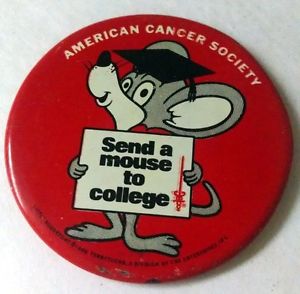
Another major project that always provided lots of laughs was “Send a Mouse to College.” Tuition for one mouse was 51 cents. I Googled just recently to learn what this project was all about because I had forgotten. The project provided mice for cancer research. The conversation online was heated ranging from blasting the American Cancer Society for animal cruelty to blasting them for taking advantage of little school children who merely wanted the glory of raising the most money but who did not understand “the ugly truth.” Oh man! And here I thought we were advancing medical science. Seriously, having lost both parents to cancer, I am glad for any advancement in research for prevention and cure.

Like all clubs at Cradock, Kappa always entered a float in the Homecoming parade. My house was the designated “float” house. Every year I rearranged the lawnmower, paint cans, and old screens in the garage to make room for our creation. I could never be sure if my parents were glad for the cleaning or annoyed at hosting a houseful of giggling girls night after night. At any rate, my parents survived three homecoming floats.

In my day, tissue paper carnations were the main ingredient of a float. Yes, we made tissue flowers from either Kleenex or toilet paper by stacking and folding several at once like a fan, then tying them in the middle with wire or string, and finally separating the layers of tissue to form the carnation.

We had the technique down, but Kappa was never a winner in the contest for outstanding floats in the Homecoming parades. Here are the floats that were made in my garage:


Club the Cavaliers: In 1966, having a real live person on the float was frowned upon. Ironically enough, this Flintstone-esque cave with cavegirl was one of our best efforts.
Time Slurps On: How cutting edge and current was this? The Slurpee was the hottest icy refreshment brand new to the area in 1967. The 7-11 even donated the cups dotted around the sides of the float.


Hats Off to Alumni: Oh what a mistake that was! The Homecoming theme was “Alumni Roundup.” We thought making a cowboy hat in hip 60s colors and then WALKING it through the streets of Cradock would be a winner. But the hat never took on the right shape, and obviously the color just made it look like a big cake. The worst of it though was that the frame was way too heavy for the Kappa girls who volunteered to carry it. One girl even quit half way through and crawled out.

Oh well. We had a good time just the same.

Don’t keep your knickers in a knot; put the kibosh on that kerfuffle; keep a hold on your Kinkajou and Kangaroo; kick up your kilt; knit a kerchief.  And whatever you do, key up for the A to Z April Challenge.

© 2016, Wendy Mathias. All rights reserved.

Tuesday, April 12, 2016

A to Z April Challenge: J is for James Hurst Elementary School

Genealogists and family historians get a lot of satisfaction from chasing their ancestors’ stories. Finding a diary, a message on a postcard, or a photo with a name attached is like the sun coming out after a storm. One day we will be somebody’s ancestor. We need to leave our descendants a little bit of sunshine too. So here is my story told alphabetically, not chronologically: Growing Up in Cradock.

is for James Hurst Elementary School.

This is where I went to school in grades 1 through 4. It was right across the street from where we lived, so needless to say, I walked to school.

At the beginning of each school year Momma bought me new shoes and a new book bag. I remember 3 pairs of saddle oxfords: navy and white, brown and white, and finally black and white which to me were the REAL saddle shoes making me wonder why I kept getting the blue ones and the brown ones – what was wrong with Momma anyway?  In later years, I came to realize that being
from Pinterest
slightly different from the pack was her thing; she never wanted what everyone else had.

image from Etsy - no known restrictions
That would also explain why my lunchbox was different from everyone else’s too. No square lunchbox for me. It was a red plaid oval just like this one that sold recently on Etsy. Just looking at that picture conjures up the aroma of lunch as the lid finally popped open after my fingers walked around the edges prying it open. The shallow tray typically held a napkin and sometimes a cookie if an apple took up too much room down below. These were the days before juice boxes, so I could buy a milk ticket (they were red, I think) with 5 punches on it (or was it 10?). Those of us buying just milk could grab a carton and head to the front of the line. Kids who bought lunch could buy a lunch ticket (they were yellow, I think). I bought lunch sometimes. Cafeteria rolls were the best. Can I get an AMEN?

I have wonderful memories of creative and nurturing teachers like Miss Wiggins, Mrs. Newman, Mrs. Daughtry, and Mrs. James, and of learning to play the flutophone in fourth grade. On the downside, it was the age of the Cold War when we had bomb drills requiring us to go into the hall, get face-down on the floor with knees under us and our heads against the wall. I doubt we understood or knew to be more afraid than we were. It was just another drill, like a fire drill only inside. School as usual.

On Saturdays and in the summer, any thoughts about bombs and fires dissipated. James Hurst provided 15 acres of playground for my friends and me.

Jungle Gym
from wikimedia commons
Monkey Bars
from wikimedia commons
It had multiple sets of the requisite recess equipment like jungle gyms and monkey bars. One time I got myself stuck sitting on top of the monkey bars. Unsure where to place my hands and what to do with my legs then dangling below me, I began to panic as I realized I might actually get hurt if I did something wrong. I don’t remember with whom I was playing that day, but she ran home to get her dad to come get me down. Probably out of sheer embarrassment, I figured out how to get down by myself before her dad could get there.

James Hurst also had lots of paved surfaces perfect for roller skating. The front of the school boasted a large “porch” and “patio” plus wide sidewalks leading to the street. A flagpole in the middle practically demanded we skate around it several times before shooting back onto our straight path.

photo courtesy of "I Grew Up in Cradock" Facebook Group
There were steps on 3 sides around those columns.
The width of sidewalk in front of the steps extended from at least
the 2 windows on either side of the front doors.

But it was the wide open space and all the trees that captured our imagination. Along Ericcson Street was a row of trees and a ditch formed by exposed roots.
From Google Maps
along Ericcson St.

In the photo snips from Google Maps, it appears the ditch has been filled in, but its ghost is visible in the shallow stretch. In the 1960s, that ditch was considerable – in some places at least an 18 inch step-down into the “rooms” of our imagined houses.  Some of the roots formed our sofas, and flat edges of the ditch became the stove in our kitchens. My favorite tree had a group of roots that worked as steps going down into my living room. At other times we moved out of the ditch and swept pine straw to outline the walls of a much bigger house.

from Google Maps

Beyond this Homecoming Parade you can see the concession
stand with the scorekeeper's box above it,
the dugouts, and  the bleachers.


The back corner of the school ground held the baseball field, home of Cradock Little League. Since I lived right across the street, it was easy to watch a game right from my front porch if I wanted to. But the concession stand with its tempting treats made me a steady customer night after night. Lime or cherry snow cones. Big Towns. Mary Janes and Pixie Stix.

Living so close to the ball field had one drawback though: people constantly rang our doorbell and asked permission to use our bathroom. Apparently portable toilets were not common enough, available enough, or cheap enough for a group of volunteers to provide in those days.

In the mid-1970s the James Hurst I knew was torn down. A showcase of modern education when it was built in 1942, the school fell prey to rot and termites. A new showcase of modern education was built in its place, and safer playground equipment was installed. All that remains of the old building is the cupola and weathervane now positioned in front of the school, still the most recognizable symbol of James Hurst Elementary School.

BEFORE - the cupola is more visible in this photo
(AFTER below)
Cupola and weathervane in front of the new James Hurst Elementary School
Juggle your time and Jump, Jog, or Jaunt on over to the A to Z April Challenge for some Jovial Jottings of Journalists and Jokesters.

© 2016, Wendy Mathias. All rights reserved.

Monday, April 11, 2016

A to Z April Challenge: I is for Imagination

Genealogists and family historians get a lot of satisfaction from chasing their ancestors’ stories. Finding a diary, a message on a postcard, or a photo with a name attached is like the sun coming out after a storm. One day we will be somebody’s ancestor. We need to leave our descendants a little bit of sunshine too. So here is my story told alphabetically, not chronologically: Growing Up in Cradock.


is for imagination.

You have to admit it: I was pretty darn cute as a kid. But that cuteness extended beyond the adorable face with a dimple in my chin. I had an imagination that kept my parents on their toes.

Wendy Slade about 1953 Portsmouth, VA  http://jollettetc.blogspot.com
Wendy about 1953
at Grandma and Granddaddy Davis's house in Cradock

Like the time I toddled into the bedroom and asked Momma, “Who’s that man in the kitchen?”  Poor Momma, probably only 24 years old.  She was petrified.  She found a baseball bat or club or something and inched her way to the empty kitchen.   Did I make this man up?  Or was there really a stranger in the house?  Momma never knew for sure, but since there were often “hobos” riding the rails through Charlottesville, she believed he was real.

Or like the time I told Momma there was a kitty cat under the bed.  Momma did not like animals in the house, particularly cats.  She looked and looked but found no cat. 

Or like the numerous times they had to set the table for 4 to accommodate my imaginary friend, Bobby Cox.  (No, not the coach of the Atlanta Braves – he hadn’t been invented yet.)  They always wondered if Bobby Cox was a boy or girl.  I don’t know either.  I have no memory of any of this, just their repeated stories amidst laughter.

Yep, adorable.

Wendy Slade probably Easter 1953 at Violetta Davis Ryan's house Harrisonburg, VA   http://jollettetc.blogspot.com
Wendy probably Easter in Harrisonburg, VA 1953

If you are so inclined, you can inspect other imaginative and innovative blogs at the A to Z April Challenge.

© 2016, Wendy Mathias. All rights reserved

Saturday, April 9, 2016

A to Z April Challenge: H is for Handwriting

Genealogists and family historians get a lot of satisfaction from chasing their ancestors’ stories. Finding a diary, a message on a postcard, or a photo with a name attached is like the sun coming out after a storm. One day we will be somebody’s ancestor. We need to leave our descendants a little bit of sunshine too. So here is my story told alphabetically, not chronologically: Growing Up in Cradock.

is for Handwriting.

At James Hurst Elementary School, cursive writing was taught in the third grade. From third grade on, I practiced beautiful penmanship. Neat and precise formation of letters with the proper slant and appropriate loops took practice. We were given special paper designed to encourage the best habits. Two solid lines separated by a dotted line marked the boundaries of parts of both capital and lower case letters.
 
from wikimedia commons
To say I enjoyed our lessons in writing cursive is an understatement. I absolutely LOVED it. My heart raced when Mrs. Daughtry came around with the practice paper. I was determined to learn to write well.

For some strange reason, my mother saved this page from a fourth grade history assignment. 

Wendy Slade history assignment example of cursive http://jollettetc.blogspot.com

I don’t know whether it was because of the beautifully phrased answers to my teacher’s questions or pride in my pencilmanship. After all, I had been writing in cursive less than a year.

Looking at the page from my Nifty notebook (see the holes at the top of the page, not the side), I can only bemoan the loss of control over pen and paper. I managed to produce lovely writing all through public school, but when I went to college, my handwriting deteriorated rapidly. I blame my professors. Taking lecture notes furiously day after day completely undid all that good practice.

Now educators are debating whether to even bother teaching cursive since no one writes anymore. Schools are equipped with computers and iPads. Credit cards and debit cards have erased the need to write a check. I have made purchases by signing my name on a vendor’s phone. The signature might look nothing like my real signature, but apparently it does not matter.

If cursive writing goes the way of the slide rule, how will our descendants read documents we leave behind and those of ancestors before us? They are hard enough for us who are used to cursive to read right now.

Here are just a few samples of the handwriting of some of my ancestors:

A letter from my great-grandmother
Mary Theresa Sheehan Killeen Walsh
to her daughter Helen

My great-grandmother Sudie Rucker
signed my mother's autograph book

from a letter from my 2X great grandfather James Franklin Jollett
to his daughter (my great-grandmother) Mary Frances Jollett Davis

"Good by your father J F Jollett
Mrs. Mollie Davis"


Hop, hurdle, or hustle to the A to Z April Challenge for Hundreds and Hundreds of posts on the letter H, and that’s no hyperbole!

© 2016, Wendy Mathias. All rights reserved

Friday, April 8, 2016

A to Z April Challenge: G is for Games

Genealogists and family historians get a lot of satisfaction from chasing their ancestors’ stories. Finding a diary, a message on a postcard, or a photo with a name attached is like the sun coming out after a storm. One day we will be somebody’s ancestor. We need to leave our descendants a little bit of sunshine too. So here is my story told alphabetically, not chronologically: Growing Up in Cradock.

is for Games.

For someone who had so many potential playmates in the neighborhood, I was just as content playing alone. I would play Solitaire until I won. If I won too soon, I would go ahead and play again.


Pick-up Sticks is actually a competitive game. Momma would sometimes sit and play with me, but if she were busy, I challenged myself. It’s a simple game, but critical thinking and hand-eye coordination were crucial to success. Trying to pick up a stick without moving any of the others was just as much fun alone as with a competitor.

Image from wikimedia commons

Image from wikimedia commons
Jacks was probably my go-to game on those days when friends were not available. I’m an honest girl. I play fair. I followed the rules for Onesies, Twosies, Threesies, Foursies right on through Tensies. The challenge was to get through the rotation without having to start over.

Learning to entertain myself was certainly a benefit of growing up in the 1960s. I am still content to be alone never at a loss for something to do. My new game? Find the Ancestor.


Gee, can’t get enough?  Then gallop over to A to Z April Challenge for a glimpse at more glorious grins and giggles.

© 2016, Wendy Mathias. All rights reserved

Thursday, April 7, 2016

A to Z April Challenge: F is for Friends on Frailey

Genealogists and family historians get a lot of satisfaction from chasing their ancestors’ stories. Finding a diary, a message on a postcard, or a photo with a name attached is like the sun coming out after a storm. One day we will be somebody’s ancestor. We need to leave our descendants a little bit of sunshine too. So here is my story told alphabetically, not chronologically: Growing Up in Cradock.

is for Friends on Frailey Place.

Growing up in Cradock in the 1960s was magical. I know that sounds like an exaggeration of how special it was or like selective memory. But trust me – it was the best place and best time to be a kid.

I have written several times about my childhood, so I am trying NOT to repeat. If you have nothing better to do, you can read more HERE and HERE.

On one single block called Frailey Place were 7 houses, 9 if you count my grandparents’ house and the Loudens’ who actually faced Gillis but cornered on Frailey. Six of those 7 had kids around my age and my sister’s age to play with.

Anne, Mary, Peggy, and me in dress-ups
Next door were the Allen girls, Peggy, Mary, and Anne. Mary was probably my closest friend on the block. We usually played outside in her yard, or my yard, or even my grandparents’ yard. Seldom did we play in Mary’s house, but I remember when Mrs. Allen let us play in the attic. There was great stuff in the attic, but the star was a child-size roll-top desk; even after we closed the door to the attic at the end of the day, thoughts of that desk stayed with me, and I longed to be able to climb the stairs to the attic again.

Mrs. Allen is the one who gave Mary and me the idea of playing with boxes, shoe boxes, to be precise. We created rooms and furnished them with furniture crafted from match boxes, jewelry boxes, spools of thread, and whatever else we could find. Each box became a different room. We could arrange the boxes in whatever formation we liked. The funny thing is that once we created the rooms, we rarely played with them. The fun was in the creation.

Mary Jollette and Rusty 
Next to the Allens was the home of Peggy and Rusty Taylor. Their mother Nancy was our mother’s best friend, and very much a second mother to my sister and me. Peggy and I were not very close because she was a few years older and always off to the stables to ride her horse. But she was right there to help me with my bug collection for science class. We had to collect 50 different bugs. ICK. Peggy helped me find and capture them. I didn’t mind watching them suffocate in a jar, but when it was time to pin them to a slab of Styrofoam, I was hopeless. Peggy to the rescue.

Peggy’s younger brother Rusty was my sister’s best buddy. They were always together. Rusty even cut her hair.


Nancy, my mother, and Rusty getting the croquet game set up

Debbie Ellis, Mary Jollette, Donna Cummings
Directly across the street from the Taylors was the Cummings house. When I played with Katherine I always wanted to play with her little pink kitchen set. This was not the child-size kitchen; it was doll-size. The little refrigerator door opened to little shelves; the inside of the door revealed a picture of the food to spark a child’s imagination. The oven door opened as well to racks that could hold a miniature tart pan. The red plastic spigot on the sink could turn. I had nothing like this. Katherine also had a good selection of paper dolls, which delighted me because I loved playing with paper dolls. One of Katherine’s sets that I can still see in my mind’s eye was an unusually large baby paper doll, the size of an actual baby doll. The baby paper dolls and their baby paper clothes were colored in the sweetest pastels with lots of detail. You could almost feel the lace and satin ribbon, but they were paper.

Katherine’s younger sister Donna was smack dab in the middle age-wise between me and my sister. It could have been awkward having her as a playmate, but she was always easy going and would just go along with whatever the plan of the day was.

Mr. and Mrs. Cummings were like parents to the rest of us too. I can still see Mrs. Cummings standing at her screen door watching all the Frailey Place kids running, skating, and bicycling up and down the road. Looking back, I have to smile knowing there was someone watching out for all of us. As they say, "It takes a village," and on Frailey Place, we kids had many parents.

Over the years, the Frailey Place gang have attended the funerals of each of our parents. We are still Facebook friends even if not social in the traditional sense. The bond formed so many years ago has not been broken.

For more Frivolity, Fantasy and Fun, do yourself a Favor and Find your way to the A to Z Challenge

© 2016, Wendy Mathias. All rights reserved