Showing posts with label Stephen Slade. Show all posts

Sunday, October 10, 2021

Sentimental Sunday


My grandaunt Helen Killeen Parker died 11 Oct 1980.

Helen Parker 1957

My grandaunt Catherine Walsh Barany was born 12 Oct 1909.

Cat at home in DC

My great-grandfather Stephen Slade died 14 Oct 1928.


My great-grandfather John Fleming Walsh died 15 Oct 1918.

The only known photo of John F. Walsh
(these 2 chips are about 1")

My grandfather Orvin Davis died 16 Oct 1963.

Granddaddy and me 

Wendy

© 2021, Wendy Mathias. All rights reserved.

Tuesday, June 1, 2021

52 Ancestors - MILITARY: Stephen Slade in the Florida Wars

On Memorial Day when we honor those who served our country during the Civil War, Spanish-American War, World Wars, Korean Conflict, Vietnam, and Iraq, we view them as heroes who gave their all. There were some lesser-known wars too, like the Mexican War in 1846 and the Florida Wars, also known as the Seminole Wars.  If anyone even thinks about – or even knows about – the soldiers who fought in the Florida Wars, today’s attitudes and standards would likely prevent them from thinking of those soldiers as heroes.

from Wikimedia Commons
produced by US Marines - in public domain

My 3X great-grandfather Stephen Slade was such a soldier when Florida was just a territory. While Florida’s muster rolls and enlistment records are not complete, it appears that at least by the age of 20 Stephen Slade did what the territory required: enroll in the local militia. The militia were the forerunner of today’s National Guard, civilians who volunteer for military service in the event of war, civil unrest, or natural disaster.

All able-bodied WHITE men between the ages of 18 and 45 were expected to join and attend required drill sessions. Postmasters, clergy, teachers, and judges were exempt. Officers wore uniforms like those of the US Army, but non-officers wore whatever they had and provided their own weapons.

The 1816 Springfield Musket was the most popular weapon
of the soldiers at that time. It had a range of 100 yards
and was not very accurate. 

The number of militia units grew as tensions escalated between white settlers and Native Americans in the 1820s and 1830s. A series of military conflicts came to be known as the Seminole Wars. Stephen Slade was just a toddler during the First Seminole War, 1816-1819. That is the period when Spain agreed to give up Florida to the US after it could not defend the territory against rebellions. A treaty required the Seminoles to leave northern Florida and confine themselves to a reservation in central Florida.

It was during the Second Seminole War (1835-1842) that Stephen Slade was of age to be called into action. This war was the result of the Indian Removal Act of 1830 which was the government’s attempt to force the Seminoles to leave Florida altogether and move west of the Mississippi. 


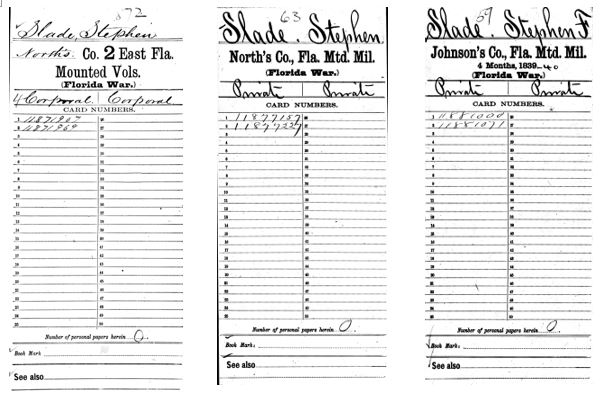
On 2 January 1835, Stephen Slade enlisted in McLemore’s Mounted Company. In May the following year he enlisted in Colonel John Warren’s Regiment, another mounted company. In January 1837 he was a private in North’s Co 1 of Warren’s mounted regiment but in June he was a Corporal in Co 2 of the East Florida Mounted Volunteers. 

This company was formed under the Act of Congress 23 May 1837 which allowed the President to accept the services of volunteers and to raise regiments of Dragoons, or Mounted Riflemen. At the time, the Company consisted of fifty-one privates, three officers, and eight non-commissioned officers which included the rank of Corporal.

After that Stephen Slade returned to serving as a private, still in a mounted company, under officers Lewis Norton and later Captain Hall.


Early on despite being outnumbered, the Seminoles managed to hold on by using guerilla warfare. The Army and militia responded by destroying Seminole farms and villages. By the 1840s, most of the Seminole population had either been killed in battle, died from starvation and disease, or relocated to Indian Territory. Only a few hundred were allowed to remain in an unofficial reservation.

An uneasy peace between White settlers and the Seminole lasted 13 years. When the Third – and last – Seminole War began in 1855, there is no sign that Stephen Slade took part.

I do not know what battles Stephen Slade saw during his time in the militia, but the Second war cost the lives of 1,500 soldiers, mostly from disease. More than 40,000 regular military, militia, and volunteers served in that war which cost as much as $40,000,000. There is no record of the number of Seminole killed in action or how many died from starvation and disease.

If you want to learn more about the Seminole Wars but don’t want to read VOLUMES, here are some good sources:

Florida Seminole Wars Heritage Trail    

Seminole Wars 


Amy Johnson Crow continues to challenge genealogy bloggers and non-bloggers alike to think about our ancestors and share a story or photo about them. The challenge is “52 Ancestors in 52 Weeks.

Wendy

© 2021, Wendy Mathias. All rights reserved.

Wednesday, April 21, 2021

52 Ancestors - DNA: Quandry


This past week a blog was highlighted in our 52 Ancestors group on Facebook. The writer had used a clue from her DNA test to break down a brick wall. Oh, how I envy her. My dad’s DNA test results just created trouble, and now I don’t know how to feel about it.

It turns out that a non-paternal event means that he carried Calhoun DNA rather than Slade. Correspondence with two men who match my dad’s DNA exactly helped me trace the Calhoun lineage. While I think I know at which generation the event occurred, I cannot be absolutely sure. I feel obligated to care, but I don’t. I am much more interested in the Slades – my father, my grandfather, HIS father – the Slades from Georgia and Florida, the ones who raised the Stephen Slade whose wife and son left Florida and came to Virginia. Those are MY people, not the Calhouns no matter what DNA they carried with them.

Therefore, I continue to search for the father of my oldest known Slade, my 3X great-grandfather Stephen Slade who was born around 1815 in Georgia and then died in Florida after 1870.

Every census for the oldest Stephen is consistent with his birth details. In looking for a potential father for him, I noticed that the Slade name did not even appear in Georgia until the 1820 census. Prior to that, the Slades were either in North Carolina or in the New England states. The best candidate for Stephen’s father is William Slade who first appeared in the 1820 Telfair County, Georgia census.


This William was between 26 and 45 as was one female, most likely his wife. There were three children under the age of 10 – 2 boys and 1 girl. One boy would have been Stephen. Since the children were so young, I will estimate the ages for William and his wife at 30 and 25.

In 1830, there was no William Slade in Telfair, but there was one in nearby Dooley with a family that resembles that of 1820. William was 50-59, a woman was 40-49, and the boys were 15-19. There was no daughter, but perhaps she had married. Or maybe it’s not the same family at all.

In the late 1820s and early 1830s, there was a William Slade who purchased land in Gadsden County, Florida, near Tallahassee in the panhandle. 

Just one of eight patents 

A study of the Georgia and Florida maps shows that Dooley and Telfair counties are in the southern half of present-day Georgia, almost in a direct line to Gadsden, Florida. Of course, that is no proof that the purchaser of 8 patents is the father of Stephen Slade.

Dooley is yellow; Telfair is olive green
both are in the south-central area

Florida Panhandle

The geography makes sense though. Madison County where Stephen made his census debut is just two counties away, east of Gadsden County. Lafayette County borders Madison on the south.

When William purchased land in Florida, did he ever actually move to what was to become the Sunshine State? In 1840, there were two William Slades – spelled Slaid – still in Dooley, Georgia and one in Washington County, Georgia, but none in Florida.

From 1850 on, it becomes rather cumbersome to track the William Slades because Georgia and Florida were both overrun with men named William Slade.

I fear that my Slade genealogy will come to a screeching halt right here. No probate records have been found for any of my presumed Slades in Florida. This is where DNA could be helpful, but without a male Slade to test, I am out of luck. The Slade men that I know all have Calhoun DNA.


Amy Johnson Crow continues to challenge genealogy bloggers and non-bloggers alike to think about our ancestors and share a story or photo about them. The challenge is “52 Ancestors in 52 Weeks.

Wendy

© 2021, Wendy Mathias. All rights reserved.

Tuesday, January 19, 2021

52 Ancestors - NAMESAKE: Name Pairings


I understand why families like to honor a father, a grandfather, even a great-grandfather by bestowing the elder’s name upon the newborn son. What I don’t understand is why some names seem to follow some families but not others. Probably everyone has a full supply of men named James, William, and John in the family tree. I sure do. But what about Leonard? Or Stephen?

The name Leonard shows up ONLY in my Davis line. No Leonard Jollett. No Leonard Rucker. No Leonard Eppard. No Leonard Slade, Walsh or Morrison.

Stephen shows up only in Slade. No Stephen Jollett. No Stephen Davis. No Stephen Rucker. No Stephen Eppard.

And it’s not JUST MY family. “Leonard” was apparently a popular name for Davis boys born in the 1760s. A Boone family genealogy claims there was a Leonard Davis born in Pennsylvania. Another claims a Leonard Davis who was a veteran of the French and Indian War. Another tells of Leonard Davis who died in Kentucky in 1817.

There are a number of men named Leonard Davis who fought in the Civil War; some were Confederates while others hailed from Vermont. Texas, Oklahoma, Illinois, Missouri, California – they all have a Leonard Davis. There are Leonard Davises in England and in Canada. Obviously, they are not all named for MY Leonard Davis.

What is it about the name Leonard that goes with Davis? Is it a natural pairing like apple pie and ice cream?

And what about Stephen paired with Slade? In my research, there are basically 2 Slade camps: the New England Slades and the North Carolina Slades. Both were crawling with Stephens from the beginnings of our country. Still are!

The Carolina Slades likely are the ones who had a few stragglers that wandered on down to Georgia and finally Florida where my oldest confirmed Stephen Slade lived and died. He had a son named Stephen and a grandson named Stephen. “Honor thy father” – I get it.

But what about all those other Stephen Slades that seem to have no connection to mine? Can we all trace our lineage to THIS Stephen Slade who was buried in Somerset, England 1 April 1607?

from Somerset England
Church of England Births, Baptisms, Burials
1531-1812, Ancestry

I realize there is probably no logical explanation for this phenomenon, but it is thoughts like these that keep me up at night. 

Amy Johnson Crow continues to challenge genealogy bloggers and non-bloggers alike to think about our ancestors and share a story or photo about them. The challenge is “52 Ancestors in 52 Weeks. 

Wendy

© 2021, Wendy Mathias. All rights reserved.

Saturday, August 8, 2020

Sepia Saturday: On Track and Off


Sepia Saturday challenges bloggers to share family history through old photographs.


This week’s Sepia Saturday challenge depicting an electric tram or cable car got me to thinking about my great-grandfather’s death certificate.
 
Death certificate for Stephen Slade
father of my paternal grandfather
The cause of death was hypostatic pneumonia resulting from a crushed pelvis sustained when he was struck by a streetcar.

I thought surely such an accident would have made the newspaper, but it didn’t. However, the news reporters were all over the story in March 1899 when a prominent citizen of Portsmouth, Virginia was killed by an electric car when he was out shopping for ice for his sick wife. As the headline said, he was “Horribly Crushed.”
 
from Virginian-Pilot 4 Mar 1899
Details of the accident reveal that he did not die on impact. In fact, there was plenty of time to call a number of doctors to his aid. They all looked at the mangled mess and shook their heads knowing there was nothing to be done.
from Virginian-Pilot 4 Mar 1899

Mr. Peed was conscious and implored those surrounding his couch to turn him over, that he was suffering excruciating agony. He knew well those who were about him and called them by name, and especially did he ask to move his legs that he might sit up.

But that was impossible, for he had been horribly mutilated, his lower abdomen being crushed and that part of his body from the waist to just below the hips was in a state horrible to behold and terrible to contemplate. His head, too, had sustained awful wounds, around which the bruised blood had settled. Just over the right forehead a ghastly looking puncture presented itself, looking as if a three-edged weapon had been used with great force.

I wonder if my great-grandfather’s injuries were anything like this.

Bystanders reported that the accident might not have happened had the victim not been deaf. They described what they saw:
from Virginian-Pilot 4 Mar 1899
A prominent Crawford street merchant said he heard some one hallowing for a distance, it seemed to him, of a square, and then looking down the street, saw the car strike Mr. Peed, pass over his body, and then, as if being released from the current, again pass over him, by a backward motion.
Another gentleman made no effort to conceal what he knew, and was positive that the fender of the car struck Mr. Peed, threw him against the end of the car, and he fell, and the car passed once over his body forward, and then again backwards. The wheels of the right hand half of the front truck passed over Mr. Peed.  

What a horrible scene! But because I am so immature, I can’t help focusing on the unfortunate man’s even more unfortunate name: Peed. OK, I am sure PEED was a fine family name. It probably is a variation of PEAT. I wonder if the name had German origins. Before spelling became more standardized, court clerks recorded what they heard. In my family, the German accent resulted in the name “Ebert” morphing into “Eppard.” Maybe that happened in Mr. Leroy Peed’s family too.

The Peed name is common here in the Hampton Roads area of Virginia. My mother used to tell the story about a talent show or recital, I have forgotten which, that she attended as a young adult. The emcee who introduced each performer announced, “Next, Martha Sue Peed at the piano.” We all laughed at that story – immaturity is a family trait.

As a teacher, my mother one year had a class with two students with unfortunate surnames: Buzzard and Sweat. I wonder how people put up with jokes on their name. I would be pronouncing them “Byu ZAARD” and “Sweet.”

When I was a teacher, I worked with a fine gentleman who was an outstanding teacher of grammar and literature: Mr. James Butts. When I left teaching to stay home with the kiddos, I was replaced by another outstanding English teacher: Mr. Marvin Fanny. Butts and Fanny – same department, same school. What stars aligned for that to happen?

I went off track this week. (Pun intended.) 

Get back on track with more street car adventures at Sepia Saturday.

Wendy
© 2020, Wendy Mathias. All rights reserved.

Tuesday, July 16, 2019

52 Ancestors - CHALLENGING: Those Pesky Slades


Slade Research, Why do I hate thee?

Let me count the ways:

1. The Slades of Georgia and Florida did not leave much of a paper trail. No death records. Certainly no birth records. Even a professional genealogist that I hired in Florida found precious little.

2. The Stephen Slade households of 1850, 1860 and 1870 are a mess making it nearly impossible to trace forward.

  • Only Stephen and supposed daughter Julia remain consistent.
  • Are Mary and Margaret the same person? Surely Margaret and Peggy are, despite the illogical difference in age from one census to the next.
  • Were James and Mary Stephen’s children or perhaps his siblings or other relation? Mary was too young to be their mother, that is, if her age was recorded correctly.
  • Peter and Pilester? Male OR female? Same? Different? I can find NO Peter Slade OR Pilester after their initial appearances. And what kind of name is Pilester, anyway?
  • Cabel was possibly Louiza and back to Cabel, from Male to Female and back to Male. However, there is a marriage record for Cabel Slade and Charles Ross, suggesting she was female all along. Then there is the sale of land by Julia Slade and Emma C. Ross. Emma Cabel Slade Ross? Emma Cabel Louiza Slade Ross? What the heck???
  • And what happened to the others? I don’t see them after the initial entry either.

3. My recent Slades are not SLADE at all. Three PERFECT matches and one genetic distance of 1 say they are CALHOUN. I never know where to put my research time. Should I concentrate on the Slades?  They were the legal family after all. Besides, it’s possible the oops-gotcha son might never have known the truth. Or should I concentrate on the Calhouns since that is where the DNA came from? If so, where do I begin since none of my matches seem to know which Slade woman and which Calhoun man (although I THINK I know).


Amy Johnson Crow continues to challenge genealogy bloggers and non-bloggers alike to think about our ancestors and share a story or photo about them. The challenge is “52 Ancestors in 52 Weeks.

Wendy
© 2019, Wendy Mathias. All rights reserved.

Tuesday, January 15, 2019

52 Ancestors - UNUSUAL NAME: Cabell Slade


According to census records in Florida, Cabel or Cabell Slade is either my second great grandaunt or second great granduncle. 

Yeah.

In the 1850 Madison County census and 1870 Lafayette County census, Cabel is listed as a male. 
 
1850 Federal Census Madison County, Florida  

1870 Federal Census Lafayette County, Florida

However, in 1874, there is a marriage record in Lafayette County for Miss Cabel Slade and Charles A. Ross. 

State of Florida
Lafayette County
To a legal authorized minister of the Gospel, Justis of the Peace or Judge of account.
Greeting
These are therefor to authorize and permit you to solemnize the writes of matrimony between Charles A. Ross and Miss Cabel Slade and make a return to my office within 10 days Then bering no seal of office I have hereunto set my hand & [Privat?] seal this December 23rd AD 1874.
R. P. Langston
Clerk of Court

State of Florida
Lafayette County
I hereby cerify that I have this day executed the above License this December 25th AD 1874.
Z Bees
M [Minister] Gospel
Recorded December 28th 1874
Lafayette County, Florida, Circuit Court, Marriage Record Book A: 1857-1874, Cabel Slade, Marriage License; Florida State Archives, Tallahassee; microfilm 152-MF002
  
When the census taker came around, did Stephen and his wife SAY Cabell was a male or did the census taker just assume so? 

And what about 1860?  No Cabell is mentioned.  However, there is a Louiza who is the same age as Cabell would have been, but no Louiza in 1850 or 1870.  Was Cabell really Cabell Louiza Slade or Louiza Cabell Slade?  

It’s possible.

Or so I thought until the sale of Stephen Slade’s land in Lafayette County in 1885. The sellers were Julia Slade and Emma C. Ross. It seems probable that the “C” stood for Cabell.

Whatever Cabell’s story is, she seems doomed to obscurity. What I have said here is ALL I know. One would think with a marriage in 1874, there would be census records at the very least to add. Alas, not even in 1880.

With a common, NORMAL, acceptable and sensible name like “Emma,” how did the Slades come up with a name like “Cabell” for a sweet baby girl born in 1848? I do not have an answer, but I did a little research on the name. Several sources say it was a French name meaning “rope.” Historically it was a boy’s name that reached its popularity around 1915 and has been declining ever since - no blips, no short resurgence of popularity, just a straight line to its new low.

I had to click on A LOT of baby name websites even to find “Cabell” as a girl’s name. There is very little information except a speculation that it is a variation of “Campbell,” a fine Scottish name. Hmm - maybe there is a clue to the Slade family heritage. Slades were supposedly Welsh, but without a maiden name for Stephen’s wife Margaret, I do not know the full story.

The name “Cabell” was strange-sounding to me, a new name I had never heard of. How did the writers of the television show “Bull” come up with the name “Cabel” for the character Cabel McCrory, the resident computer expert played by Annabelle Attanasio? Despite being written out of the show, will her popularity spark a new wave of little Cabells dressed in pink?


Amy Johnson Crow continues to challenge genealogy bloggers and non-bloggers alike to think about our ancestors and share a story or photo about them. The challenge is “52 Ancestors in 52 Weeks.

Wendy
© 2019, Wendy Mathias. All rights reserved.

Monday, June 18, 2018

52 Ancestors: Effie Times Two


This week’s 52 Ancestors in 52 Weeks theme is “Same Name.” For YEARS I have known my father’s paternal grandmother as “Mary Effie Morrison Slade.” We always thought it was funny that her sister was also named Effie, Effie Mae to be exact. As young wives and mothers, Mary Effie Morrison Slade and Effie Mae Morrison Hanrahan lived next door to one another at 416 and 418 Randolph Street in Portsmouth, Virginia.

Mary Morrison Slade https://jollettetc.blogspot.com
Mary Morrison Slade
at her son Fred Slade Sr's house
7 Tanner Place, Portsmouth, VA
My research into my dad’s side of the family has been sporadic; results have been little. Brick walls aplenty! It’s time to shine the light on Mary “Effie” Morrison Slade.

Census records indicate that Mary Morrison was born about 1878 in Tennessee. However, I cannot find her there in 1880. By 1900 she was already married to my great-grandfather Stephen Slade and living in Princess Anne County, now Virginia Beach. Virginia has made death records available online, but OF COURSE Mary Morrison’s is not there! Fortunately, her sister’s is. Effie’s daughter Frances Evelyn Hanrahan Williams named her mother’s parents as Robert Morrison and Evelyn Hosier.

When searches for Robert and Evelyn together came up empty, I tried searching for them separately. Robert Morrison produced just too many hits, so I tried Evelyn Hosier. There was nothing promising there either as most of the Evelyn Hosiers were an older Evelyn married to a man named Hosier.

I have had good luck with birth records at FamilySearch, so I tried my hand with “Effie Morrison.” BINGO. Up popped “Effa Morrison,” born to Robert Morrison and NOT Evelyn BUT Cornelia F. 

from FamilySearch

Then all these little Morrison children popped up: Emma, Kate M., an unnamed Male child, and Rosa V. But no Mary Effie. All were born in Norfolk, Nansemond County, Virginia. Not a one in Tennessee.

Did the Morrisons move to Tennessee for a short period and then return to the same spot in Virginia? That does not seem reasonable to me.

The only time Robert and Cornelia Morrison appear in a census together is 1880 with one child: Kate M.  Could this be my Mary Morrison? Was she Katherine Mary? Mary Katherine? Mary Kate? Not Mary Effie at all? I cannot help thinking that since those other children were registered, surely Mary would have been also.
 
1880 Western Branch, Nansemond Co, VA
Another argument that Kate M could be Mary is that there is no other sign of Kate after the 1880 census. The other children all died in infancy, and their deaths are listed in the death index on FamilySearch. Had Kate died, certainly her death would have been noted as well.

A recent reminder to review old notes was spot on in pointing out the obvious. I went to Find-a-Grave to double-check Mary Morrison Slade’s death date on her tombstone. Whoever created the memorial posted her name as “Mary Cornelius Morrison Slade.” If I were a betting gal, I would bet they meant “Cornelia.” Then when I looked again at census records, I saw she was entered as “Mary C. Slade.” I had always assumed the “C” was the result of either enumerator error or error in transcription. Now I have a new thought.
 
Tombstone of Stephen Slade and Mary Morrison Slade
Olive Branch Cemetery, Portsmouth, VA
photo courtesy of Steve Poole
While I will not say conclusively “case closed,” I have corrected my database replacing “Mary Effie” with “Mary Cornelia.” Still, my gut feeling is that she and Kate were one and the same. Maybe “Kate” was just a cute nickname.

While I’m tossing out theories, here is another one in answer to the question, “Why did Effie’s daughter Frances Evelyn think her grandmother’s name was Evelyn Hosier?” I imagine she was told she was named after her grandmother. In Frances Evelyn’s mind, that must have meant the name “Evelyn.” In the birth and death records of her children, Cornelia Morrison was always listed as Cornelia F. In 1860, there was no Cornelia Hosier but there was a Frances, age 8, living with parents Richard and Sarah, and a passel of siblings. In 1870, Cornelia age 17 was in the household, but no Frances. Her name was apparently Cornelia Frances Hosier. Not Evelyn.

Wendy
© 2018, Wendy Mathias. All rights reserved.