Saturday, June 6, 2020

Sepia Saturday: Woman at the Window


Sepia Saturday challenges bloggers to share family history through old photographs.


There is nothing remarkable about this week’s Sepia Saturday prompt featuring a woman near a window. Yet surprisingly it tricked me into noticing in how many photos my grandaunt Lillie Killeen was positioned near a window.

Lillie Killeen at work https://jollettetc.blogspot.com
Lillie at work 1942

Lillie at Aunt Helen's 1966 https://jollettetc.blogspot.com
Lillie at Aunt Helen's house 1966

Lillie at Tangier Island 1973 https://jollettetc.blogspot.com
Lillie visiting on Tangier Island 1973

I have written about Lillie several times HERE and HERE. Today I want to share two funny stories about her.

The Potted Plant
While her sister Helen Killeen Parker was away, Lillie looked after the things at the house. She faithfully watered the flowers and plants, even the ones inside. However, one of the healthiest-looking potted plants was actually made of SILK. (We’ve all been fooled like that, right? Right??)

Oven Bags

In my early married life, the Reynolds Oven Roasting Bags were all the rage. Everyone was thrilled to be able to roast a chicken or turkey in one. Turkey came out juicy. A pot roast was perfect and the vegetables were not mushy. When her friends touted the benefits of cooking in a bag, Lillie wanted to get on board. So she got a plastic bag, added a nice roast, and popped it in the oven. Only it wasn’t a legitimate roasting bag, just a regular ol’ plastic bag. The results were exactly as you’d expect.

Now I don’t mean to sound like I’m laughing at her. Well, ok, yes, I am. It’s a funny story. However, I do not mean to imply she was stupid. I think she was a victim of her age and changing technology much like people of my generation struggle to adjust to the world of computers and social media. Keeping pace is often a challenge.

Lillie as a young girl https://jollettetc.blogspot.com
Young Lillie
When I look back at Lillie, I do not see a silly old woman tripped up by technology. I see the caregiver. Lillie was the first of 9 children born to Mary Theresa Sheehan Killeen Walsh, 6 with John Joseph Killeen and 3 with John Fleming Walsh. She was probably always charged with taking care of SOMEBODY.


Lillie with John Holland 1917 https://jollettetc.blogspot.com
Lillie with Mae's baby John 1917

She doted on her sister Mae’s children.


She traveled from Virginia to New York to help a cousin who had just given birth.

Lillie in New York 1917 https://jollettetc.blogspot.com
Lillie in New York 1917
Lillie in New York 1920  https://jollettetc.blogspot.com
Lillie in New York 1920
Even the doors have windows


Whenever her sister Helen entertained, Lillie was right there at her side making sure everyone was served and taken care of. My sister is just like that. “Lillie Jr” rattles around in the kitchen preparing food and filling glasses for everyone, rarely taking time to join in the fun herself. I have to tell my sister, “OK, Lillie, you can sit down now.”
 
Lillie at Helen's house 1977 https://jollettetc.blogspot.com
Lillie 1977 at Helen's house
The window on the world is open at Sepia Saturday.

Wendy
© 2020, Wendy Mathias. All rights reserved.

Wednesday, June 3, 2020

52 Ancestors - WEDDING: The Honor of Your Presence or Presents


My grandaunt Helen Killeen must have had a lovely wedding. The invitation was embossed, not merely printed, on cream-colored card.
 
Helen and Herbert's wedding invitation https://jollettetc.blogspot.com
3 Nov 1927 Thursday morning wedding
Helen Martha Killeen and Herbert Webb Parker
For someone who saved a gazillion pictures of herself and friends at the beach and on camping trips, I am puzzled by the total absence of even one single wedding photo. With no photo of the actual ceremony or reception, I must wonder if Aunt Helen wore a wedding gown or a nice suit, if she carried a bouquet or wore a corsage, if she had a number of bridesmaids or just one witness. Judging by the formality of the invitation and the list of gifts in her wedding gift book, it must have been a beautiful event with many guests.
 
Helen's wedding gift book https://jollettetc.blogspot.com
The wedding gift book lists 65 gifts and guests
Some of Helen's wedding crystal
Pattern: Rose by Fry Glass
I have enjoyed researching the names of the guests in search of family connections and stories worth telling. But what I love best, though, is the list of gifts she received. Bedspreads and dresser scarves. Silver. Glassware. Those were the days. I doubt anyone asks for silver these days. Likely no one requests pickle forks, oyster forks, lettuce forks, preserve spoons or tomato servers, no matter what they are made of.

Helen and Herbert received lots of glassware: 3 dozen sherbet glasses, 18 goblets, 18 ice tea glasses, a couple sandwich plates, a couple mayonnaise bowls, some cut glass pickle dishes and sugar bowls, and any number of colored glass bowls. I was the lucky recipient of her water pitcher and matching sherbets, goblets, and ice tea glasses – not all 72 pieces though. I wonder if she exchanged some of the gifts. Who needs 36 sherbet glasses?


Amy Johnson Crow continues to challenge genealogy bloggers and non-bloggers alike to think about our ancestors and share a story or photo about them. The challenge is “52 Ancestors in 52 Weeks.

Wendy
© 2020, Wendy Mathias. All rights reserved.

Saturday, May 30, 2020

Sepia Saturday: Landlady


Sepia Saturday challenges bloggers to share family history through old photographs.


This week’s Sepia Saturday photo of a man digging a hole brought to mind photos I have shared before of the construction of an apartment building. With inheritance from her father and probably a bank loan, my grandaunt Violetta Davis set her sights on financial independence by building a home that would generate rental income too.
Construction of Violetta Davis Ryan's apartment building 1935 https://jollettetc.blogspot.com
Jacob Conrad's crew preparing to lay the foundation
at 473 South Mason St, Harrisonburg, VA

It was 1935. Violetta was a school teacher and principal. She hired J. W. Conrad & Son Contractors and Builders for the job. The plans called for 5 apartments. She would live in one and rent the others. Her early renters included faculty at Harrisonburg Teachers College (now James Madison University – GO DUKES!) where she was also on the staff as supervisor of student teachers.
Framing the basement https://jollettetc.blogspot.com
Framing the basement
Violetta supervising the construction of her home https://jollettetc.blogspot.com
Violetta supervising the construction of her home.
I wonder if that is Jacob Conrad on the 2nd floor in dress shirt and hat
or the man Violetta is talking to.
Violetta's home 473 South Mason St Harrisonburg, VA  https://jollettetc.blogspot.com
The finished product. The center door opens to a common hall
and stairs with doors to the apartments on the left and right.
Decorative iron grates below the first floor windows hide the fact
that there are basement windows too. 
Back view of the apartment building https://jollettetc.blogspot.com
The back of the building soon after completion
In 1936, Violetta married Virgil “Dick” Ryan. He was a business man, an entrepreneur, who owned a news stand and bowling alley. Newspaper articles indicate he had a good eye for opportunity. Whether it was HIS idea or Violetta’s to add on to the apartment building in 1937 is anyone’s guess. In several news articles about the building boom in Harrisonburg, the Ryans were named among owners and contractors who were building or remodeling.
Report of permit to remodel Daily News Record 25 Mar 1937 https://jollettetc.blogspot.com
Apparently the Ryans spent $20,000 to add an apartment
to the 473 South Mason Street building
from the Harrisonburg Daily News Record 25 Mar 1937

Evidently this is when Violetta’s apartment building went from 5 apartments to 6 when the attic was converted into a one-bedroom apartment.
Back view with attic apartment after renovation 1937 https://jollettetc.blogspot.com
The attic apartment 
While Violetta was the OWNER of the apartment building, Dick seemed to be the manager, if the rental ads are any indication.
 
from Harrisonburg Daily News Record 22 Jun 1940
from Harrisonburg Daily News Record 31 Jul 1940
Dick died young in 1941 and Violetta remained on her own the rest of her life. Whatever she learned about business from her husband she put to good use. In 1950, she purchased another apartment building just down the street. She always referred to it as “the Hartman house.” I never understood the significance of that name until a search in NewspaperArchive turned up an obituary for Roy S. Hartman. It turns out Roy’s wife was Dick Ryan’s sister. That means Roy was Violetta’s brother-in-law.

In 1940, Roy and his wife Edna lived in this apartment building. Google images show it is now a typical college apartment building looking rather worn. However, it used to look much neater. 
"Hartman House" from Google Maps
The summer before my senior year in college, Violetta offered me the attic apartment. It was CUTE. Those windows facing the street were in the living room OR possibly a bedroom, depending on how a renter would use the big open area just inside the entrance to that apartment. The renters at the time placed their beds in what more logically seemed like a kitchen-living room combo. Anyway, it was a cute apartment but I opted for the convenience of campus life.

Between Violetta and the Hartmans lived Edgar Sipe and family. According to the 1930 and 1940 censuses, their home was a single-family home, but I remember it as two apartments because Barry and I lived upstairs from 1975-1976. It was also one of Violetta’s properties but I have been unable to determine when she purchased it. Mr. Sipe died in 1943, so sometime after that, for sure.
 
"Sipe House" from Google Maps
We entered through the door on the left which opened to a landing
where we hung our coats before going up the stairs.
This apartment was HUGE. I wish I had pictures. While the 2 bedrooms were large with good closets, and the living room boasted those beautiful windows, and the eat-in kitchen had a real pantry, it was the bathroom I remember best. It had BLACK tile around the tub, black and white mosaic floor tiles, and the original pedestal sink. It was so pretty, but honestly, I never wanted black tile after a year of cleaning that bathroom. It really showed lint and dust.

Apartments were not the only properties Violetta invested in. She also owned a building that she referred to as “the store building,” whatever that meant. For a time, she rented it to John Edge for his piano and guitar business.

from the Harrisonburg Daily News Record
6 Jun 1959
Violetta was very much a woman with a head for business. And it all started with digging a hole.

Make your way to Sepia Saturday to see what others have dug up for this week.

Wendy
© 2020, Wendy Mathias. All rights reserved.

Wednesday, May 27, 2020

52 Ancestors - UNCERTAIN: John Fleming Walsh


One thing I am certain of: I am UNCERTAIN who the parents were of my great-grandfather John Fleming Walsh. To be honest, I think he probably was UNCERTAIN as well.
 
John Fleming Walsh https://jollettetc.blogspot.com
The only photo we have of John Fleming Walsh
2 chips from a cabinet card about 1-inch square
The few documents that include John Walsh’s parents are consistent. In an index of marriages, he claimed his parents were Patrick and Mary Walsh.
 
from an index of marriages in Portsmouth, VA
Those same names appear on his death certificate.
John Fleming Walsh death certificate https://jollettetc.blogspot.com
John Fleming Walsh death certificate
That sounds pretty definite. So why can’t I find the family in a census?

John Fleming Walsh was born about 1868. According to the 1910 census, he was born in Virginia and both parents were from Ireland. That matches the information on his marriage record. Yet there is no Patrick and Mary Walsh with a son John in the 1860, 1870 or 1880 census in Virginia.

Thinking maybe John Fleming Walsh was wrong about his place of birth, I expanded my search. The Patrick and Mary Walsh families in Massachusetts did not add up because the son John was much too old. One Patrick and Mary Walsh in Minnesota came close with a son John almost the right age but he was born in Canada. Just to be sure, I traced the families but found no John Walsh who lived in Virginia and married Mary Theresa Sheehan Killeen.

Allowing alternate spellings of Welsh, Welch and Weltch produced no good matches either.

When I searched for John Walsh born 1868 with a mother named Mary Walsh from Ireland, I found a very strong possibility. The 1870 census for Norfolk, Virginia shows Maria Walsh from Ireland as the head of household along with children Catherine (b 1856), Mary (b 1860), and John (b 1867). There were two boarders from Ireland and two from Virginia.
 
snipped from 1870 Federal Census, Norfolk, VA
The logical conclusion is that Maria (or MARY) was a recent widow, so I looked in the 1860 census for Mary Walsh born in Ireland about 1830. There she was with a daughter Kate – common nickname for Catherine - born 1856. The husband was there too, but it wasn’t Patrick. It was John.
 
snipped from 1860 Federal Census, Norfolk, VA
John? OK. It is possible his name was John Patrick or Patrick John. Wanting and NEEDING to learn more about John Walsh’s whereabouts, I made him my focus. Unfortunately, there is no death record online.

There are some Navy enlistment records. W. John Walsh born 1830 in Ireland enlisted in the Navy October 1857. Then John W. Walsh born 1829 in Ireland enlisted October 1856. Both negate any thoughts that John and Patrick were the same person.

There are several records of a John Walsh in the Norfolk Naval Hospital during the Civil War. In 1863 John Walsh was treated for fever due to exposure to malaria while on the Mississippi River. In 1864 John Walsh/Walch was admitted to the Naval Hospital for phthisis, which was a form of pulmonary tuberculosis, ironically the same cause of death recorded for John Fleming Walsh in 1918.

The Registers of Patients at Naval Hospitals 1812-1934 include 3 men named John Walsh who were discharged during the Civil War: one from the USS Sassacus, one from the USS Para, and one from the USS Hartford. These were all Union ships. At first I thought it was unlikely someone living in Virginia would fight for the Union, but there were many who did. Besides, if any of these John Walshes were the same ones who enlisted in the mid-1850s, he would have had no choice other than desertion, I suppose.

ALTERNATE THEORIES
Could John Fleming Walsh have been simply mistaken about his father’s name? After all, he was fatherless as a toddler. Could he have lied about who his father was? I was struck by the presence of 2 men named Patrick in the Walsh household: Pat Jacobs in 1860 and Patrick Gilford in 1870. I have other non-paternal events in my family line, so one more would not be a surprise. Perhaps John grew up with Patrick being LIKE a father, the only father-figure he ever knew. Just a thought worth pursuing.

Unfortunately, my pursuit was rather fruitless.

Pat Jacobs, a blacksmith, was born about 1839 in Ireland and was 7 years younger than Mary. He most likely is not anyone that John Fleming Walsh would have viewed as a father figure because Pat Jacobs showed up in 1865 in New York. He was still a blacksmith, married, and a father to a 3-month old. The same family continued to live in New York.

Patrick Gilford, on the other hand, was close to Mary’s age. He too was from Ireland. Unfortunately, the policeman is MIA in records after 1870 although there are plenty of men named Patrick Guilfoyle in New York.

Without more to go on, the identity of the parents of John Fleming Walsh is STILL UNCERTAIN. When the COVID-19 quarantine lifts, I must schedule a trip to the Library of Virginia.


Amy Johnson Crow continues to challenge genealogy bloggers and non-bloggers alike to think about our ancestors and share a story or photo about them. The challenge is “52 Ancestors in 52 Weeks.

Wendy
© 2020, Wendy Mathias. All rights reserved.

Saturday, May 23, 2020

Sepia Saturday: Car Under Cover


Sepia Saturday challenges bloggers to share family history through old photographs.


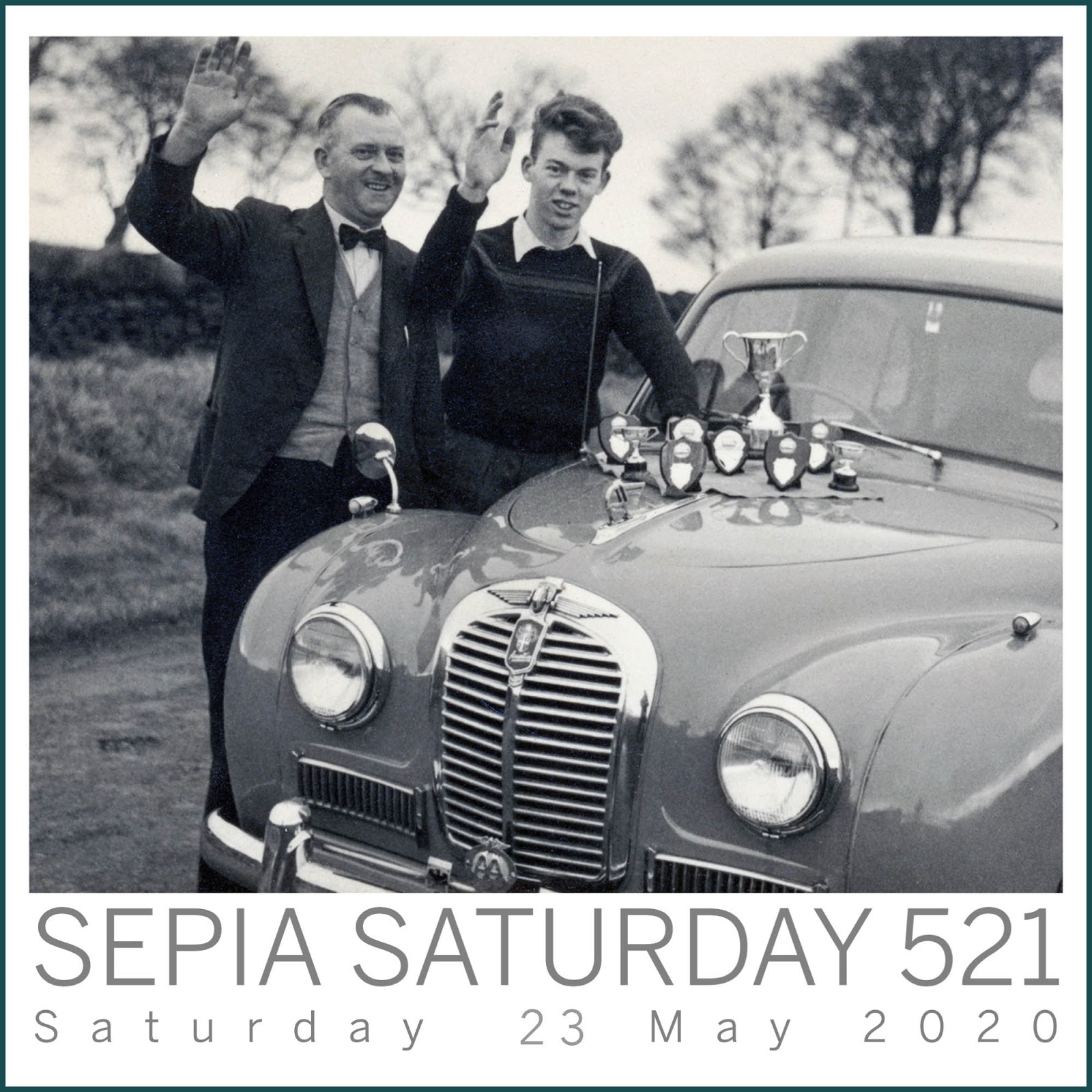
I could not help noticing all the trophies displayed on the hood of the car in this week’s Sepia Saturday photo prompt. With nothing new to add to a post about trophies written in 2013, I decided to apply a broader interpretation: stuff on the hood of a car.
 
Unknown Shenandoah, VA early 1920s https://jollettetc.blogspot.com
Photo in scrapbook of Velma Davis Woodring
This is just another of the gazillion photos in my “UNKNOWN” file. The original is in a scrapbook belonging to my grandaunt Velma Davis Woodring. The driver LOOKS like Velma, but the older Velma I knew in the 1960s when she was in her 50s. This photo was taken much earlier, probably in the mid-1920s when she would have been a teenager. The boys are strangers to me. The place? Probably somewhere in the town of Shenandoah, Virginia.

So what were they up to? Why did they have those branches all over the hood? The boy is in shirt-sleeves, so it’s doubtful they were gathering evergreen boughs for Christmas decorating. They look HAPPY, so it’s doubtful they had just crashed into a tree.

Not much to say here. So, like the gentlemen waving in the prompt, I’ll bid adieu.

Please visit the award-winning bloggers at SepiaSaturday.

Wendy
© 2020, Wendy Mathias. All rights reserved.

Wednesday, May 20, 2020

52 Ancestors - TOMBSTONE: Masons

John F. Coleman
Coverstone Cemetery, Shenandoah, VA
Mitchell and Reba Coleman Morris
Coverstone Cemetery, Shenandoah, VA
Lester and Mabel Floyd Marsh
Fort Hill Memorial Park, Lynchburg, VA
Russell and Edith Rucker Bumgardner
Coverstone Cemetery, Shenandoah, VA
Otto "Jack" and Margaret Killeen Sprott
Forest Lawn Cemetery, Norfolk, VA
What do the tombstones of some of my distant relatives have in common?

Each one contains the symbol of the Masons, a fraternal organization that traces its origins to the fraternities of stonemasons in the 14th century. The Masons controlled the qualifications for membership in a masonry craft guild and how stonemasons would interact with customers.

The most identifiable symbol of the Masons is an architect’s tools: the square and compass. The symbol may or may not include the letter “G.” The letter has several interpretations: God, Geometry (considered the noblest of sciences), Great Architect of the Universe.

The Masons are often viewed with suspicion. Some say they are a cult in opposition to Christianity. Others view Masons as a serious group eager to do good in the world.


Amy Johnson Crow continues to challenge genealogy bloggers and non-bloggers alike to think about our ancestors and share a story or photo about them. The challenge is “52 Ancestors in 52 Weeks.

Wendy
© 2020, Wendy Mathias. All rights reserved.

Saturday, May 16, 2020

Sepia Saturday: In His Own Write


Sepia Saturday challenges bloggers to share family history through old photographs.


This week’s Sepia Saturday photo of 3 gentlemen enjoying a pint in a car lot made me wonder about the back-story. Was this a business meeting? Were they winding down after work? Perhaps they were college chums planning a class reunion. That is something my dad might have done as a member of the Portsmouth Cavalier Club of the University of Virginia. Most large cities had a version of the Cavalier Club for socializing and networking.
 
Portsmouth Cavalier Club of UVA 1950 https://jollettetc.blogspot.com
Fred Slade on the top row, 2nd from right
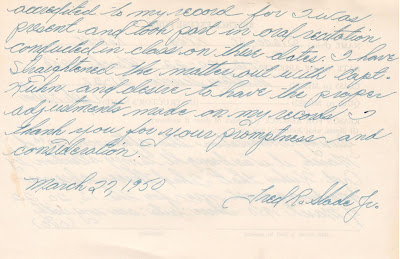
Apparently, that was not the only “club” my dad joined while a student at UVA. The boxes of STUFF retrieved from my grandparents’ attic after 70 years contain clues to a time in Daddy’s life that I knew nothing about. The first hint was this Absence Excuse Form that he filled out on March 27, 1950. His instructor Captain Kuhn had accused him of missing 3 classes in Military Science. Daddy argued successfully that he had been present and even participated in oral recitation.
Absence Excuse Form Military Science class UVA 1950 https://jollettetc.blogspot.com
Front
Absence Excuse Form Military Science class UVA 1950 https://jollettetc.blogspot.com
Back


Military Science??? What? Why was he studying Military Science? What did that have to do with earning a degree in Economics?

Surprise aside, I love seeing my dad’s handwriting – that distinctive capital F and lower-case e. And the polite formality of his tone – that is FRED SLADE all day long.

Then there are these letters to the love of his life – my mother, by the way – sent from Fort Eustis, an Army training facility between Williamsburg and Newport News, Virginia. His return address is written boldly covering the entire reverse of the envelope:
Envelope from Fort Eustis https://jollettetc.blogspot.com

Yes, ROTC. Who knew? Not me. 

I also did not know he called my mother “George.” 
Envelope to Mary E Davis aka George https://jollettetc.blogspot.com

Oh, to learn the story about that!

In his letters, Daddy tells a little about his life as a cadet.


We have had a rather easy week compared to that of last week. The hours are just as long but the work it is less of a grind on a body. I wish to goodness it was over and past and I was home. I dispise this dern mess, if it wasn’t for the fact of loosing the $27 per month next year and having to listen to the yaking from Julia & Co I would quit and curse George Kuhn (Capt.) to high hell and back. He is the only real S.O.B. I have ever met and I ache to tell him so!
NOTE: Yes, the same Capt Kuhn that reported Daddy for missing 3 classes. I suspect Kuhn had the same low opinion of Cadet Fred Slade.
“Julia & Co” – Julia is his mother; “& Co” could be his father OR the string of Julia’s many sisters


Well, they, the government, are about to scare me out of my boots. If the jerks start a war, I be dern if I wouldn’t croak! This is a heck of a place to be in such a crisis. The General is quite up on his toes and our program is going to be more emphatic etc. & so on. They gave us some big “Cock & Bull” Story about the importance of our position and told those who may be fortunate enough to go home to take advantage of it and enjoy our weekend for the future is so unstable 

and unpredictable etc. The officers who lecture to us are so witty, its always “Fellow Officers,” instead of gentlemen as it was last week before the Korean incident.
Still get plenty of laughs in during course of a day. What a simple bunch of tools we have at this place. (There are a few exceptions)

I can hear him. No matter the nature of an experience, whether it was a happy time or a fearful one, he relayed it with a mix of philosophical reflection and sarcasm. And laughter. He would have been laughing while writing.

The college yearbook for 1950 confirms that Daddy was in the First Year Advanced Class of the Army ROTC. While there was also a First Year Basic Class, maybe his time in the Coast Guard had qualified him for the Advanced Class. As his letter indicated, he joined for the money probably supplementing the $75 he was already receiving through the Veterans Administration.

The Battalion History on UVA’s website clarifies some of what Daddy wrote about in his letters. The ROTC program at UVA was only a year old when he joined. It was started in response to the Cold War. The detachment was part of the Transportation Corps. The cadets attended summer camp at the Army Transportation Center at Ft. Eustis where they trained on trucks, ships, locomotives, and other types of equipment. There were over 500 members of the Army ROTC battalion at UVA during the 1950s.
I doubt Daddy stuck around for a second year of ROTC. He and “George” got married. While Momma worked in the Bursar’s Office, Daddy was a full-time student taking temporary jobs here and there driving a cab or working at a snack bar. I think that’s what it was. However, there are no bits of paper in the attic treasures to say.

Pull up a chair and pour yourself a pint as you enjoy more stories and old photos at Sepia Saturday.

Wendy
© 2020, Wendy Mathias. All rights reserved.