My aunt Beverly Slade ("Aunt Betty") and my father Fred Slade
I do not know the occasion for which Daddy wore a boutonniere and posed with his little sister outside their home in the Cradock Gardens community of Portsmouth, Virginia.
In March 2020, when COVID-19 was just taking hold here in
Virginia, I received an email from the most recent owner of my grandparents’
house in Portsmouth. She was installing new insulation in the attic and
discovered several boxes of STUFF that belonged to my parents and grandparents.
One of the most confusing “treasures” is this order book.
Order Book
It is about 6” wide and 14” long with a soft cover. The pages
are arranged with columns that probably allow for entries of debits and
credits. However, the entries look nothing like what a storekeeper or other
businessman might record. Flanking a mysterious series of numbers are on the
left a date including day of the week and on the right a name.
I believe this is the record book of a Bookie. Soooo, who
was the Bookie in the family?
Steve and Catherine 1936
I know of one for sure – Steve Barany, husband of my
grandaunt Catherine Walsh Barany. However, this book probably was not his. For
one thing, Steve and Cat divorced. When she moved in with her sister, it is not
likely she brought Steve’s belongings with her. For another thing, most of the
items in the attic were from my mother’s side of the family, not from my father’s
side except for a few books and souvenirs of his college life.
There is nothing familiar in the handwriting to help
eliminate someone or point to another. However, some of the names entered in
the book point directly to my father’s father, Granddaddy Slade. There are MANY
listings for Morrison, the same surname of Granddaddy’s mother Mary Morrison
Slade. I searched several of the other names on Ancestry for clues connecting
them to my grandfather. Many names came up as possible neighbors or at least
people in the close geographical area.
My dad's parents: Julia and Fred Slade Sr
Could my sweet granddaddy have been taking illegal
gambling bets on boxing matches, horseracing, baseball games, football games,
cock fights and who knows what else?
Frankly, yes. He had been in prison for tax evasion and moonshining,
so illegal gambling probably fit right into his wheelhouse.
I have tried to make sense of the numbers, but knowing
nothing about figuring the odds and placing bets prevents me from presenting
anything intelligent here. This is what I see:
The left page is almost always marked “Day” while the
right page is marked “Night.”
The wide column contains 3 sets of numbers, mostly
3-digit but some 2-digit numbers. In every instance the 3rd number is
the difference when you subtract the 1st number from the 2nd
number.
The last number is always 4 digits. The round numbers suggest
maybe they represent money, dollars and cents without a decimal point.
Another point of interest is that the entries are in
blocks of roughly a week with each day carefully dated. It occurred to me that
maybe the last number is the payout; however, every person has a number in the
column. If the last number was a payout, there were no losers. That seems
illogical. The last number must mean something else.
I don’t know why, but I decided to divide the 3rd
number by the last number. In every weekly group, the “answer” within that week
is almost the same. For example, 111 divided by 2220 is .05, as is 154 divided
by 3080, and 93 divided by 1860. Does that mean the payout was .05 percent? Was
Granddaddy’s fee .05%? See – I’m not a gambler, much less a Bookie.
Suddenly I noticed a pattern in the Day and Night
entries. Looking across the corresponding day from day to night, I noticed that
the second number during the day became the first number at night. The night’s
second number became the next day’s first number. And so the pattern repeated
through the week.
Repeating pattern of numbers in the Day and Night sides of the book
So just what am I looking at?
Amy Johnson Crow continues to challenge genealogy
bloggers and non-bloggers alike to think about our ancestors and share a story
or photo about them. The challenge is “52 Ancestors in 52 Weeks.”
I grew up knowing that my parents were proud of me. I
never heard them say, “We are SO proud of you, darling daughter” but I knew it.
I felt it. Proof is in the things they saved from my childhood: a silly
handprint on a paper plate; a 4th grade history assignment answering
questions about Sir Walter Raleigh; a homemade valentine card. When my mother
and I were both teaching English, she asked to use my poetry unit.
Mary Morrison Slade great-grandmother
That is why I was shocked to hear that my
great-grandmother (my paternal grandfather’s mother) was not proud of her
children. What a sad statement.
I can understand her disappointment in three of her sons Fred,
Lester, and Richard – a.k.a. Buck. Fred and Lester had several run-ins with the
law and even served time for running bootleg whiskey across the state line from
North Carolina to Virginia during Prohibition. As head of the “bootleg
syndicate,” as the newspaper called it, Fred was also found guilty of tax
evasion and was duly punished.
A good 10 or more years younger than his brothers, Buck
was probably not involved in bootlegging. If he was, his name was never
mentioned in the newspaper. But he was no saint.
In 1935 Buck gave his mother another crime to worry
about. Buck and his friend Lloyd Martin stole a car. For some unstated reason,
they entered the backyard of Mrs. Gladys Wilkins which led to a confrontation
with some men checking them out. Buck and Lloyd left but returned only to be
met by the police who ordered them to leave.
What did Buck and Lloyd do? They fired 5 gunshots into
the house, at least one of which went into a young boy’s bedroom. They also shot
the windshield out of a patrol car during the high-speed chase through the city
which ensued when the policeman called for back-up.
Then just like a scene in a cop show on television, Buck
and Lloyd lost control of the stolen car and drove into a ditch. They fled but
were quickly apprehended.
Buck and his pal were charged with grand larceny for
stealing a car and felonious shooting into the Wilkins’ residence.
from Virginian-Pilot
20 Aug 1935
These reports in the newspaper are difficult for me to
comprehend because when I knew the Slade brothers, they were big, lovable men.
All were married, had good jobs, and were loved by their children, their
sisters, their in-laws. Even today family members share stories about them and
laugh about some of the funny things they did. There must have been some good
in them that their mother missed.
Amy Johnson Crow continues to challenge genealogy
bloggers and non-bloggers alike to think about our ancestors and share a story
or photo about them. The challenge is “52 Ancestors in 52 Weeks.”
Sepia Saturday challenges bloggers to share family
history through old photographs.
I was surprised to find a perfect match for this week’s
Sepia Saturday prompt featuring a man wearing his dog.
Burlington Cab Company 1956 Julia Slade and friends
The photo was taken at my grandparents’ home and taxi cab
yard in 1956. That is my granny leaning on one of the cabs. I suspect the man
holding the dog was a driver, but I do not know for sure. Maybe they were just
friends of the family.
I like dogs. I don’t want a dog. I don’t want to walk
them. I don’t want to vacuum up their hair. I don’t want to follow along behind
them with a plastic bag and a scoop. I don’t want to have to bother with boarding
them so that I can leave town. But I do like dogs. Other people’s dogs.
Me and a dog probably 1952
This is one of my favorite pictures. That’s me with a
dog. I don’t know whose dog it was or where this picture was taken. I like this
picture so much that it is one of the few of me in a frame. I’m not even sure
why I like it. Maybe it’s that vintage bottle or the way I was strapped into
the seat with a towel or blanket or possibly a cloth diaper. Maybe it’s those
little fists. Oh, maybe it’s the dog!
Apparently, dogs like me.
Granddaddy Slade and George Moore's dog
Here is my paternal grandfather
with his brother-in-law’s dog. When our family visited my dad’s Aunt Margaret
and Uncle George Moore, the dog watched over me while I napped. No one could
get near me until I woke up. Good dog!
My grandparents used to laugh telling a story about me
and their neighborhood dogs. We lived in Burlington, North Carolina a short
while when Daddy was helping out with his parents’ taxi business. I would
gather all the dogs on the steps to our house to play school. Even after we
moved back to Virginia, the dogs showed up faithfully, at least for a while
until they got the hint. (Hmm, I wonder if the dog on that man's shoulders was one of my students.)
See – I really do LIKE dogs, but this is the only dog I
need.
Planter - need a plant AND a new spot in the yard
For some good ol’ shaggy dog stories, visit Sepia Saturday.
Sepia Saturday challenges bloggers to share family
history through old photographs.
This week’s Sepia Saturday prompt features a pretty snappy
bar well-stocked with spirits, seltzer bottles, and a variety of cocktail
glasses. It looks like the kind of place where many of my family - both living
and dead - would have spent a pleasant hour or four.
You might say that my family has had a long love affair
with alcohol, both legal and illegal. According to family legend, my father’s
maternal grandfather John Fleming Walsh was a descendant of the Walsh family
that produced some brand of Irish whiskey. However, I cannot find any
connection. During the Civil War my great-great grandfather James Franklin Jollett produced spirits and paid taxes on it. At the tail end of Prohibition,
my paternal grandfather Fred and his younger brother Lester got themselves into
trouble over it.
Yes, trouble. BIG trouble.
Lester was arrested for bootlegging in 1929, but in 1930
he was cleared after claiming to have been just an innocent passenger in the
car when arresting officers raided the still near Blackwater Swamp in Southampton
County. But how innocent could he have been? Lester bore a purple scar on his
face, the unfortunate result of an encounter with an exploding still.
Brothers Busted!
Lester might have gotten by with it once, but in 1936 he
was not so lucky. He and big brother Fred were among the 23 arrested for
bootlegging. It was front page news. Headlines and lead paragraphs were
peppered with descriptions of the “rum ring” and “bootleg syndicate” as well as
claims of a “liquor conspiracy.”
The indictment charged the 23 with operating distilleries
in North Carolina, possession and transportation of liquor to Virginia going
back at least to 1933.
from Virginian Pilot 9 Jun 1936 Newspapers.com
Of the 23, only 12 including Fred and Lester went to
trial. Six were not apprehended. One pleaded “nolo contendere” (accepting
conviction but not pleading guilty). Four pleaded guilty and turned State’s
evidence.
Witnesses Paint an Ugly Picture
One of the key witnesses for the Government was Preston
Sawyer. He told the jury that his partners included Fred Slade, Lester Slade, Lloyd
Sundiez, and Millard Warren. In describing this “syndicate,” Sawyer said that
they had formed the group to prevent price-cutting in the bootleg business. They
were headquartered in several places in Portsmouth including a gasoline station
and a couple houses.
from Virginian Pilot 9 Jun 1936 Newspapers.com
Several witnesses confirmed that the liquor was bought at
$5-$7 per 5-gallon jug and then sold at $9. An occasional retail sale sometimes
brought in a higher amount.
Another important witness was George Roundtree who was
then serving time in the Atlanta penitentiary for bootlegging. He testified
that he had to quit the business because the “Portsmouth syndicate” (aka Fred,
Lester, and Millard Warren) had threatened to put him in jail unless he
purchased from them.
from Virginian Pilot 10 Jun 1936 Newspapers.com
Good grief, Granddaddy!
Case Goes to the Jury
The judge set 4 of the 12 free. The jury was left to decide
the fate of the remaining 8, including Fred and Lester. On June 13, 1936, the
headline read “Jury Hangs.”The judge
ordered a mistrial with instructions to try the case again. If the case
actually went to trial, it must have been ho-hum news because there is no
follow-up in newspapers available online.
HOWEVER, a week later my granddaddy and his “partner in
crime” Millard Warren were sentenced to 18 months in the Atlanta federal prison
for violation of the internal revenue laws on untaxed liquor. Alumni of the
Atlanta penitentiary include Al Capone and other Mafia figures, fraudsters
Carlo Ponzi and Frank Abagnale (portrayed by Leonardo DiCaprio in the movie
Catch Me If You Can), and actor Woody Harrelson’s father who murdered a federal
judge. Yep, Granddaddy was in fine company.
Does He Look Like a Criminal to You?
I have tried to make sense of all this, this other side
of the sweet man I called Granddaddy. The man I knew was a generous and kind
gentleman. He was always in a good mood, ever cheerful and positive. He carted
my granny and her sisters to the grocery store without complaint. Part of me
looks at the times - the Depression. It is easy to blame the economic struggles
he must have faced, but really, that is no excuse. I just have to accept that
sometimes good people do bad things.
Sepia Saturday challenges bloggers to share family
history through old photographs.
This week’s Sepia Saturday prompt shows a man standing
beside one of those 1930s-1940s cars that my family refers to as “jelly bean” or
“kidney bean” cars because of the bulbous shape.
Anyone who is obsessed with family history and challenged
by trying to identify people in unmarked photos has surely heard of Maureen Taylor, the Photo Detective. She is everyone’s go-to expert on finding clues in
old photos. With her instruction, even the casual family historian has learned
to pay attention to details like styles of clothing, use of props, and what the
photo is printed on.
In my best imitation of the Photo Detective, I decided to
try my hand (and eye) at dating photos by studying jellybean cars.
Photo 1
Wendy and a Nash Statesman Custom
Can you date a photo with just a partial view of a car,
specifically the wheel? Why, yes, you can. When I zoomed in, I could read
“Statesman Custom.” Hmm, not familiar. With the aid of Dr. Google, I learned it
was a Nash, an American car manufactured between 1916 and 1954, and then until
1957 after the creation of the American Motors Corporation. Since I know that
adorable child, I used those sturdy walking shoes and balancing fists to narrow
down the years the photo was taken to 1952 or 1953. Therefore, the car had to
be older than that.
Even someone who doesn’t know the child can date this photo if they pay close attention. As I studied wheel after wheel, I noticed that in early Statesman Customs, the model name appeared closer to the door, not over the wheel like in my photo. Then look what happened in 1952.
1952 Nash Statesman Custom
The folks
at Nash moved the model name over the wheel.
MY GUESS - 1952 (early 1953 at the latest)
Photo 2
The deckle edge is a sure sign that this next photo dates
between the 1930s and 50s, but the car will surely point you to the later years
of that range. Knowing these people made it easy to guess the make of this car
and year. My father was a Ford man, so I guessed his father was too. The grill,
the hill-shaped hood, the vented door window all cry FORD. My grandparents
never had much money, so I could not imagine they bought a new car very often.
Therefore, I started with 1949. However, from 1949 through 1951, the shape and
placement of the fog lights or signal lights did not match my photo. The 1952
Ford however introduced the propeller-looking light mounted on the edge of the grill
in a direct line below the headlights. But was it the Mainline, Crestline, or
Customline Ford? The answer probably lies INSIDE the car, but I will guess the
Mainline, certainly not Customline as my grandparents’ finances probably would
not have allowed it.
1952 Ford Crestline looks similar
to my grandparents' car
MY GUESS - 1952 or later
Photo 3
Glenn on Granddaddy's Buick
The ultimate “jelly bean” was my grandfather Orvin Davis’s
Buick. I do not know how many cars he owned in his lifetime, but I know this
Buick with its iconic VentiPorts and gunsight hood ornament was his last. It
was the car he chauffeured me and the neighborhood kids in to buy penny candy
at the drugstore. It was the car that carried us across the state every summer
to visit my cousins. As a child, I thought it was the biggest, heaviest, and
ugliest machine ever imagined. I was probably right.
But I digress - back to my
detective work. I tried zooming in to read the name of the model etched across
the grill. The best I can decipher is that the word is 5 letters, so that
eliminates the Roadmaster. It could say Super. It could say Eight. From what I
can tell, they were the same thing, but I find more photos showing “Eight,” so I
will go with that.
Cropped - small image from a large photo
Granddaddy's Buick
Since the 1948 Buick Super Eight had more of that jelly bean
shape with a semi-fastback style than Granddaddy’s car which had more
definition, his car probably dates after 1948. The metal strip on the
windshield seems to have been eliminated from the 1950 models. Therefore, it
seems likely the car was a 1949 model, and because I know the car was still
around in 1963, dating this photo more accurately will require studying the
little boy and his clothes. MY GUESS - 1949 model but photo around 1953
Photo 4
Violetta Davis and Dick Ryan
between 1935 and 1941
One last jelly bean car is this one. I confess it has
given me a fit. Knowing the people, I can say for sure the car dates before
1941 which is the year Violetta’s husband Dick Ryan died. The object of most of
my research was this wing-like rear fender. I compared cars from 1935 (they
married in 1936). Apparently that wing fender was popular among car
manufacturers.
The Chevrolet, Lincoln, and Buick had a rear fender most
like the one on Dick Ryan’s car.
Next I tried comparing the small rear window and exterior
spare tire holder. The search was hampered by the fact that most of the
pictures I found were of cars that have been restored by auto enthusiasts who
might have altered the exterior. But for the most part, most cars did not have
the same slope as Dick’s car.
Then I remembered I have another picture showing the
front of the car.
First two women are unknown
Violetta and her sister Velma Davis Woodring
Once again, like Dick’s car, the front fenders on the
Chevrolet, Lincoln, and Buick had the same gentle slope like a sliding board.
The other cars’ front fenders were more like a hill with a definite stop where it met the
running board.
Furthermore, the shorter length and VERY pronounced vent
on Dick’s car eliminated most of the contenders which had narrow vents and long
front ends.
But I could find no car with a vent like this one. The
very pronounced vent on the Buick seemed somehow related but not an exact
match. I was beginning to think the car rehab artists of today may have
substituted the vents. I put my research aside for another day.
Then BOOM - just like that, this picture popped up:
1935 Ford Slantback
Look at the side vents. Look at that slope and spare tire. This has to be the car.
And that led to this YouTube video.
It’s long with a lot
of talking. But I sat through it because my grandaunt and uncle had that car: a
1935 Ford Slantback which had NO TRUNK, by the way. The car in the video has not
only the very large vent but also the same molded lines around the window and
along the slanted back. One of the interesting features of this car shown in
the video is the ashtray that spins around like a revolving door. Violetta was
a smoker, so she probably liked that.
MY GUESS - 1935 or 1936
I am no Maureen Taylor, but studying the details of old
cars has been a fun little exercise for me. Admittedly, there was no new
revelation, no new connections to anyone, just little factoids to add to my
family history.
Sepia Saturday challenges bloggers to share family
history through old photographs.
For every family historian and genealogist, this week’s
Sepia Saturday photo of a tree is the iconic symbol of “the family tree” with
its roots to the past holding firm, its numerous branches spreading out in all
directions, and its individual leaves added anew every year. The title of this
post might then make you think you’re in for a snoozefest through the Slade
lineage. Not so.
Here is the only photo I have of my father’s paternal grandmother,
Mary Morrison Slade. She is standing in front of a Weeping Willow tree in the
front yard of my grandparents’ home in the community called Cradock in
Portsmouth, Virginia.
Great Grandmother Mary Morrison Slade mid-1940s Portsmouth, Virginia
Even though she died when I was 8, I have no memory of
her. She was probably extremely
debilitated by dementia and therefore my parents kept me from her. Apparently she had been that way for many
years. My dad said that even as a young man he often had to break a date to go
look for his grandmother when she wandered and got lost.
Mary Morrison Slade was widowed at the age of 49 in 1928,
the same year my dad was born. Often I have wondered how widows managed in the
days before it was common for women to work and have their own income. In 1930, Grandma Slade was
the head of household in a house she rented on Henry Street. One son, two daughters
and one son-in-law were there too. The only one with a job was the son-in-law.
In 1940 Mary was living at 416 Randolph Street. According to the 1940 census, this was the
same house where she lived in 1935, which tells me she had moved there between
1930 and 1935. Maybe the move was driven by finances because the house she
rented in 1930, just a street away, was $20 a month. The “new” house, which she
rented for $11 a month, was next door to her sister Effie and her husband Henry
Hanrahan.
from Wikimedia Commons This is NOT where Mary Slade worked, but it is a typical sewing project factory or workroom.
Grandma Slade, born in Tennessee, had completed 5 years
of school. During her married life, she
was always the wife of a farmer, but now she was a working woman employed in
the government-sponsored WPA sewing project. The specific job appears to be “Iron lady,” but the handwriting in the 1940 census is
unclear. Her statement that she was unemployed
for 65 weeks prior to March 1940 contradicts the statement that she worked 52
weeks in 1939 earning $780. She claimed no other source of income.
The Work Project Administration (WPA) was part of the New
Deal effort to put people to work. The
sewing project was specifically designed for women who were considered
unemployed heads of household either because they were widowed, abandoned, or
disabled. The sewing project was the
lowest paid position, but women received training in using sewing machines. They made clothing, bedding, and supplies for
hospitals and orphanages. Grandma Slade
is the first ancestor I’ve found who was employed under the New Deal.
I do not know where Grandma Slade was living when she
posed in front of the tree in my grandparents’ yard. The Weeping Willow
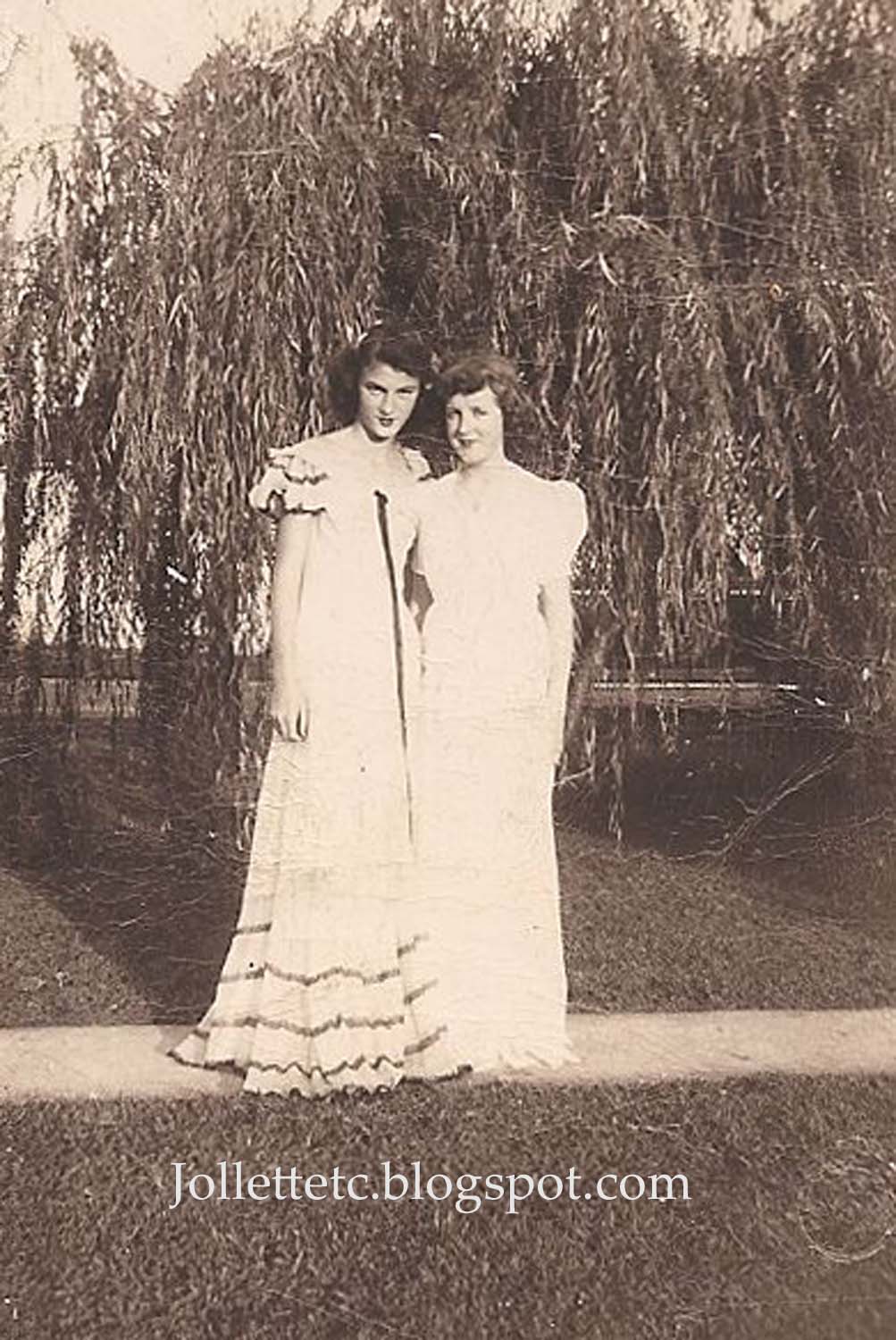
certainly made a nice backdrop for photos though. On the evening of my Aunt
Betty’s music recital, she and her friend Jackie posed there too.
Jackie and Betty
Don’t weep. There are many more stories and old photos of
trees at Sepia Saturday.
Sepia Saturday challenges bloggers to share family
history through old photographs.
Leo and Fred (my dad) 1937 (not quite the right age to be an altar boy yet!)
Like the three boys in this week’s Sepia Saturday photo,
my dad and his brother served as altar boys when they were young. That was in the 1930s at St. Paul’s Catholic
Church in downtown Portsmouth, Virginia. At that time they (and their parents)
were living with their grandmother Mary Theresa Sheehan Killeen Walsh, a VERY
Irish, VERY Catholic matriarch. She loved those boys and was determined to see
to it they were raised right. That meant they received a proper education at
the Catholic school and they served the Church. Likely most of the boys that
were in Daddy’s class at St. Joseph’s Academy were altar boys too.
The role of altar boy was an important one. He carried
the cross and processional candles; he held the book for the priest; he carried
the incense and censer; he rang the altar bell; he presented the bread, wine
and water to the priest, and he washed the priest's hands as well. The
altar boy was instructed thoroughly in all parts of the Mass and responded IN
LATIN to the priest’s prayers. He also joined in the chants of the liturgy. During
Mass, he displayed proper reverence at all times to set a good example for
the congregation to help them be more reverent too.
As an assistant to the priest, an altar boy was expected
to be well-behaved in general, not just in church.
But boys will be boys.
One day at school, Daddy and his friends held one of the
boys by his ankles and lowered him out the window to peek into the girls’
classroom below them. What was so enticing about that classroom to make little
boys risk life and limb is anyone’s guess. This adventure or prank – whatever it
was – was short-lived, however, because meanwhile upstairs in the safe confines
of the classroom, the boys were startled when the nun came back. Everyone knows
not to cross a nun, so there was nothing for the boys to do but let their
friend go. Drop him, they did, right into the bushes.
Oh to have been a fly on the wall that day!
Aunt Lil
As punishment, the boys had to remain after school with
the nun. When she realized she had to get to the bank, she made the boys go along
with her. Who did they run into but Aunt Lil, a maiden aunt who also lived with
Daddy’s grandmother. Daddy thought surely they would be in trouble now, but part
of being a successful mischief-maker is being a quick thinker. They told Aunt
Lil they were guarding the nun because she was carrying money. Apparently sweet
Aunt Lil bought that story.
Please visit the bloggers at Sepia Saturdaywhere
everyone is on their good behavior.