Monday, July 8, 2013

Mystery Monday: One Step Closer in the Search for Mary Ann

Mystery Monday is a daily prompt at Geneabloggers encouraging bloggers to share mystery ancestors or mystery records – anything which is currently unsolved.  With any luck fellow genealogy bloggers will lend their eyes to what has been found so far and possibly help solve the mystery.
As soon as I saw John and Elizabeth Lingle Armentrout with 4 children (including Maria) listed in the “Miscellaneous” chapter of the Armentrout Family History by Russell S. Armentrout, I went to work.

1810 Rockingham County, Virginia Federal Census
Click to enlarge

In studying the 1810 Rockingham County, Virginia Census, I noticed John Armantrout (Ermentraudt/Armentrout) was a neighbor of George Armantrout and near neighbor of Augustine Armantrout, both known sons of Johan Friederich Ermentraudt, the most likely candidate for father of “my” John Armentrout.

Since they were close in age, they look like brothers:


John
George
Augustine
Males under 10
-
1
3
10 – 16
-
-
-
16 - 26
-
-
1
26 - 45
-
-
-
Over 45
1
1
1
Females under 10
1
2
-
10 - 16
1
-
1
16 - 26
1
-
-
26 - 45
-
1
1
Over 45
1
-
-


The ages of the girls line up with the names identified with this John Armentrout family:

  • 16-26 - Maria born 1795
  • 10-16 - Elizabeth born 1798
  • Under 10 - Linda born 1805
  • Over 45 – John’s wife Elizabeth Lingle Armentrout
The fact that there were no male children makes sense since young John was not born until 1816.

Likewise, the ages match what is known of George’s family:

  • Male under 10 – Michael born 1807
  • Females under 10 – Barbara born 1806, and Magdalena born 1809
  • Female 26-45 – George’s wife Elizabeth Michael Armentrout

And Augustine’s family:

  • Males under 10 – Emanual born 1801, Charles born 1805, and Frederick born 1808
  • 16-26 – John George born 1793
  • Female 10-16 - ? Magdalena would have been about 19 but she also was married before 1810 and likely out of the house.  Possibly this is another child for whom other records have not been found.
  • Female 26-45 – Augustine’s wife Margaret Schneider Armentrout.

What makes all this even more compelling are the other near neighbors.  These names appear together on the SAME page of a 31-page census recorded by Daniel Bryan for Rockingham County. 

  • Jacob Lingle
  • Jacob Lingle (senior)
  • Martin Snyder/Schneider
  • Jacob Stoutemire

Using the theory that people dated and married within a three-mile radius, I conclude that the two Jacob Lingles must be the father and brother of Elizabeth Lingle who married John Armentrout.  Is it possible?  Let’s see:


John
Jacob
Jacob Sr.
Males under 10
-
2
-
10 – 16
-
1
-
16 - 26
-
-
-
26 - 45
-
1
-
Over 45
1
-
1
Females under 10
1
3
-
10 - 16
1
-
-
16 - 26
1
-
-
26 - 45
-
1
-
Over 45
1
-
1

Obviously John and younger Jacob are of the same generation with children of similar age while Jacob Sr. and his wife are empty-nesters.  Of course, without DNA or at least a marriage record or other document, this is conjecture, but a pretty strong one anyway.

Like a good neighbor, Martin Snyder/Schneider and his wife were the sponsors at the baptism of John and Elizabeth Lingle Armentrout’s daughter Maria, the one I hope was the woman later known as Mary Ann. 

So what about Jacob Stoutemire?  What does he contribute to the solution to the mystery?  The answer reads like the Six Degrees of Kevin Bacon game, so pay attention:

  • Jacob Stoutemire was the father of Ann Stoutemire.
  • Ann Stoutemire married Fielding Jollett in 1822, but she died before 1828.
  • In 1828 Fielding married his second wife, Mary Ann Armentrout.
  • Mary Ann was the daughter of a John Armentrout. 

This scenario satisfies my curiosity about how Fielding might have met Mary Ann when his farm, which bordered the Stoutemire line, was in Naked Creek while Mary Ann’s family seemed to be closer to McGaheysville.  The theory of the 3-mile dating circle is also reinforced if it turns out that Maria and Mary Ann are the same person and that John and Elizabeth Lingle Armentrout are my 4G grandparents.

Theories!  Everybody has one.  The trick is to make this circumstantial evidence stick, and that will mean proving Maria and Mary Ann are the same person.  Or that possibly Mary Ann is another daughter.  After all, there is a sizeable gap between the births of Elizabeth and Linda and between Linda and John. 

Just for once it would be nice if my family would be predictable:  follow tradition, stay close to one another, leave a trail.  Is that too much to ask?


© 2014, Wendy Mathias.  All rights reserved.

Friday, July 5, 2013

Sepia Saturday: A Story Told in Bronze


Sepia Saturday challenges bloggers to share family history through old photographs.


This week’s Sepia Saturday photo is a commemorative plaque honoring Louis Pasteur, specifically his successful treatment of a little boy with a rabies vaccine. 

Like most commemorative plaques, bronze medals also tell a story.  My great grandfather John Fleming Walsh served in the Marines during the Spanish American War.  When he died abruptly in 1918, just a short twelve years after meeting and marrying my great grandmother Mary Theresa Sheehan Killeen Walsh, he left behind the only real story I know of him in the form of bronze medals. 


John Fleming Walsh
The only known picture of my great grandfather
John Fleming Walsh

Military awards recognize service and personal accomplishments during a service member’s career.   In his two years as a Marine, John Walsh, who for some unknown reason used the alias “John W. Fleming,” took part in some significant battles.

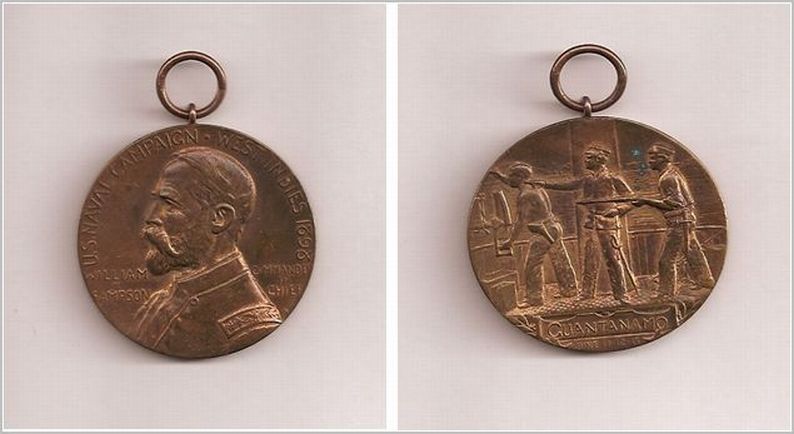
SAMPSON MEDAL: This decoration was given to those who served in the fleet of Rear Admiral William T. Sampson during the Spanish-American War.  While I don’t know what ship he was on, the medal indicates John Walsh was in combat in the waters of Cuba and the West Indies. 

William T. Sampson Medal front and back belonging to John Fleming Walsh

The obverse of the medal is a bust of William T. Sampson; the reverse depicts a Navy officer, Sailor, and Marine along with the action for which the medal was awarded, in this case Guantanamo.  The date June 11, 12, 13 indicates that John Walsh was among the first troops ashore in Cuba sent to secure the newly formed naval base at Guantanamo. 

What a battle that must have been.  The Spanish were short on food, so they waited several days for the Americans to unload the ship’s stores.   The Marines were not expecting an attack, so they constructed no trenches.  On June 11, they were caught by surprise when Spanish guerillas opened fire leading to what became known as “100 hours of fighting” because they didn’t sleep for 100 hours. 

M 1895 Colt-Browning Machine Gun
image from http://military.wikia.com/

As a private in Company F Artillery, John Walsh probably answered fire behind the M 1895 Colt-Browning machine gun, the first successful gas-powered machine gun used in service.


Spanish Campaign Medal belonging to John Fleming Walsh
Such medals were attached to a campaign clasp with a ribbon.
The original ribbon was red and yellow
but later the ribbon was changed to blue and yellow
at Spain's request not to use the colors of Spain. 
SPANISH CAMPAIGN MEDAL:   This medal was awarded to any member of the Navy or Marine Corps who served in the Philippine Theater of the Spanish-American War between May 1 and August 16, 1898.  The obverse shows Moro Castle and lighthouse which overlooked Havana Harbor, Cuba.  Beneath the fortress is a stack of cannon balls, denoting arms of war.  The words “Spanish Campaign” and “1898” encircle the scene.


PHILIPPINE CAMPAIGN MEDAL:  This medal was issued to members of the Navy or Marine Corps who performed service in the Philippines between February 4, 1899 and December 1, 1904.  John Walsh might have served ashore in support of the Army or onboard ship.

The obverse depicts the gate leading into Manila.  

Philippine Campaign Medal belonging to John Fleming Walsh


The reverse of both the Spanish and Philippine medals is the same:  the American bald eagle with wings spread is perched on an anchor with draped chain over the words “For Service.”  The wreath at the base of the medal is oak on the left to denote strength and laurel on the right to denote victory.


Campaign clasps belonging to John Fleming Walsh

Recipients of such medals often wore a campaign clasp showing the various battles and the ship name.  The only one with a name is “Manzanillo,” but from my cursory research it was not a ship name.  Rather it was the scene of a battle in Cuba between June 30 and August 12, 1898.  In fact, “August 12” is inscribed on the back of the pin.  That was the day the First Marine Battalion launched the bombardment of Manzanillo in anticipation of a full invasion.  However, President McKinley declared an armistice with Spain on that day.


Spanish War Veterans Medal belonging to John Fleming Walsh

SPANISH WAR VETERANS MEDAL:  There would have been a ribbon that looked like the American flag connecting the two parts of this medal which was given to anyone who served in the armed forces during the Spanish American War or Philippine American War.  At the top is the American bald eagle within a laurel wreath and victory shield.   The bottom of the ribbon would have attached to the cavalry saber, infantry rifle, and naval anchor representing the various branches of the military.  That part attaches to the War cross with the four arms reading “Porto [sic.] Rico,” “Cuba,” “Philippines” and “USA.”   The dates 1898-1902 denote the range of the two wars which the military views as really the same war.  The reverse of the cross reads like a compass with “North,” “South,” “East,” and “West” on the arms and “United” in the center.

Whether my great-grandfather was a war hero or simply a Marine who was lucky to avoid injury and Yellow Fever, John Fleming Walsh left more stories in bronze than in any words my family ever told.


For more stories in bronze or in sepia, please visit my friends at Sepia Saturday.


© 2014, Wendy Mathias.  All rights reserved.

Wednesday, July 3, 2013

(Almost) Wordless Wednesday: Sweet Baby

Wordless Wednesday is a daily prompt at Geneabloggers that asks family historians to create a post in which the main focus is a photograph or image.


Unidentified baby in album of Mary Frances Jollett Davis

This unidentified baby in the album of my great grandmother Mary Frances Jollett Davis might be little Josy who lived a short two years.  But I’m not sure.

Compare the photo to the baby in this one:


Millard, Orvin, Josy Davis about 1902
Millard, Orvin, Josy Davis
about 1902

The hair is combed slightly differently.  The dress looks the same on top, but the hem looks scalloped unlike the straight edge in the previous photo.  Yet, both babies are barefoot.

What do you think?  Are they the same child?


© 2014, Wendy Mathias.  All rights reserved.

Monday, July 1, 2013

Mystery Monday: A Wrinkle in the Search for Mary Ann

Mystery Monday is a daily prompt at Geneabloggers encouraging bloggers to share mystery ancestors or mystery records – anything which is currently unsolved.  With any luck fellow genealogy bloggers will lend their eyes to what has been found so far and possibly help solve the mystery.
Last week I thought I was wrapping up my “Searching for Mary Ann” series until I could gather some wills and deeds for the siblings of John Ermentraudt.  Then I noticed an interesting name in the chapter called “Miscellaneous” in the Armentrout Family History by Russell S. Armentrout. 

The Miscellaneous chapter contains family lines that have not been attached to any of the seven known sons and daughter of Anna Elizabeth Hain Ermantraudt, the family that arrived in Pennsylvania in 1739 and subsequently helped settle the Shenandoah Valley of Virginia in the 1750s. 

That interesting name is also that ever-problematic JOHN.  Nevertheless, I have hope.  Here’s why:  Even though his birth and death dates are unknown, there is a definite marriage date of May 6, 1791 to Elizabeth Lingle in Rockingham County. 

And there are children! 

The first is Maria, born May 25, 1795.  Maria? Mary? It’s possible, right?  The date is a question, but then in very old records dates are typically iffy.  My records indicate MY Mary Ann was born anywhere from 1795 to 1805. 

Other children:
Elizabeth born August 8, 1798
Linda born April 18, 1805
John born February 16, 1816

What is more interesting is that all these children were baptized at the Peaked Mountain Church like so many of the other Armentrouts as well as the children of Mary Ann and Fielding Jollett.

Adding more interest upon interest are the names of the sponsors of the Armentrout children – names like Schneider, Geiger, and Augustine Ermentraudt. 

I previously announced my gut feeling that Augustine Ermentraudt could be my Rosetta Stone. Schneider and Geiger/Kyger are also names that I identified as holding strong possibilities.  Could MY John Ermentraudt have been right here under our genealogical nose all along?  Why did no one pick up on it?

I’m trying not to jump up and down in ecstasy – don’t want to jinx myself.  But now I have another way to think about this mystery.


© 2014, Wendy Mathias.  All rights reserved.
Friday, June 28, 2013

Sepia Saturday: Sermons in Stone


Sepia Saturday challenges bloggers to share family history through old photographs.


This week’s Sepia Saturday photo of the Wombeyan Caves in New South Wales suggests caverns, caves, and grottos. 
Fred Slade 1948 Cullman, Alabama
Fred Slade 1948
St. Bernard's College, Cullman, Alabama


My dad’s first college experience was in 1948 at St. Bernard, a small Catholic college in Cullman, Alabama.  Daddy threw himself into his studies.  He often reflected on how much he enjoyed discussions of philosophy, literature, and religion with the Benedictine brothers who taught there. 


Fred Slade 1949 St. Bernard College, Cullman, Alabama
Fred Slade catching some rays while studying


Somewhere between studying, playing intramural basketball, and serving as a class officer, Daddy made time to visit the world-renown Ave Maria Grotto there on campus.  It was one of his favorite places.


Postcard of Ave Maria Grotto Cullman, Alabama
My dad's postcard of Ave Maria Grotto
produced by W. M. Cline Co, Chattanooga, Tennessee

Fred Slade and friends at Ave Maria Grotto, Cullman, Alabama 1948 or 1949
My dad is first on the left.  They are standing next to the main grotto,
a miniature cave featuring marble stalactites and statues
honoring the Virgin Mary.  It is the same gated feature
on the right of the postcard above.

This landscaped 4-acre park is in an old quarry located on the grounds of St. Bernard Abbey.  It contains 125 miniature reproductions of the world’s most famous religious buildings.  

Most of them are Roman Catholic cathedrals and monasteries like St. Peter’s Basilica, Montserrat Abbey, Carmel Mission in California, and Sanctuary of Our Lady of Lourdes.  Also there are scenes of ancient Jerusalem, Noah’s Ark, and Tower of Babel.

The Ave Maria Grotto has been called "a sermon in stone."


Postcard of Ave Maria Grotto Cullman, AL
Basilica of St. Paul
postcard produced by W. M. Cline Co, Chattanooga, Tennessee

Postcard of Ave Maria Grotto Cullman, AL
Temple of Jerusalem and Some Buildings of the Palestinian Miniatures


But there are secular tributes, too, including the Alamo, Leaning Tower of Pisa, Hansel & Gretel’s Temple of the Fairies, and German Castles.  There is even a miniature of the St. Bernard Abbey power station.


Maybe Daddy took Granny to see the Ave Maria Grotto when she visited him in October 1948.  She sent this colorful postcard of the Grotto home to Granddaddy.

Postcard of Ave Maria Grotto sent by Julia Slade to Fred Slade 1948
Temple of Jerusalem and Some Buildings of the Palestinian Miniatures
On the back: Genuine Curteich-Chicago "C.T. Art-Colortone" Post Card

Postcard of Ave Maria Grotto sent by Julia Slade to Fred Slade Oct 1948

Sunday
Hello Dear
Having a wonderful time.  Sure wish you were here.  Leaving tomorrow AM.  Hope to see you Tuesday.
Love 
Julia


Collage of Ave Maria Grotto scanned from The Bernardian 1949
Collage of Ave Maria Grotto
scanned from The Bernardian 1949
Click to enlarge


The Grotto was the result of a 50-year hobby by Brother Joseph Zoettl, one of the brothers at St. Bernard.  It opened to the public in 1934 and Brother Joe added his last building in 1959. 

Brother Joe’s art was a model of recycling practices before recycling was cool.  He began the grotto with some marble that had been crushed when a train derailed in 1933 not far from Cullman.  The buildings were adorned with marbles, glass, broken tile, toothpaste caps, seashells, costume jewelry, and even toilet bowl floats.  Needless to say, the miniatures are quite detailed, albeit not always accurate or to scale. 


The work of Brother Joseph Zoettl is the subject of a documentary that will air sometime in the fall of this year.  He has been compared to St. Thérèse of Lisieux and St. Francis of Assisi, both of whom led small and quiet lives that have inspired others with their emphasis on simplicity.

It is quite possible that Daddy might have met Brother Joe since he lived at St. Bernard from 1892 until his death in 1961.

Here is one of many tours of the Ave Maria Grotto available on YouTube. (Do yourself a favor and turn the sound OFF.) 


Grab a flashlight and visit more caves, caverns, and maybe some grottos at Sepia Saturday.


© 2014, Wendy Mathias.  All rights reserved.

Wednesday, June 26, 2013

Wordless Wednesday: Cute Kid


Wordless Wednesday is a daily prompt at Geneabloggers that asks family historians to create a post in which the main focus is a photograph or image.


Unidentified child in photo album of Mary Frances Jollett Davis


This cabinet card in the photo album belonging to my great grandmother Mary Frances Jollett Davis is yet another puzzle.  He’s a cute little boy, but I don’t know who it is.

The composition is what really puzzles me.  It seems sloppy to have left a coat hanging on the chair.  Is that the backdrop rolled up on the floor?  Are those curtains on the sides?  What is going on?


© 2014, Wendy Mathias.  All rights reserved.

Monday, June 24, 2013

Mystery Monday: Searching for Mary Ann, part 5

Mystery Monday is a daily prompt at Geneabloggers encouraging bloggers to share mystery ancestors or mystery records – anything which is currently unsolved.  With any luck fellow genealogy bloggers will lend their eyes to what has been found so far and possibly help solve the mystery.


Records for John Ermentraudt, son of Johan Friederich, have not been found, likely destroyed during the Civil War when Union soldiers overtook the wagon carrying Rockingham County’s deeds, wills, and records of marriage, birth, and death to safety. 

My next effort to find a mother and siblings for my 3G grandmother Mary Ann Armentrout Jollett is to look at Friederich’s other children.  Perhaps Mary Ann’s uncle or cousins bought and sold land or left wills that might offer a clue to solve this mystery.  Maybe Mary Ann and Fielding Jollett sponsored a niece or nephew at baptism.  But first I need to identify the possible candidates.

Friederich and Maria Catrina Hedrick Ermentraudt had seven children besides John. 

1. Anna Magdalena was born in 1747 in Berks County, Pennsylvania, but since there are no further records for her, it is believed she might have died as a child.

2. George was born in 1750 in Berks County, Pennsylvania.  He was 54 when he married Elizabeth Michael in Rockingham County, Virginia.  Given George’s advanced age at marriage, it is possible he had been married before making it also possible that there are more children unaccounted for.  Alas, no record.  He and Elizabeth had three children: Barbara (1806), Michael (1807), and Magdalena (1809) who would have been roughly Mary Ann’s age.  Surely they would have known each other and played together as children.  Unless I can find marriage records, the two girls will be difficult to trace.  Michael married and moved his family to Ohio and then to Iowa.  My one hope is that he purchased and then sold land in Rockingham County before he moved.

                Next step:  Look for deeds and will for George first and then Michael.

3. Christopher was born 1761 in Augusta (now Rockingham County), Virginia.  He married Mary Catherine Pence in 1792.  The two lived in Rockingham County at least until he died in 1812.  They had 5 children: Ann Mary (1793-1825), Barbara (1794 - ), Mary C (1796 - ), Christopher (1798 - ), and Margaret (1800 - ).  This line will likely lead to a dead end as to date nothing is known about the three middle children.  Ann Mary married Alexander Trout but died early.  Thirteen days later he married her sister Margaret. 

                Next step:  Check Christopher’s will

4. Charles was born May 8, 1763 in what is now Rockingham County, Virginia and died two days before his birthday in 1836 in Ohio.  He married Christina Gray of Ohio, but they had no children.  It is not likely he left any bread crumbs in Virginia because as soon as he came of age, he was drafted into the Militia and served throughout the Revolutionary War.  He moved to Ohio right afterwards. 

                Next step:  Skip him

5. Augustine was born in Rockingham County January 22, 1765 and died before 1850, still in Rockingham.  This is good news.  He and wife Margaret Schneider had seven children, all of whom remained in Rockingham:  Magdalena (1791 - ), John George (1793 - ), Emanuel (1801 – 1890), Charles (1805 – 1863), Frederick (1808 – 1882), Amanda (1815 – 1890), and Anna Rebecca (1816 – 1880).

                Next step:  Concentrate first on Augustine, his land dealings and will.

6. Frederick was born about 1767 in Rockingham County and died in 1837 in Allegheny County.  I am not too hopeful that Frederick will lead me to the answer to my question:  Who was Mary Ann’s mother?  He married Elizabeth Wolfe in Botetourt County.  For a time they owned land in Monroe County (now West Virginia) and may have lived there as well, but for most of his adult life he was in Allegheny.  And that’s where all nine children were too:  Jacob (1800 – 1879), Mary (1802 - ), George (1804 - ), Catherine (1806 - ), John (1808 - ), Abraham (1810 - ), Joseph (1814 - ), Elizabeth (1820 - ), Sarah (1824 - ).

                Next step:  Eh, go back to Augustine.

7. Catherine Barbara was born in 1769 in Rockingham County.  She married Fredrick Geiger/Kyger.  Kyger is still a BIG name in Rockingham County, so it’s a safe bet they stayed put even if the children moved around.  They had 9 known children:  Anna Elizabeth (1794 – 1841), Barbara (1797 – 1875), George (1799 – 1837), Catherine (1800 – 1883), Anna Maria (1802 - ), Rebecca (1805 - ), Christina (1806 - ), Lucy (1810 – 1860), and Charles (1811 - ).

                Next step:  Look for land dealings of Fredrick Geiger/Kyger. 

CONCLUSIONS:  The cold, hard facts about the siblings of John Ermentraudt offer no clues to Mary Ann’s mother, on the surface at least.  At this point I need to stop this series until I can get to the Library of Virginia to learn whether any wills and deeds are available.  My gut feeling is to start with Augustine.


© 2014, Wendy Mathias.  All rights reserved.