Wednesday, November 28, 2012

Wordless Wednesday: Fingers up! Toes in!


Wordless Wednesday is a daily prompt at Geneabloggers that asks family historians to create a post in which the main focus is a photograph or image.

Velma Davis Woodring July 1925
Velma is in the dark dress.
July 1925


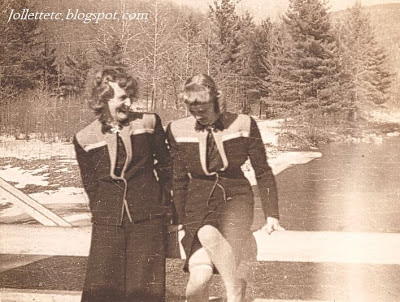
This is the perfect photo for Wordless Wednesday because I have no idea what these girls are doing.  My great-aunt Velma Davis and some college friends are on the front porch of her house in Shenandoah, Virginia.  Maybe they’re just being silly.  Velma loved to take crazy pictures.


© 2014, Wendy Mathias.  All rights reserved.

Monday, November 26, 2012

Mystery Monday: You're right; I'm wrong


Mystery Monday is a daily prompt at Geneabloggers that asks us to share mystery ancestors or mystery records – anything in our family history research which is currently unsolved.  With any luck fellow genealogy bloggers will lend their eyes to what has been found so far and possibly help solve the mystery.


In a recent Sepia Saturday post, I made light of my great-aunt Velma’s use of the term “scabs” thinking she was simply looking down her nose at some unsavory neighbors.  Several readers – no, make that MANY readers – called me on it, noting that the term “scabs” is used to denote workers who refuse to join a labor union or those who cross the picket line to take a striking worker’s job.

OK OK, you’re right.  As it turns out there was a nationwide railroad strike among the shopmen in 1922 (same year as Velma’s letter to Violetta) when the Railroad Labor Board announced that hourly wages would be cut by seven cents.  It was the last straw in an ongoing feud over a number of issues including working conditions and outsourcing of shopcrafts to avoid the pay, pension and benefits that would have gone to railroad employees.  NOTE: this affected the shops only, not operators’ unions that represented engineers, firemen, and conductors.  Just the shops.  And Shenandoah, Virginia was a major town along the Norfolk & Western line.  There were lots of shops. 

N & W Railroad Strikers 1922
Railroad Strikers in front of the old hotel 1922
Shenandoah, Virginia
scanned from Shenandoah: A History of Our Town and Its People

The railroads employed strikebreakers to fill vacancies caused by the strike.  Hiring “scabs” only increased the tension and hostilities between the railroad and striking workers.  In fact, the National Guard and US Marshals were on duty in seven states.

President Warren G. Harding proposed a settlement but with very little benefit for the labor unions, so railroad companies rejected any notion of compromise.  Eventually the strikes died down as local shopmen made deals on the local level.


Jacob P. "Jake" Hockman
Jacob "Jake" Hockman on the right
scanned from Shenandoah: A History of Our Town and Its People
I still don’t know how the Hockmans figured in the story of the scabs and the potential firing of Paul Hockman.  His father Jacob “Jake” Hockman owned a lumber and coal yard.  No doubt he supplied coal for the railroad as well as local businesses.  

Paul Hockman could possibly have worked for the railroad, but I have not looked in sources beyond what is easily available on Ancestry.  In 1920 he was only 14 and not working, but by 1930 he was managing his father’s lumber and coal yard.  


© 2014, Wendy Mathias.  All rights reserved.

Thursday, November 22, 2012

Sepia Saturday: Violetta and Velma


Sepia Saturday challenges bloggers to share family history through old photographs.


This week’s Sepia Saturday prompt featuring a portrait of two little girls reminds me of the unmistakable sister bond that has revealed itself in so many generations and in so many lines in my family.  The close connection my great-grandmother Mary Frances Jollett Davis shared with her five sisters spilled over into the life-long friendship between her daughters Violetta Lorane Davis Ryan and Velma Hilda Davis Woodring.

“Violetta and Velma” – that’s how we always said it, never “Velma and Violetta,” and rarely just one name at a time.  That’s how close they were.
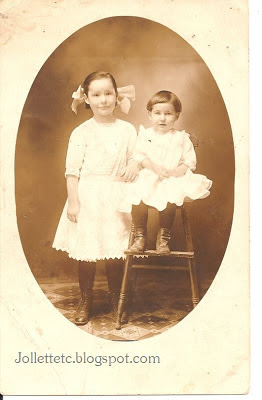
Violetta and Velma Davis about 1910
Violetta and Velma Davis
About 1910
Violetta and Velma Davis about 1914
Violetta and Velma Davis
About 1914


Davis sisters at home 411 Sixth Street, Shenandoah, Virginia
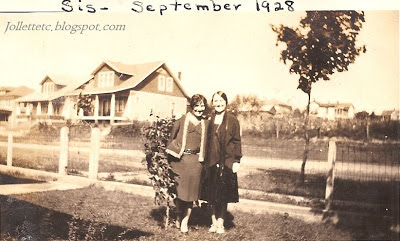
I love how Velma captioned the picture:  Sis - September 1928


When Violetta went to college, she and Velma no doubt wrote many letters to one another, most of which went into the “round file.”  However, for some strange reason this little gem was spared.  It shows a sweet relationship in which 14-year old Velma asks a favor and spreads a little gossip. 


Shenandoah, Virginia
November 14, 1922

Dearest Violetta,
I guess you will be surprised when you read this to see who it is from.  Don’t look at the mistakes as I am writing this in a hurry.

Whew, we have no exemptions from exams this year.  I think it is terrible don’t you.  I think they are going to be uniform.  The teachers are not sure.  I hope our own teachers make them out tho’.

Mother said to tell you to get you a dress and hat.  She said to get something that would wear good.


There is not much news around this joint now.  Everything is dead.  Mama let me play basketball.  I play on the 2nd team as this is my first year.

Violetta would you mind getting me something.  I need a pair shoes real bad.  I want grey oxfords with black trimmings if you can get them, size 5 ½ kindly wide.  Or get something pretty I can wear some grey stockings with.  Getting something you think is pretty.  And send them to me if you aren’t coming home soon.

And can you get me a Matthews music book Grade 2 and send it at the same time.


I started taking music from Mrs. Olliver last week.  I like her real well for a teacher.  She sure did give me a hard lesson.  I take it this eve.

I don’t know how you would get the things we send you if it wasn’t for Mr. Foltz do you.  He certainly is nice.

I think the scabs over at Hockman’s come down and talk to Thelma and Mrs. Hockman right often.  I saw one down there last night talking to them.   I know Claude S was embarrassed yesterday.  He was talking and said, “There are going to fire Paul [Thelma’s brother] and Edward and some others just as soon as they can and put some of the other men


back to work.”  Then someone pointed Thelma out to him and he looked real funny.

As I don’t know anything else I won’t tell you anymore.

Lovingly,
Velma


Hmm, I imagine Violetta winced at some of those grammar errors.  And at the "scabs" visiting their good neighbors.


As much friends as sisters, Violetta and Velma just had fun together.

Picnic with Dick and Violetta Ryan, Velma Woodring, Mary Frances Davis
Dick and Violetta Ryan, Velma Woodring
Mary Frances Jollett Davis on a picnic
I guess Woody took the picture.


Velma Davis Woodring and Violetta Davis Ryan
Velma and Violetta about 1947 or 1948
I don’t know why they are dressed alike here. 
Such was not their habit, as far as I know.


It is generally believed that Velma took a job teaching in Korea because she did not approve of one particular fellow and his low-class wife that Violetta not only befriended but also defended and supported.  (Scabs!)  The truth is, nobody in the family approved, but we couldn’t all go to Korea!  

Even then, their love and friendship remained strong. When Velma became ill with cancer, she returned from Korea, sold her home in Martinsburg, West Virginia, and moved into one of Violetta’s apartments so that Violetta could help take care of her. 

That’s what sisters do.


Check Sepia Saturday for Girls, Girls, and more Girls.

EDITORIAL NOTE:  Because of the many comments regarding the "scabs" mentioned in Velma's letter, I did the due diligence and looked into the possibility of a labor strike.  You can read the follow-up HERE.


© 2014, Wendy Mathias.  All rights reserved.

Wednesday, November 21, 2012

Wordless Wednesday: Blessings


Wordless Wednesday is a daily prompt at Geneabloggers that asks family historians to create a post in which the main focus is a photograph or image.

Dinner at Grandma Davis' 1964
I wrote on the back of this photo: Grandma should not have
walked in front of the camera.
Left to right: Grandma Lucille Rucker Davis, Uncle Orvin Jr (Davis),
Aunt "Scoop" Davis, just a sliver of cousin Barbara Davis,
me with that fine perm, cousin Glenn Davis

For lack of a photo, I’ve been forced to cheat.  This is actually a Christmas dinner at my Grandma’s house, but our Christmas dinner always looked like a Thanksgiving dinner:
  • Turkey
  • Dressing – both traditional and cornbread
  • Gravy
  • Mashed potatoes
  • Sweet potatoes
  • Green beans
  • Collards
  • Cranberry sauce
  • Pumpkin pie, Apple Pie, Coconut cake


I wish for you this holiday
Good company
Good food
Good times

Happy Thanksgiving!  


© 2014, Wendy Mathias.  All rights reserved.

Friday, November 16, 2012

Sepia Saturday: Book 'em


Sepia Saturday challenges bloggers to share family history through old photographs.


This week’s Sepia Saturday photo prompt of a library full of boys reading inspired me to take a good look at some old textbooks passed down from my great-grandfather and grandfather.


Literature and history books belonged to my grandfather.
The little math book belonged to my great-grandfather.


WALTER’S ARITHMETIC BOOK

Ray's Practical Arithmetic
My great-grandfather proudly wrote his name on several pages of his arithmetic book.  “Walter B. S. M. Davis.” 

Arithmetic book belonging to Walter Davis

But he was not the first to use it.  The inscription “A. N. Davis” suggests at least one older brother of the 15 Davis children used the book too:  Amaziah Nathaniel.

Amaziah Nathaniel Davis
Amaziah Nathaniel Davis wrote his name
on several pages of the arithmetic book.

The book was Ray’s Practical Arithmetic, Part Third.  The Ray’s series was one of the most respected textbooks of its day because it emphasized “real life” math that students could apply to practical pursuits of running a farm, a business, a household, even a grocery store.  Early on the series was praised for beginning with the basics using concrete items like blocks and marbles in order to prepare students to be able to visualize the abstract later on when higher level critical thinking was required.  Ray’s almost exclusive use of word problems is credited with improving students’ reading comprehension. 


Ray's Practical Arithmetic
This textbook is very unappealing by today's standards.
No colorful charts.  Very little "white space."

Dr. Ray believed education could help students develop high moral character.  So his math problems often showed honest men and women hard at work plowing fields, planting and harvesting crops, building, buying and selling, being generous and sharing their goods.  


Look at some typical math problems:
  • If 16 men build 18 rods of fence in 12 days, at the same rate, how many men can build 72 rods in 8 days?
  • When cloth costs $4.37 ½ per yard, at what price per yard must it be sold to gain 33 1/3 percent?
  • What is the value of 1 pound 3 pennyweights of gold ore at 3 cents a grain?

Although Dr. Joseph Ray died in 1855, his arithmetic books are still in use today, especially among homeschoolers.  However, I’m not sure how the homeschoolers feel about the explanation of pints, barrels, and hogsheads required in beer measurements.   But I must admit, the explanation of apothecary measurements could be helpful to today’s drug dealers who might need to know how to answer this one:
  • What will 1 pound 1 dram 1 ounce of opium cost at 4 cents a scruple?

ORVIN’S HISTORY BOOK


History of Virginia textbook belonging to Orvin Davis
I don’t know how much American history was included in my high school history textbooks, but only once did we make it to World War II.  How far did the teachers of my grandfather Orvin Davis get exposing him to American history? 

His book is about the size of a 5”x7” photograph and just about ¾” thick.  The last chapter is entitled  “The Reconstruction Period 1865-1890.”  

I guess there’s something to be said for being born early. 

ORVIN’S LITERATURE BOOK

Literature textbook belonging to Orvin DavisStepping Stones to Literature: A Reader for Fifth Grades is one ambitious collection of works by such people as Nathaniel Hawthorne, William Cowper, Sir Walter Scott, Elizabeth Barrett Browning, and John Ruskin.  JOHN RUSKIN!!!  Has anyone read Ruskin?  I have.  Hopefully my grandfather at age 10 was exposed to some lighter weight Ruskin than I got in graduate school.  Good grief.

Page from the textbook


The introduction to the book says it all:  “…its authors aimed to include nothing but good literature …. The tendency of the day is to scrappy reading.  It is fostered by newspapers, periodicals, and compendia of literature; and it is hoped that these Readers will help to combat this unfortunate tendency, and lead to the reading of good books.”

As textbooks always do, this one gives teaching suggestions, especially on ways to improve oral reading.  The authors are not shy about saying Americans have poor speech habits and “disagreeable voices.”  They deem it a “national defect.”  They even recommend calisthenics to improve students’ carriage, breathing through the nostrils, drilling for proper enunciation, using a dictionary to assure proper pronunciation, and learning to incorporate the right inflections to express the feeling of the written word. 

So noble.  But these are fifth graders. 

Here is what fifth graders did to their books even in 1910:


Textbook of Orvin Davis


Textbook belonging to Orvin Davis

The message has been erased for the most part, but it says, "Look on page [?] and you will see my sweethearts name."


Flipping pages, I found this on page 25: 


Textbook belonging to Orvin Davis

On page 300, there's this message saying "She ran away from me and nobody knows where she is." 

Textbook belonging to Orvin Davis

So who was she, for crying out loud??  Hrmph.  I thought books held the key to all knowledge. What a let-down.

Looking closely at these very old books (over 100 years old) makes me rethink the rural one-room schoolhouse.  I always assumed those poor kids probably got a second-rate education because the school couldn’t afford to do any better.  But I see now that Rockingham County and Page County in Virginia provided the best textbooks to be had in their day. 

Stand up straight, breathe through your nostrils, and turn the page to Sepia Saturday where you can read more about books and libraries, with feeling, of course.  


© 2014, Wendy Mathias.  All rights reserved.

Wednesday, November 14, 2012

Wordless Wednesday: Fun in the snow


Wordless Wednesday is a daily prompt at Geneabloggers that asks family historians to create a post in which the main focus is a photograph or image.


Friends of Lillie Killeen, December 1945
December 1945

Judging by the smirk on this woman’s face, she’s not overly scared of that rifle.  I don’t know who these people are – just friends of my great aunt Lillie Killeen.


© 2014, Wendy Mathias.  All rights reserved.

Tuesday, November 13, 2012

Tombstone Tuesday: The Knights


Tombstone Tuesday is a daily prompt at Geneabloggers which asks bloggers to create a post including an image of a gravestone of one or more ancestors; it may also include a brief description of the image or the ancestor.


My great grand aunt Leanna Jollett Knight and my great grand uncle James Mitchell Knight are buried in the Evergreen Church Cemetery in Greene County, Virginia.  The prettiest stone church is just across the street from the cemetery, which is enclosed by a low wall made from the same stones.  The surrounding scenery is breathtaking no matter the season. 

Evergreen Cemetery, Greene County, Virginia
from Findagrave.com
photo by Jan Hensley


James Mitchell Knight tombstone, Greene County, Virginia
from Findagrave.com
photo by Jan Hensley
Leanna A. Knight tombstone, Greene County, Virginia
from Findagrave.com
photo by Jan Hensley


James M. Knight                                                              MOTHER
May 9, 1866                                                                      Leanna A. Knight
Feb. 16, 1942                                                                    Born
                                                                                            Mar. 14, 1867
                                                                                            Died
                                                                                            Sept. 20, 1936


© 2014, Wendy Mathias.  All rights reserved.